You got married. You didn’t sign up to lose your financial identity. Plenty of couples keep separate accounts and still run a household that works. The trick isn’t merging everything into one pot: it’s building a system where shared bills get paid on time and both people can see what’s left. If you’re part of a couple that keeps separate finances while married, you’re not unusual, and you’re not doing it wrong. You just need a clear method for splitting the shared stuff.
Why more married couples keep money separate
A 2023 survey published by Bankrate found that 43% of partnered adults keep at least some money in individual accounts. That number has climbed steadily since 2018, and anecdotal evidence from financial planners suggests the trend continued through 2025 and into 2026. The reasons vary, but they tend to cluster around a few themes.
- Unequal incomes. One partner earns significantly more. Keeping separate accounts lets each person contribute proportionally without one feeling like a dependent.
- Prior debt. Student loans, car notes, or credit card balances from before the wedding feel like personal obligations. Separate accounts keep that debt from muddying the shared picture.
- Second marriages. Kids from a first marriage, existing alimony, or assets you want to protect make full merging complicated.
- Autonomy. Some people simply function better when they control their own spending. That’s a personality trait, not a character flaw.
None of these reasons signal distrust. They signal self-awareness. The real risk isn’t keeping money apart: it’s failing to coordinate on the bills you share. A couple with separate finances who talks about money once a week is in better shape than a couple with a joint account who never checks it.
The goal is clarity, not uniformity. You each know what you owe the household, you each know what’s yours, and nobody gets surprised by a missed electric bill.
What has to be shared: the bills, not the balances
Start by listing every expense that belongs to the household. Not your personal subscriptions or your gym membership: the stuff you’d both be stuck with regardless of who pays.
| Category | Examples |
|---|---|
| Housing | Rent or mortgage, property tax, HOA |
| Utilities | Electric, gas, water, internet, trash |
| Insurance | Health (if shared plan), home/renters, auto (if shared) |
| Groceries | Shared meals and household supplies |
| Kids | Daycare, school fees, activities |
| Debt (shared) | Joint credit card, shared auto loan |
| Savings goals | Emergency fund, vacation, home down payment |
Personal expenses stay out of the shared pile. Your car payment on a vehicle titled only to you, your streaming service, your hobby spending: those come from your own account.
The line between shared and personal isn’t always obvious. Eating out together might be shared. Eating out with friends might be personal. You’ll need to decide, and the decision matters less than both people agreeing to it.
Write the list down. A shared note on your phone works. Update it when something changes. This list becomes the backbone of every money conversation you have.
Funding a shared bills account from two paychecks
Once you know the total shared number, you need a system to fund it. Three common approaches work well for couples maintaining separate finances in marriage.
The 50/50 split
Each person pays half. Simple. Works best when incomes are roughly equal. If your shared bills total $3,200 a month, each of you deposits $1,600 into a joint bills account.
The proportional split
Each person pays a percentage based on income. If one partner earns $6,000 a month and the other earns $4,000, the split is 60/40. On that same $3,200 in bills, the higher earner deposits $1,920 and the other deposits $1,280.
The category split
Each person owns specific bills. One handles the mortgage and insurance. The other covers utilities, groceries, and daycare. This avoids a joint account entirely but requires more coordination.
Here’s a quick comparison:
| Method | Best for | Watch out for |
|---|---|---|
| 50/50 | Equal earners, simplicity | Can feel unfair if incomes differ by more than 20% |
| Proportional | Unequal earners, fairness | Requires recalculating when income changes |
| Category | Couples who dislike joint accounts | Harder to see total household spending |
Whichever method you pick, automate the deposits. Set up a recurring transfer from each checking account on payday. If you get paid biweekly and your partner gets paid on the 1st and 15th, stagger the transfers so the bills account stays funded throughout the month.
A quick example of the math: say your combined shared bills are $4,100 a month. You earn $5,500 and your partner earns $3,800. Your proportional share is about 59%, so you transfer $2,419. Your partner transfers $1,681. Those two transfers cover every shared bill, and neither person has to think about it again until something changes.
Seeing one household number without one account
Splitting bills is the mechanical part. The harder question: how do you both know what’s actually safe to spend before the next paycheck? Your bank balance doesn’t tell you. It shows what’s in the account right now, not what’s already spoken for.
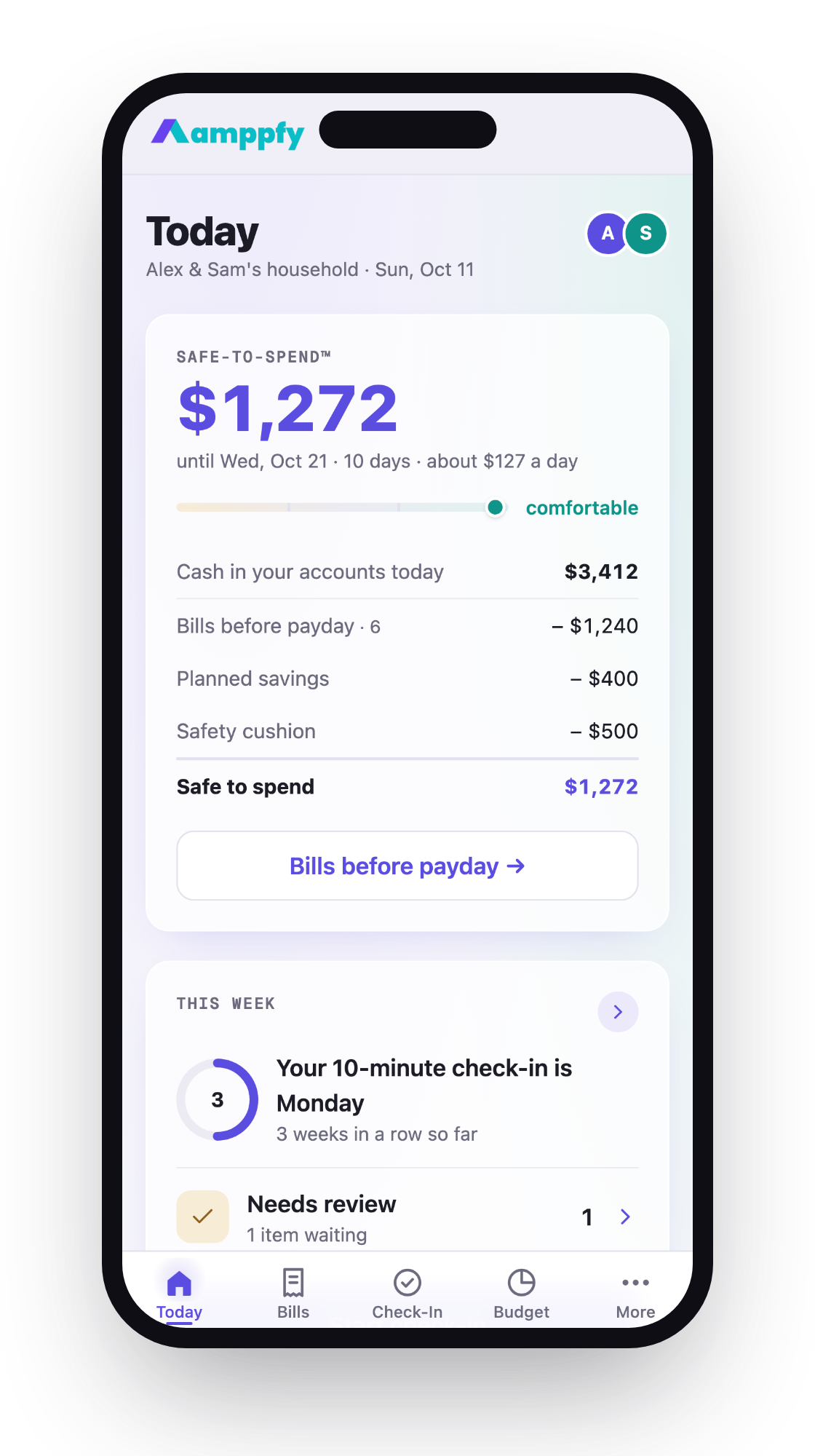
You need a single number that accounts for upcoming bills, savings you’ve committed to, and a buffer for the unexpected. That math looks like this:
$4,200 cash − $1,850 bills due before payday − $300 savings − $400 cushion = $1,650 Safe-to-Spend
That’s the Amppfy approach. You enter your balances (about 30 seconds per account), plug in your bills and paydays, and the app shows one Safe-to-Spend™ number with the four-line math printed underneath. Both partners get their own login and see the same household number. Private balances stay private.
The weekly check-in takes about ten minutes. Update your balances, confirm upcoming bills look right, and glance at the calendar view to spot the lowest-cash day before payday. That single glance replaces the anxious mental math most people do three times a day in their bank app.
This setup works especially well for married couples with separate finances because nobody has to share account passwords or grant access to personal spending. You each see the shared picture. You each keep your own space.
If you’ve tried budgeting apps before and quit because the bank sync broke or the categories felt like homework, this is a different model. No bank login required. You type in what you know, and the number updates.
The conversations that still need to happen
A system handles the math. It doesn’t handle the feelings. Even with a clear split and a shared view of the numbers, you still need regular conversations about money.
What to talk about every month
- Any income changes: raise, bonus, reduced hours, freelance dry spell
- Upcoming irregular expenses: car registration, annual insurance premium, holiday travel
- Whether the current split still feels fair to both people
- Progress toward shared savings goals
What to talk about once a year
Pull out the full picture. Review your combined net worth. Check whether your emergency fund covers three months of shared expenses. Look at retirement contributions. These aren’t weekly topics, but skipping them entirely creates blind spots.
How to keep it productive
Set a time. Sunday morning coffee works for a lot of couples. Keep it short: 15 minutes is enough for a monthly check. Use the numbers in front of you, not memory. When you’re looking at the same Safe-to-Spend number and the same bill calendar, there’s less room for “I thought you paid that.”
The tone matters. This isn’t an audit. It’s two adults coordinating a shared project. If one person spent more than expected, the response is “let’s adjust” not “why did you.” Keeping finances separate already reduces friction. A calm, regular conversation keeps it from building back up.
One practical tip: if a big purchase is coming (new furniture, a family trip, a car repair), decide together how it gets funded before the money leaves any account. That single habit prevents most of the arguments couples have about money.
Frequently Asked Questions
Is it legal for married couples to keep separate bank accounts?
Yes. There’s no law requiring married couples to merge bank accounts. You can maintain individual checking, savings, and investment accounts throughout your marriage. The only legal consideration is that in community property states (like California, Texas, and Arizona), income earned during the marriage may be considered jointly owned regardless of which account holds it. Check your state’s rules if you’re concerned about asset classification.
How do married couples with separate finances handle emergencies?
Agree in advance on an emergency fund and where it lives. Many couples open a joint savings account funded equally (or proportionally) for true emergencies: job loss, medical bills, major home repairs. If you keep $10,000 in a shared emergency fund and each contribute $200 a month, neither person has to scramble or ask for money when something breaks. The key is defining “emergency” before one happens.
Does keeping separate finances hurt your credit score?
Your credit score is individual regardless of your account structure. Marriage doesn’t merge credit reports. The only way your partner’s finances affect your score is through joint accounts or loans where both names appear. Keeping finances separate actually insulates your credit from your partner’s individual debt decisions.
What’s the biggest mistake couples make with separate money?
Failing to coordinate on shared goals. You can split every bill perfectly and still end up frustrated if one person is saving aggressively for a house while the other is paying off student loans with no timeline. The system works when both people know the shared priorities and their individual roles in reaching them. A ten-minute weekly check-in with Amppfy, where you both see the same number and upcoming bills, keeps those priorities visible without turning money into a daily negotiation.
Making separate finances work long-term
Keeping your money separate after marriage isn’t a compromise. It’s a structure. The couples who make it work share three habits: a clear list of shared expenses, an automated funding method, and a short regular conversation about the numbers.
Pick your split method. Automate the transfers. Check the shared picture once a week. Adjust when life changes. That’s the whole system.
If you want one place to see your household’s Safe-to-Spend number without merging accounts or connecting bank logins, Amppfy is free and takes about ten minutes to set up at amppfy.com/app/.