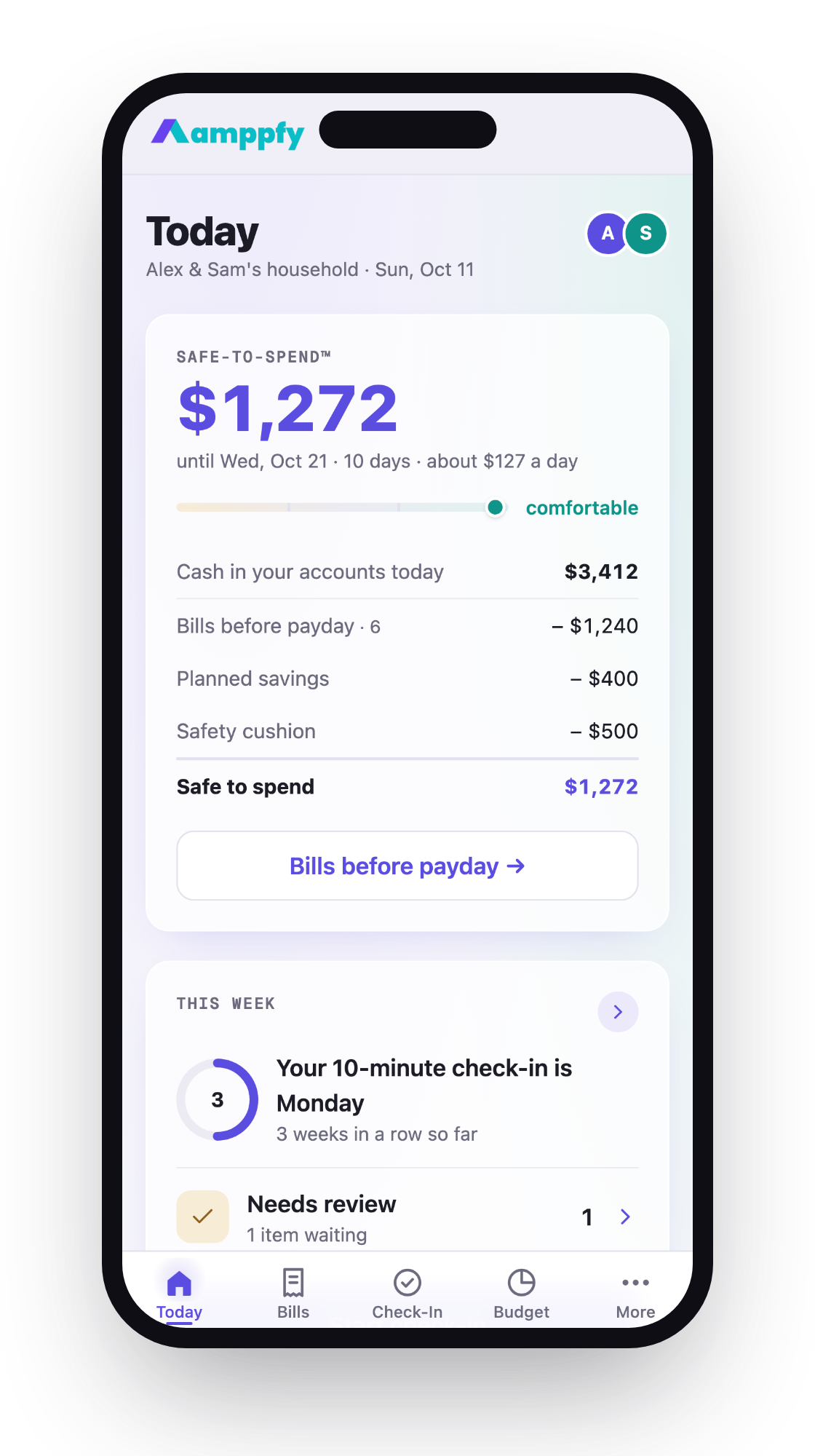
Most people who want to save $1,000 in a year on a biweekly pay cycle get stuck on the yearly goal. A thousand dollars feels abstract when you’re staring at a checking account that refills every two weeks. The real question isn’t “can I save a thousand?” but “what’s the per-paycheck number, and where does it come from?” That number is $38.47. It’s small enough to work, specific enough to plan around, and clear enough to protect. The rest is just timing and a system that moves the money before you can spend it.
$38.47 a paycheck: why the small number works
Twenty-six paychecks land in a standard biweekly year. Divide $1,000 by 26 and you get $38.46, which rounds to $38.47 to cover the penny. That’s the entire formula.
| Piece | Number |
|---|---|
| Annual goal | $1,000 |
| Paychecks per year | 26 |
| Per-paycheck transfer | $38.47 |
| Running total after 26 transfers | $1,000.22 |
The reason this math matters more than a monthly figure is simple: your bills, your groceries, and your rent all orbit around paydays, not calendar months. A monthly target of $83.33 doesn’t tell you what to do on Friday when the direct deposit hits. The per-paycheck number does.
A 2024 Federal Reserve Survey of Household Economics found that 37% of U.S. adults couldn’t cover a $400 emergency with cash or its equivalent. Saving $38.47 per paycheck won’t fix that gap overnight, but after roughly 11 pay periods you’ve crossed the $400 mark. That’s a meaningful milestone in about five months.
Why does the small number stick? Because your brain doesn’t fight it. Thirty-eight dollars is a few takeout meals or one streaming bundle you forgot to cancel. It doesn’t trigger the same resistance as “save a thousand dollars.” You’re not asking yourself to change your life. You’re asking yourself to move one number before you do anything else with that paycheck.
Moving it on payday, before Safe-to-Spend™
The transfer has to happen before you look at your balance and start spending mentally. This is the single habit that separates people who hit the goal from people who mean to.
Here’s the sequence:
- Paycheck lands (Friday morning for most biweekly workers).
- Transfer $38.47 to a savings account: set it up as an automatic recurring transfer through your bank.
- Then check what’s left.
If you check first, the full balance feels like available money. Your brain anchors to that number. The $38.47 suddenly feels like a sacrifice instead of a default.
Amppfy’s Safe-to-Spend™ number handles this automatically. It subtracts your planned savings before showing you what’s available: $3,412 cash − $1,240 bills − $38 savings − $500 cushion = $1,634. You never see the inflated number. You only see what’s actually yours to spend before the next payday.
Set the automatic transfer for payday itself, not the day after. Most banks let you schedule recurring transfers on a biweekly cadence tied to a specific date or day of the week. If your bank only allows monthly scheduling, set two transfers: one for the first paycheck of the month, one for the second. Close enough.
The point is removing the decision. You don’t “decide” to save each cycle. The money moves. You spend what’s left. The goal fills itself.
What to do on the three-paycheck months
Two months each year contain three paydays instead of two. In 2026, those months are January and July for most Friday paycheck schedules (check your own calendar to confirm). These months are the reason 26 paychecks exist instead of 24.
You have three options for the extra paycheck:
- Option A: Transfer $38.47 as usual. You’ll finish the year slightly ahead of $1,000. This is the simplest path and the one that requires zero thinking.
- Option B: Skip the third transfer. You’ll need to make up the difference later or accept finishing around $923. Some people use this approach when a three-paycheck month coincides with a heavy expense cycle like back-to-school or holiday spending.
- Option C: Transfer a larger amount on the third paycheck. If you’ve been tight on a few earlier cycles, the bonus paycheck is a natural catch-up point. Throwing in $75 or $100 on that third check can absorb earlier shortfalls without pain.
Here’s what each option looks like over the year:
| Strategy | Total transfers | Year-end balance |
|---|---|---|
| A: Always transfer $38.47 | 26 × $38.47 | $1,000.22 |
| B: Skip both bonus checks | 24 × $38.47 | $923.28 |
| C: Double up on bonus checks | 24 × $38.47 + 2 × $76.94 | $1,077.16 |
Option A is the default. Set it and forget it. The three-paycheck months take care of themselves because your automatic transfer doesn’t know or care that it’s a “bonus” paycheck. It just fires.
When a tight cycle forces a skip
Some pay periods are just hard. The car needs tires. A medical copay hits. Your kid’s school trip costs $120 you didn’t plan for. Skipping one $38.47 transfer doesn’t ruin the goal. It creates a gap of less than 4%.
Here’s how to handle it without guilt or math anxiety:
Skip the transfer for that cycle. Don’t move a partial amount. Don’t borrow from next month’s rent to keep the streak alive. The goal is $1,000 by year’s end, not “never miss a single transfer.” Those are different goals, and the second one leads to quitting.
To recover, pick one of these paths:
- Split the missed amount across your next four paychecks. That’s roughly $9.62 extra per check: $48.09 instead of $38.47 for a month.
- Use one of the three-paycheck months to double up (see the section above).
- Round up your regular transfer to $42 for the rest of the year. The extra few dollars per check absorb the skip over time.
A tool like Amppfy can help here. When you update your savings goal balance during your weekly check-in, the app recalculates your Safe-to-Spend number. You see immediately whether the skip changed anything about your spending room for the rest of the cycle. No spreadsheet required. About 30 seconds of typing.
The worst response to a skipped transfer is deciding the whole plan is broken. One missed cycle out of 26 means you end the year at $961.75. That’s still $961.75 more than you had. Adjust, keep going, and let the math do its job.
Watching the goal fill on a payday calendar
A visual tracker turns an abstract savings goal into something you can see filling up. You don’t need a fancy app for this, though one helps. A simple calendar works.
Building a payday calendar
Print or create a 12-month calendar. Mark every payday with a circle. Write “$38.47” next to each one. As you complete each transfer, fill in the circle or check it off. Next to the check, write your running total: $38.47, $76.94, $115.41, and so on.
This does two things. First, it shows you how close you are to milestones. Crossing $250 (about 7 paychecks in) feels real. Crossing $500 at the halfway mark feels like proof. Second, it shows you exactly how many transfers remain. Seeing “11 more” is more motivating than “I need $423 more.”
Digital tracking that takes seconds
If paper isn’t your style, Amppfy’s savings goals feature shows your progress toward $1,000 on a payday-aligned timeline. Each time you do your 10-minute weekly check-in and update your savings balance, the goal bar moves. You can see the lowest-cash day in your upcoming month, which helps you anticipate whether the next transfer will feel tight or easy.
What the calendar reveals over time
After three or four months, patterns emerge. You might notice that the pay period covering the first of the month is always tighter because rent hits. Or that mid-month cycles are consistently easier. This information is useful. It tells you which cycles might need a smaller transfer and which ones can absorb a catch-up amount.
The calendar isn’t about perfection. It’s about visibility. You can’t manage a goal you can’t see, and a running total next to each payday makes the progress impossible to ignore.
Frequently Asked Questions
What if I get paid biweekly but my paydays shift because of holidays?
Holiday shifts usually move your paycheck one business day earlier, not later. Your automatic transfer will still fire on the scheduled date. If your bank processes the transfer before the deposit clears, set the transfer for one day after payday instead. The $38.47 amount stays the same regardless of when the deposit lands.
Can I save $1,000 biweekly if I have irregular income like overtime or commissions?
Yes. Base your $38.47 transfer on your guaranteed net pay. Treat overtime and commission checks as separate events. When a bigger check arrives, you can add an extra transfer or leave your base plan alone. The core plan works on your minimum predictable income.
Should I put the $38.47 in a high-yield savings account or a regular one?
A high-yield savings account earning around 4-5% APY in 2026 will add roughly $25 to $30 in interest over the year on a balance that grows gradually. It’s not life-changing, but it’s free money. Keep the account at a different bank than your checking if you tend to dip into savings. The friction of a one-to-two day transfer delay helps.
Is $38.47 per paycheck really enough to make a difference?
After one year you have $1,000. After two years, $2,000. That’s enough to cover most car repairs, a month of groceries, or an insurance deductible. The BLS Consumer Expenditure Survey shows the median unexpected expense for U.S. households falls between $500 and $1,500. One year of $38.47 transfers puts you squarely in that range.
Your next payday is the starting line
Saving a thousand dollars in a year on a biweekly schedule comes down to one number repeated 26 times. You don’t need to rethink your spending. You don’t need to cancel everything you enjoy. You need $38.47 moved before you see your full balance, a plan for the two bonus months, and permission to skip a cycle without quitting.
Start on your next payday. Set the automatic transfer today. If you want a tool that subtracts your savings goal before showing you what’s safe to spend, try Amppfy for free at amppfy.com/app/ and let the number do the thinking for you.