You pulled three 12-hour nights this week. Your paycheck landed with shift differential, a few hours of overtime, and holiday pay stacked on top of base. Next pay period you’re on days only, and the check drops by $400. Budgeting for nurses and other shift workers isn’t about willpower: it’s about math that keeps moving. The right nurse budget tips around shift differential pay can turn that chaos into a pattern you can actually plan around.
Most budgeting advice assumes the same deposit hits your account every two weeks. That’s not your life. Your income swings with the schedule, and your bills don’t care which rotation you’re on. This piece lays out a system built for paychecks that change size every cycle: how to find your floor, match bills to pay dates, and put the surplus to work before it disappears.
Differentials, overtime, and why the check swings
Your base hourly rate is only part of the story. Shift differentials, overtime, weekend premiums, and on-call pay all layer on top, and each one shows up differently depending on your schedule.
How each pay component hits your check
| Pay type | Typical range | When it appears |
|---|---|---|
| Base hourly | Fixed per contract | Every paycheck |
| Night differential | $3 – $8/hr extra | Checks covering evening/night shifts |
| Weekend differential | $2 – $6/hr extra | Checks covering Sat/Sun shifts |
| Overtime (1.5x) | Kicks in after 40 hrs/week (or 12 hrs/shift in some states) | Varies by schedule |
| Holiday premium | 1.5x – 2x base | Holiday pay periods only |
| On-call pay | Flat rate + callback rate | Unpredictable |
A nurse working three 12-hour night shifts one week and two day shifts the next can see a $300 – $600 swing between checks. Multiply that across a month and you’re looking at real variance: not a rounding error.
The key problem isn’t that you earn less overall. It’s that you can’t predict which check will be big and which will be small until the schedule posts. Overtime might appear because a coworker called out. A holiday falls mid-cycle. You pick up an extra shift. Each of these changes what lands in your account, and traditional monthly budgets break down fast.
Understanding which pay components are guaranteed and which are variable is the first step. Base pay plus any contracted differential you always work: that’s your predictable income. Everything else is a bonus, even if it shows up most months.
Set a floor: the smallest check you can count on
Stop planning around your average paycheck. Plan around your smallest one. That floor is the number your entire bill-paying system rests on.
How to calculate your floor
- Pull your last six pay stubs (or the last three months of deposits).
- Find the lowest net deposit.
- Subtract any one-time anomalies (a training reimbursement, a sign-on bonus installment).
- Round down to the nearest $50.
That rounded number is your floor. If your lowest check in the past three months was $1,847, your floor is $1,800.
Here’s a worked example for a full-time RN paid biweekly:
- Lowest check (days only, no OT): $1,800
- Typical mixed check (some nights): $2,100
- High check (nights + OT + weekend): $2,500
You build your bill plan around $1,800. Not $2,100. Not the average of all three. The floor.
Why this works: you’ll never be short on a lean pay period. Every dollar above $1,800 becomes money you direct on purpose rather than money you accidentally spend because it was sitting in checking. According to the Bureau of Labor Statistics, the median annual wage for registered nurses was $86,070 in 2024, but that median hides enormous check-to-check variation for nurses working rotating schedules. Your floor captures your reality, not a national average.
If your schedule changes seasonally (travel contracts, PRN periods, or a unit switch), recalculate the floor each quarter. Ten minutes with your pay stubs keeps the number honest.
Match bills to pay dates on a two-week cycle
Once you know your floor, split your fixed bills across your two monthly paychecks. The goal: neither check carries too heavy a load.
Sorting bills into two buckets
List every recurring bill with its due date. Then assign each one to Check A (first paycheck of the month) or Check B (second paycheck). Most billers let you move due dates with a phone call or an online request.
| Check A (around the 1st – 7th) | Check B (around the 15th – 21st) |
|---|---|
| Rent/mortgage | Car payment |
| Electric | Car insurance |
| Internet | Phone |
| Streaming subscriptions | Student loan |
| Groceries (first half) | Groceries (second half) |
Aim for roughly equal totals on each side. If rent eats 60% of one check, move every other movable bill to the other check.
Here’s the math for a nurse with an $1,800 floor:
- Check A obligations: $950 (rent $1,100 would be too tight: consider requesting a mid-month due date for a smaller bill to rebalance)
- Check B obligations: $850
- Remaining per check: $850 and $950 for savings, gas, food, and breathing room
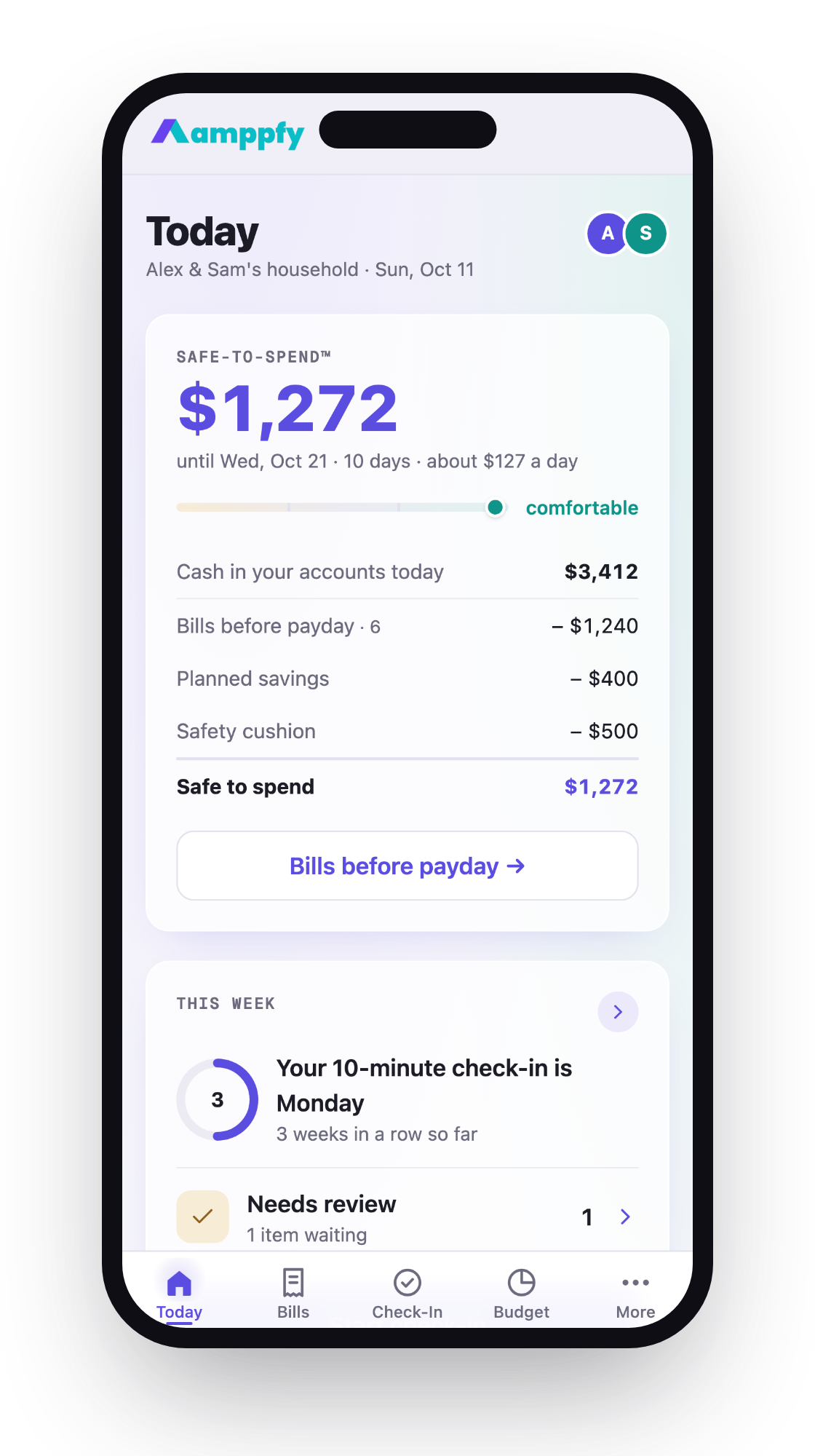
The two-check split removes the “which bills do I pay first” panic. You know before the schedule even posts that your floor covers both sides. An app like Amppfy can map bills to pay dates and show your Safe-to-Spend™ number: available cash minus bills due before payday, minus planned savings, minus a cushion you pick. That single number tells you what’s actually available after obligations, not just what’s in checking.
Call your billers this week and cluster due dates around your pay dates. It takes about 20 minutes total and saves months of mental juggling.
Where the extra goes on a big check
A big check feels like a reward. And it is: you earned that differential and overtime. But without a plan, the surplus blends into daily spending and vanishes.
A priority list for surplus dollars
When your deposit exceeds your floor, run the extra through this order:
- Top off your cushion. If your safety buffer dipped below your target (one to two weeks of expenses), refill it first.
- Fund your next savings goal. A vacation fund, a certification course, a down payment: pick one active goal and send a fixed amount.
- Pay down high-interest debt. Anything above 8% APR gets an extra payment.
- Split what’s left. Half to a “fun” category, half to next month’s first bill bucket as a head start.
Here’s how that looks on a $2,500 check when your floor is $1,800:
$2,500 deposit − $1,800 floor obligations = $700 surplus
- $200 → cushion top-off
- $200 → vacation savings goal
- $150 → extra credit card payment
- $150 → split: $75 fun, $75 rolled forward
The key is deciding before the money lands. Set the priority list once, and each big check follows the same path. You’re not making a new decision every two weeks: you’re following a rule you already wrote.
A 2024 Federal Reserve survey found that 37% of U.S. adults would struggle to cover a $400 emergency expense with cash. Building your cushion from surplus checks puts you on the other side of that number within a few pay cycles.
One practical tip for shift workers specifically: don’t count on overtime money until it clears. Schedules change. Shifts get canceled. Treat OT as a pleasant surprise, not a line item.
A check-in that fits a 12-hour-shift week
You’re not going to sit down for an hour on Sunday to reconcile a spreadsheet after working three consecutive 12s. The system needs to survive your schedule, not the other way around.
The 10-minute weekly check-in
Pick one day that’s almost always a day off. For many nurses on a 3-on-4-off or rotating pattern, that’s often a Wednesday or Thursday. Set a recurring reminder. Here’s what the check-in covers:
- Update your checking and savings balances (30 seconds per account if you’re typing them into an app).
- Confirm upcoming bills for the next 7-10 days haven’t changed.
- Glance at your Safe-to-Spend number. If it’s comfortable, you’re done. If it’s tight, look for one bill you can shift or one expense you can delay.
- Note whether your next check will be a floor check or a surplus check based on the schedule that just posted.
That’s it. Ten minutes. You can do it in the break room between charting.
Amppfy’s weekly check-in works this way by design: you update balances manually (no bank login needed), and the app recalculates your Safe-to-Spend after bills, savings, and your chosen cushion. The month calendar even marks the lowest-cash day so you can see pinch points before they arrive.
If you have a partner sharing bills, the check-in doubles as a quick sync. Both of you see the same number without sharing every personal account balance. One person updates, the other glances at the result. No spreadsheet wars.
The best budget system for shift differential income isn’t the most detailed one. It’s the one you’ll actually use at 6 a.m. after a 7p-7a rotation.
Frequently Asked Questions
How do I budget when my shift differential changes every pay period?
Build your plan around your lowest recent paycheck (your floor), not your average. Assign all fixed bills to that floor amount. When a check comes in higher because of night or weekend differential, route the surplus through a priority list: cushion first, then savings goals, then debt, then discretionary. This way your bills are always covered, and extra pay has a job before it hits your checking account.
Should I include overtime in my budget?
No. Treat overtime as unplanned income. OT shifts get canceled, schedules change, and units get overstaffed. If you build OT into your baseline, a slow month leaves you short. Budget on base pay plus any differential you’re contracted to work. When OT money arrives, send it through your surplus priority list.
What’s the easiest way to move bill due dates to match my pay schedule?
Call each biller or use their app’s chat feature. Most creditors, utilities, and subscription services will shift your due date by up to 15 days with a single request. Cluster half your bills around each paycheck. The whole process takes about 20 minutes and only needs to happen once.
How do travel nurse contracts affect this system?
The floor method still applies: just recalculate it at the start of each contract using the new base rate and expected stipends. Travel contracts often include housing and meal stipends that aren’t taxed the same way, so your net check may look different from a staff position. Update your floor, reassign bills, and run one check-in after your first deposit to confirm the numbers.
Build a System That Works on 4 Hours of Sleep
Your income isn’t broken: it’s just variable. The fix is a floor you trust, bills split across two checks, a priority list for surplus, and a weekly check-in short enough to finish before your coffee gets cold. Nurse budgeting with shift differentials doesn’t require complex spreadsheets. It requires a simple structure that holds up whether you’re on nights, days, or somewhere in between.
Take 15 minutes this week to pull your last six pay stubs and find your floor. That single number changes everything. If you want a tool that turns your floor, bills, and goals into one Safe-to-Spend number you can check between shifts, Amppfy is free and takes about 10 minutes to set up at amppfy.com/app/.