A subscription you forgot about hits your checking account the day before rent clears. That $14.99 streaming service or $49/month software tool you stopped using three months ago just ate into money you’d already mentally spent. Canceling recurring charges before they post is one of the simplest ways to protect the cash you actually need between paychecks. The trick is knowing where to look, who to contact, and how to make the cancellation stick.
Most people don’t ignore these charges on purpose. They just forget. A 2024 survey from the Federal Reserve Bank of New York found that U.S. households carried an average of roughly 12 recurring subscriptions. Some of those are essentials: insurance, phone plans, cloud storage you use daily. Others are zombie charges, services you signed up for during a free trial and never touched again. This guide walks through a practical sequence: find the next charge date, cancel directly with the merchant, know when to involve your bank, reclaim the freed-up cash, and build a quick monthly habit so nothing slips through again.
Find the Next Charge Date First
Before you cancel anything, you need to know when the next charge is scheduled. Canceling a subscription the day after it renews usually means you’ve already paid for another cycle, and most merchants won’t refund a partial month.
Where to find your renewal dates
Start with your email. Search for “receipt,” “renewal,” “subscription,” or “upcoming charge.” Most services send a billing confirmation or renewal reminder 3 to 7 days before they charge you. That email usually includes the exact date and amount.
Next, check the subscription management pages built into your phone and app stores:
- Apple (iPhone): Settings > your name > Subscriptions
- Google Play: Play Store > Payments & subscriptions > Subscriptions
- Amazon: Account > Memberships & Subscriptions
- PayPal: Settings > Payments > Manage automatic payments
These dashboards show active subscriptions, the next billing date, and the renewal price. They won’t catch charges billed directly to your debit or credit card, though. For those, pull up your bank or credit card statement and search for repeating amounts.
Build a quick reference list
Once you’ve gathered everything, put it in one place. A simple table works:
| Service | Amount | Next Charge Date | Billed Through |
|---|---|---|---|
| Streaming A | $15.99 | Jan 12 | Credit card |
| Gym app | $29.99 | Jan 18 | Debit card |
| Cloud storage | $9.99 | Jan 22 | Apple |
| Meal kit | $59.99 | Jan 25 | Debit card |
Amppfy’s subscriptions list does this automatically, showing each subscription’s next charge date so you can spot what’s coming before payday. But any spreadsheet or notes app works if you keep it current.
With dates in hand, you can cancel the ones you don’t need before the next billing cycle hits.
Cancel with the Merchant, Then Confirm in Writing
Your first step is always going directly to the merchant. Don’t start with your bank. Banks treat subscription disputes differently from fraud, and skipping the merchant can create complications you don’t want.
How to cancel directly
Most services let you cancel through their website or app. Look for “Account,” “Billing,” or “Manage Plan” in the settings menu. Some companies bury the cancel button, but FTC rules finalized in 2024 now require businesses to make cancellation as easy as sign-up. If you subscribed with one click, you should be able to cancel just as fast.
For services that require a phone call, here’s a sequence that saves time:
- Call during off-peak hours (Tuesday or Wednesday morning tends to have shorter hold times).
- Say “cancel my subscription” clearly when prompted by the automated system.
- Decline retention offers unless the discount genuinely changes your mind.
- Ask for a confirmation number or email before you hang up.
Always get written proof
This is the step most people skip, and it’s the one that matters most. After you cancel, send a short email to the company’s support address. Something like:
“I canceled my subscription to [Service] on [date]. My account email is [your email]. Please confirm this cancellation and confirm no further charges will be billed.”
Save the reply. If a charge appears later, that email is your evidence. Without it, you’re stuck in a he-said-she-said loop with customer support.
Cancellations through app stores
If you subscribed through Apple or Google Play, canceling on the merchant’s website alone won’t stop the charge. You need to cancel through the app store’s subscription manager. The merchant doesn’t control billing in that case: Apple or Google does. Cancel in both places to be safe.
When to Ask Your Bank to Block a Merchant
Going to your bank should be your second move, not your first. But there are clear situations where it’s the right call.
When a merchant won’t stop charging you
If you’ve canceled, have written confirmation, and the company still bills you, contact your bank or credit card issuer. You have two options:
| Action | What It Does | Best For |
|---|---|---|
| Dispute the charge | Requests a refund for a specific transaction | A charge that posted after you canceled |
| Stop payment / merchant block | Prevents future charges from that merchant | A company that keeps billing despite cancellation |
A dispute triggers a chargeback investigation. Your bank will ask for proof you canceled, which is why that confirmation email matters. Most disputes resolve within 30 to 60 days.
A merchant block (sometimes called a “stop payment on recurring charges”) tells your bank to reject future transactions from that specific company. Not every bank offers this for card transactions, but most do for ACH debits. Call your bank and ask specifically: “Can you block future charges from [merchant name]?”
A word of caution
Don’t use chargebacks as a shortcut to avoid canceling properly. Banks track how often you dispute charges. Too many disputes can flag your account. Some merchants will also send unpaid balances to collections if you dispute without canceling the underlying agreement first.
The clean path: cancel with the merchant, get confirmation, then dispute or block only if the merchant ignores your cancellation.
When to request a new card number
If a shady company won’t stop billing you despite a block, ask your bank for a new card number. This cuts off every recurring charge tied to that card, though, so you’ll need to update your payment info with services you do want to keep. It’s a last resort, but it works.
Putting the Money Back into Your Number
Canceling a subscription frees up cash. The question is what happens to that cash. If it just sits in your checking account, it tends to disappear into everyday spending. You never feel the benefit.
A better approach: redirect the freed-up amount toward something specific. Here’s the math for someone who cancels three unused subscriptions:
$15.99 streaming + $29.99 gym app + $9.99 cloud storage = $55.97/month
That’s $671.64 a year. Not life-changing, but meaningful. Enough for a weekend trip, a car repair fund, or two months of groceries for a single-parent household.
Route it to your Safe-to-Spend number
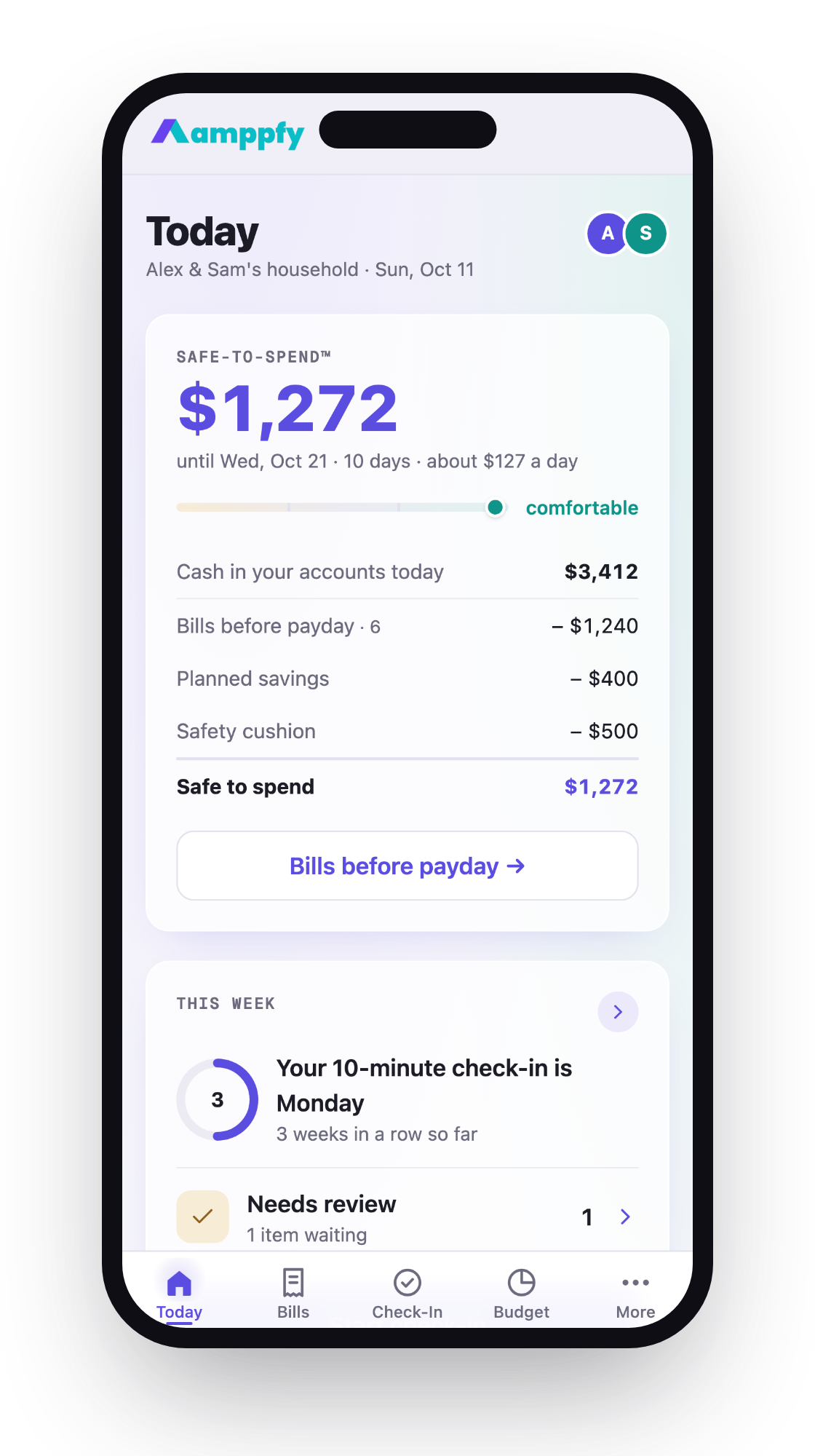
If you use Amppfy, removing a subscription from your bills list instantly updates your Safe-to-Spend number. The math is always visible: $3,412 cash – $1,240 bills – $400 savings – $500 cushion = $1,272. Drop $56 from the bills line and your safe-to-spend figure rises by the same amount. You see the difference the same day you cancel.
You can also redirect that $56 into a savings goal. Amppfy’s payday nudge funds goals first, so the money moves before you have a chance to spend it on something forgettable.
Even without an app
If you’re working with a spreadsheet or a notebook, the principle is the same. Write down what you canceled, the monthly amount, and where you want that money to go. Then set up an automatic transfer for that amount on payday. The key is making the redirect automatic. Willpower fades. Automation doesn’t.
A Monthly Two-Minute Sweep
One cancellation session won’t protect you permanently. New free trials turn into paid subscriptions. Annual renewals sneak up. A quick monthly check keeps zombie charges from coming back.
What to review each month
Set a recurring reminder on the first of each month (or whatever day works for you). Then run through this short checklist:
- Open your bank or credit card statement from the past 30 days.
- Scan for any recurring charge you don’t recognize or no longer use.
- Check your app store subscriptions page for anything new.
- Confirm that previously canceled services haven’t restarted billing.
The whole process takes about two minutes. Pair it with your Amppfy weekly check-in and you’ll catch new charges before they become a three-month-old problem.
Red flags to watch for
- A charge from a company name you don’t recognize (merchants sometimes bill under a parent company’s name: Google “merchant name” + “what is this charge” to identify it)
- A price increase on a service you do use (many subscriptions raise prices annually with minimal notice)
- A “free trial” that converted to a paid plan
- A charge labeled “annual” that you originally signed up for as monthly
Catching these early means you can cancel recurring charges on your terms, before the next billing cycle, rather than chasing refunds after the fact.
Frequently Asked Questions
Can I get a refund for a subscription I forgot to cancel?
It depends on the merchant. Some companies, especially larger ones like Apple, Google, and Amazon, will refund one billing cycle if you ask within a few days of the charge and haven’t used the service. Smaller companies vary. Your best approach is to contact support, explain you intended to cancel before renewal, and ask politely. If the merchant refuses and you have evidence you tried to cancel beforehand, file a dispute with your bank.
Will canceling a subscription through my bank also cancel my account with the merchant?
No. Blocking a charge at the bank level stops the payment, but it doesn’t cancel your agreement with the merchant. The company may still consider your account active and could send the unpaid balance to collections. Always cancel directly with the merchant first, then use your bank as a backup if charges continue.
How do I find subscriptions I signed up for with an old email address?
Search that old email inbox for terms like “welcome,” “subscription,” “trial,” and “receipt.” Also check the subscription managers on Apple, Google Play, and PayPal, since those are tied to your account rather than a specific email. If you no longer have access to the email, contact the merchant’s support team with your name and payment method details to locate the account.
Is there a difference between canceling a free trial and canceling a paid subscription?
The process is the same, but the timing matters more with free trials. Most trials convert to paid plans automatically on a specific date. If you cancel before that date, you pay nothing. If you cancel one day late, you’ve already been charged for the first cycle. Set a calendar reminder for two days before any trial expires so you have time to decide.
Keep Your Cash Where You Need It
Stopping unwanted charges isn’t complicated, but it does require a system. Find the dates, cancel with the merchant, confirm in writing, and sweep your statements once a month. The money you save goes further when you direct it somewhere intentional rather than letting it dissolve into daily spending.
If you want one place to see your subscriptions, their next charge dates, and how they affect the cash you actually have before payday, Amppfy is free and takes about 10 minutes to set up at amppfy.com/app/. You type in your balances, add your bills and subscriptions, and the app shows your Safe-to-Spend number with the math right underneath. That’s it. No Sunday afternoon project. Just a clear answer to “what can I actually spend right now?”