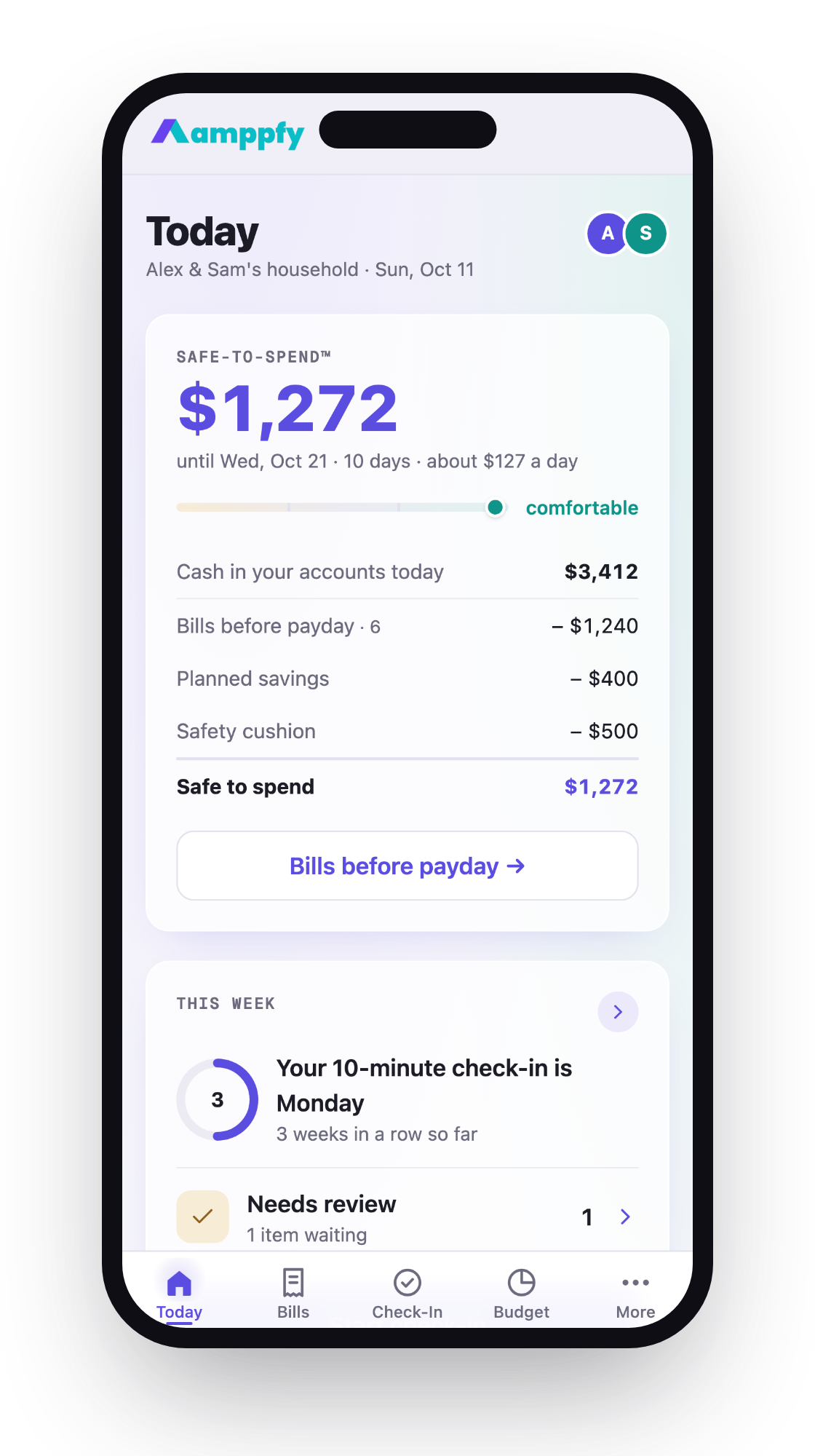
You’ve checked your bank balance three times this week. The number looks fine, but you’ve got rent, a car payment, and a streaming renewal all hitting before your next paycheck. So what’s actually yours to spend today? Figuring out a per-day spending amount until payday strips away the guesswork. It turns one vague checking account balance into a clear, repeatable number you can act on every morning.
Why a per-day number beats a monthly budget when money is tight
Monthly budgets fail most people for one simple reason: they’re too abstract. You set a $400 grocery budget on the first of the month, spend $180 the first week, and have no real sense of whether you’re ahead or behind. By week three, you’re guessing. By week four, you’re stressed.
A daily number works differently. It’s concrete. It’s small enough to feel real. You wake up, you know you can spend $91 today, and every purchase either fits or it doesn’t. No spreadsheet required.
This matters because housing and transportation alone consume half of the average household’s total spending[1]. That leaves a surprisingly thin slice of income for food, clothes, gas, and everything else. A monthly budget hides how thin that slice really is. A daily figure makes it visible.
The per-day approach also works better for couples. Instead of debating category totals, you share one number. Both of you know what’s available right now, not what was available eleven days ago when you last updated a spreadsheet.
There’s a psychological benefit too. A monthly budget punishes you with a big red number at the end. A daily number resets every morning. Yesterday was yesterday. Today is a fresh amount.
The math: Safe-to-Spend™ divided by days until payday
The four-line formula
The daily number starts with one calculation. Here’s the formula:
Cash in your accounts, minus bills due before payday, minus savings you’ve committed to, minus a safety cushion you pick. That gives you what Amppfy calls your Safe-to-Spend™ number. Then divide it by the days left until payday.
One line of math looks like this:
$3,412 cash − $1,240 bills − $400 savings − $200 cushion = $1,572 Safe-to-Spend
$1,572 ÷ 14 days = $112 per day
That $112 is yours. Groceries, coffee, gas, a haircut: it all comes from that daily amount.
What counts as “bills”
Bills are anything that auto-drafts or must be paid before your next paycheck. Rent, utilities, insurance, subscriptions, minimum loan payments. If it leaves your account before payday, subtract it.
Choosing your cushion
The cushion is personal. Some people use $100. Others use $500. It’s the buffer between your math and real life: the co-pay you forgot about, the parking ticket, the kid’s field trip fee. Start with whatever lets you sleep. You can adjust it next pay cycle.
Why this beats checking your bank app
Roughly 60% of consumers now want a real-time view of their balances[2] to manage cash flow. But your bank balance doesn’t subtract upcoming bills. It shows what’s in the account, not what’s safe to use. The formula above fills that gap.
A worked example on a two-week cycle
Meet Jordan. Paid every other Friday. Here’s Jordan’s situation on payday morning:
| Line | Amount |
|---|---|
| Checking + savings balances | $2,860 |
| Bills due before next payday | $1,100 (rent prorate, electric, phone, car insurance, two subscriptions) |
| Savings goal contribution | $200 (split from a $400/month target) |
| Safety cushion | $150 |
| Safe-to-Spend | $1,410 |
| Days until next payday | 14 |
| Daily amount | $100.71 |
Jordan rounds down to $100 per day. That extra $10 across two weeks pads the cushion a bit more.
How a typical week plays out
- Monday: $22 on gas, $14 on lunch. Spent $36. Rolled $64 forward.
- Tuesday: $68 grocery run. Spent $68, but yesterday’s $64 rollover means Jordan is still $96 ahead across both days.
- Wednesday: No spending. Another $100 rolls forward.
- Thursday: $45 dinner out with a friend. Still ahead for the week.
- Friday: $130 on new running shoes. That’s $30 over the daily number, but the rolled-forward surplus from earlier in the week covers it.
The daily figure isn’t a hard wall. It’s a pace. Some days you spend more, some days less. What matters is the running total across the pay period. Think of it like a step counter: 10,000 steps is the target, but you don’t panic if you sit through a long meeting. You catch up later.
What Jordan’s cushion caught
On day nine, Jordan’s cat needed an emergency vet visit: $140. Without the $150 cushion, that would’ve blown the budget. With it, Jordan adjusted the remaining five days from $100 to $72 each and still landed on payday with a few dollars to spare.
What to do when one day blows the number
It happens. A car repair. A birthday gift you forgot. A grocery run that somehow hit $200. One day over your daily spending limit doesn’t wreck the pay period. Here’s how to recover without drama.
Recalculate, don’t panic
Take your remaining Safe-to-Spend balance and divide by the days left. That’s your new daily number. Simple.
Say you had $700 left with seven days to go: that’s $100/day. Then you spent $250 on tires. Now you have $450 with six days left. New daily number: $75.
| Before the tire purchase | After |
|---|---|
| Remaining Safe-to-Spend: $700 | Remaining Safe-to-Spend: $450 |
| Days left: 7 | Days left: 6 |
| Daily number: $100 | New daily number: $75 |
You didn’t fail. You recalculated. That’s the whole system working as intended.
Three ways to absorb a big hit
- Spread it out. Lower your daily number for the remaining days, as shown above.
- Find one thing to skip. Cancel a dinner plan, push a non-urgent purchase to next pay cycle, or cook from the pantry for two nights.
- Pull from the cushion. That’s what it’s there for. If the expense is truly unexpected, use part of the cushion and rebuild it next cycle.
The key is that none of these options involve shame or guilt. You’re adjusting a number, not breaking a promise. Amppfy recalculates your Safe-to-Spend in real time, so you can see the new daily figure immediately after updating your balance.
When earned wage access is an option
Some employers now offer early access to wages you’ve already earned. The CFPB clarified in late 2025 that certain employer-partnered daily pay programs aren’t classified as credit[3], provided they meet specific conditions. One key requirement: the provider can’t use debt collection or credit reporting if the advance isn’t covered[4] by your next paycheck.
If your employer offers this, it can help bridge a genuine emergency. But it’s not a substitute for knowing your daily number. Pulling wages early just shifts the math to a shorter pay period with less cash.
Resetting the daily number every payday
Payday is reset day. Here’s the routine, and it takes about ten minutes.
- Update your account balances. Open your bank app, note the numbers, and enter them into whatever tool you use.
- Confirm your upcoming bills. Check which payments hit before the next payday. Add any new ones (annual subscriptions have a way of sneaking up).
- Set your savings contribution. Even $25 counts. Fund your goal before you fund your spending.
- Choose your cushion. Keep it the same or adjust based on what you learned last cycle.
- Divide. Safe-to-Spend ÷ days until next payday = your new daily number.
That’s it. Write the number on a sticky note, set it as your phone wallpaper, or let Amppfy show it to you automatically. The point is visibility.
The payday-morning checklist
- Balances updated
- Bills confirmed (watch for bills that rolled forward from last cycle)
- Savings funded first
- Cushion set
- Daily number calculated
If you share finances with a partner, both of you should see the same number. That removes the “I thought we had more” conversation. Amppfy handles this by giving each partner their own login while showing the same Safe-to-Spend figure.
Building momentum over multiple cycles
The first cycle is the hardest. You’re estimating. You might set the cushion too low or forget a bill. By cycle three, you’ll know your real patterns. By cycle six, you’ll have a cushion that actually fits your life. The daily number gets more accurate every time you reset it.
Frequently Asked Questions
Should I include irregular income like freelance payments in my daily number?
Only include money that’s already in your account. If a freelance payment hasn’t arrived yet, don’t count it. Once it hits your bank, update your balance and recalculate. Counting money you expect but don’t have is the fastest way to blow your number.
What if I get paid weekly instead of biweekly?
The formula works the same way. Shorter pay cycles actually make the daily number easier to manage because you’re planning over seven days instead of fourteen. Less time means fewer surprises. Run the same four-line calculation every payday morning.
Do I need to subtract credit card payments from my Safe-to-Spend?
Yes, if the payment is due before your next payday. Subtract the minimum payment (or whatever amount you plan to send) as a bill. Don’t subtract the full credit card balance unless you’re paying it off entirely this cycle.
Can couples with separate accounts use this system?
Absolutely. Each person calculates their own daily number based on their own balances and their share of joint bills. If you split rent 50/50, each of you subtracts half. The math stays clean as long as you agree on who pays what before the cycle starts.
Your daily number starts with ten minutes
The whole system fits on the back of an envelope. Cash minus bills, minus savings, minus cushion, divided by days. That’s your daily spending figure until payday. Recalculate when something big happens. Reset every payday. Get a little sharper each cycle.
Take ten minutes this payday to run the math. If you want the number calculated for you and kept current all week, Amppfy is free and takes about the same ten minutes to set up. One number, visible every time you open the app, with the math printed right underneath.