You opened your bank app three times before lunch. Each time, the number was the same. Each time, you felt a tiny hit of relief, then a pull to check again an hour later. That loop has a name: it’s the anxiety of checking your bank account too often, and it’s more common than you’d think. Roughly 17% of U.S. adults check financial accounts multiple times daily[1], with the rate climbing higher among millennials and Gen Z. The good news is that a calmer system exists, one that replaces the compulsive glance with a single number you can trust.
Why the Balance Check Never Settles the Question
Your checking account balance looks like a fact. It’s a number, right there on the screen, down to the penny. But it’s missing context, and context is the whole point.
The balance doesn’t subtract the car insurance due Thursday. It doesn’t account for the grocery run you planned for Saturday. It says nothing about the $200 you meant to move into savings. So you stare at $2,800 and still can’t answer the only question that matters: how much of this can I actually spend before payday?
That gap between the number and the answer is what keeps you coming back. You’re not checking because you forgot the balance. You’re checking because the balance alone doesn’t tell you if you’re okay.
The Relief-and-Return Cycle
Each check delivers a small hit of reassurance. The money’s still there. But because nothing about the underlying uncertainty changed, the reassurance fades fast. You check again. And again. The pattern mirrors what therapists describe in anxiety loops: a short-term relief that can make problems feel bigger over time[2], because you never build lasting confidence in the answer.
It’s Not About the Money
Here’s the part that surprises people: 37% of Americans who report feeling financially distressed actually have more than $10,000 in savings[3]. The anxiety isn’t always about being broke. It’s about not knowing where you stand relative to what’s coming. A raw balance can’t fix that, no matter how many times you refresh it.
The Number That Answers It: Safe to Spend Before Payday
If the balance doesn’t settle the question, what does? A single calculation that accounts for everything between now and your next paycheck.
The math looks like this:
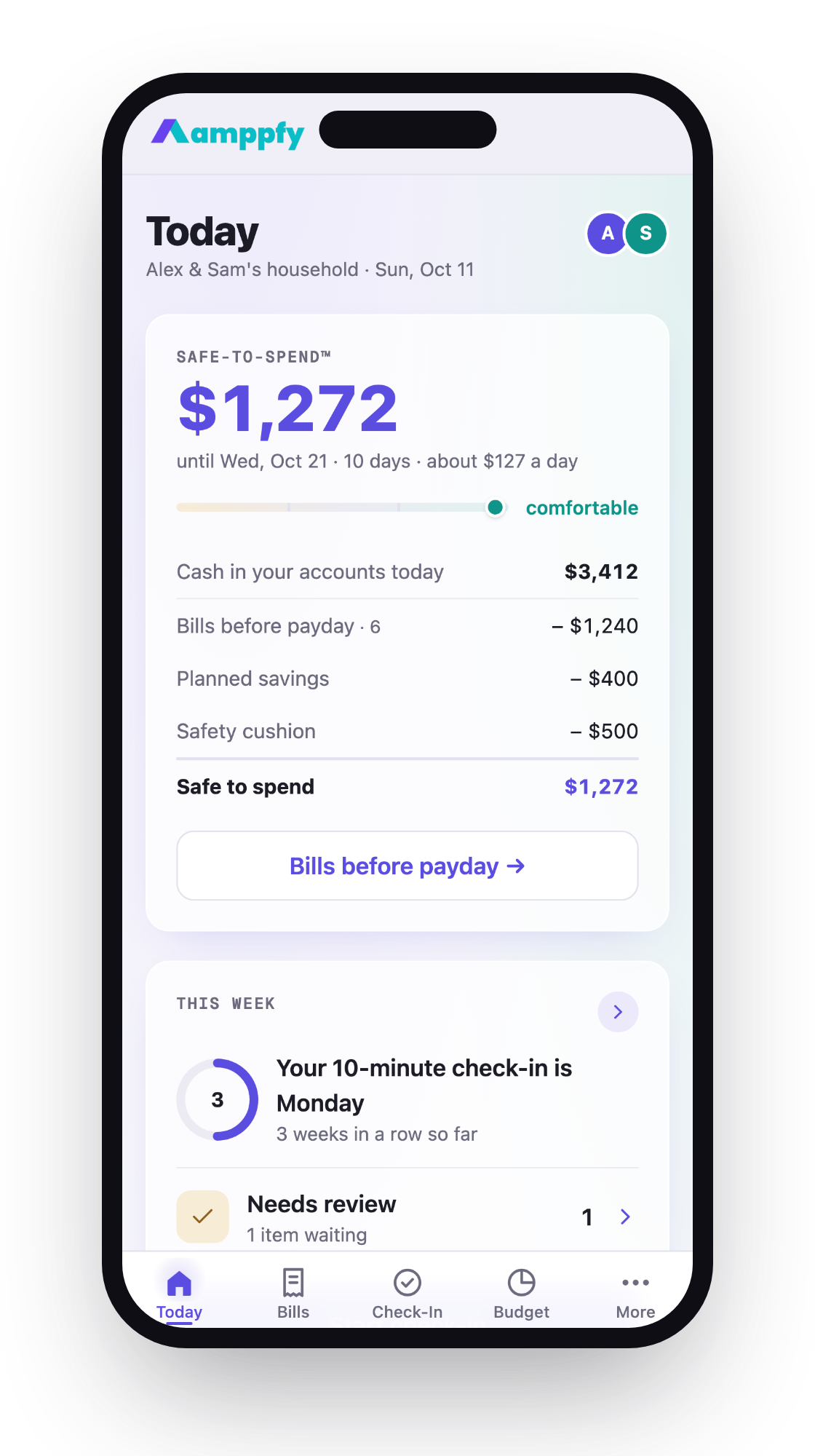
$3,412 cash − $1,240 bills − $400 savings − $500 cushion = $1,272
That $1,272 is what Amppfy calls your Safe-to-Spend™ number. It’s the money left after bills due before payday, savings you’ve committed to, and a cushion you choose. The four-line math is always visible underneath so you can see exactly how the number was built.
Why One Number Beats Ten Checks
| What you see | What it tells you | Does it answer “Am I okay?” |
|---|---|---|
| Bank balance | Cash in the account right now | No |
| Safe-to-Spend | Cash minus obligations before payday | Yes |
When you can glance at one number and know the answer, the urge to keep checking fades. You’re not suppressing the anxiety. You’re removing the question that caused it.
How the Cushion Works
The cushion is yours to set. Some people use $200. Some use $500. It’s a buffer against the stuff you forgot or the stuff you can’t predict: a copay, a parking ticket, a birthday gift. The cushion means your Safe-to-Spend number already has a margin of error built in. That margin is what makes the number trustworthy enough to stop refreshing.
Checking Once a Week, on Purpose
The goal isn’t to avoid your money. Avoidance creates its own anxiety spiral. The goal is to replace ten scattered, anxious glances with one purposeful sit-down.
Research from a MyBankTracker survey found that 23.6% of respondents spend 30 minutes per week on financial management[4] and characterized this group as “diligent.” Quality beats frequency. A single focused session does more than fifty nervous peeks.
A 10-Minute Weekly Check-In
Pick a day. Tuesday works well because it’s far enough from the weekend to catch any Monday charges but early enough to course-correct. Here’s what the session looks like:
- Open your accounts. Update each balance. This takes about 30 seconds per account.
- Confirm your upcoming bills are correct. Did anything change? Did a subscription price go up?
- Look at your Safe-to-Spend number. Is it where you expected?
- If a bill got added or a paycheck landed, adjust. Done.
That’s it. Ten minutes, once a week. Amppfy is built around this rhythm: you enter balances yourself, confirm bills, and the number updates. No bank sync to break. No transaction categorization homework.
What If You Can’t Stop Mid-Week?
If the urge hits on a Thursday, try a 30-second rule. Open the app, look at your Safe-to-Spend number, close the app. You’re not banning yourself from looking. You’re giving yourself a faster, calmer answer so the loop doesn’t start.
What to Look at Instead of the Balance
Once you shift from raw balance to Safe-to-Spend, you free up mental space to notice things that actually matter. Here’s where to point your attention during that weekly check-in:
- Lowest-cash day this month. Your balance might look fine today but dip dangerously on the 22nd when rent, a car payment, and a subscription all hit. A month calendar with the lowest-cash day marked shows you that pinch point in advance.
- Bills rolling forward. Did your internet bill post? Did your gym membership renew? Bills that auto-advance after they’re paid save you from re-entering them each month.
- Subscription next-charge dates. That streaming service you forgot about is billing in four days. Catching it now gives you time to cancel or budget for it.
- Net worth, month by month. Your checking account balance goes up and down with every paycheck and every bill. Net worth tells a steadier story. Even a small upward trend over three months is meaningful.
The Couples Angle
If you share expenses with a partner, the question isn’t just “Am I okay?” but “Are we okay?” Two people checking the same joint account ten times a day doubles the anxiety without doubling the information. A shared Safe-to-Spend number, where both partners see the same figure but keep private balances private, answers the question once for both of you.
Turning Notifications from Alarms into Heads-Ups
Bank notifications are designed to grab your attention. Low balance alert. Large transaction alert. Fraud alert. They’re built to sound urgent, and urgency feeds the checking habit.
A calmer system sends a heads-up, not an alarm. The difference is tone and timing.
| Alarm-style notification | Heads-up-style notification |
|---|---|
| “Your balance is below $500” | “Your electric bill posts tomorrow: $142” |
| “Large purchase detected: $89” | “After groceries, your Safe-to-Spend is $1,130” |
| “You spent more than usual this week” | “Payday is Friday: your savings goal funds first” |
Why Timing Matters
A heads-up the day before a bill hits gives you a chance to move money if needed. A payday nudge that funds your savings goal first means you don’t have to decide whether to save: it’s already planned. These small design choices turn your phone from a source of anxiety into a tool that does the worrying for you, once, and then stops.
Red Flags That Your Notifications Need a Reset
- You feel a jolt of dread every time your phone buzzes.
- You’ve turned off all financial notifications because they stress you out.
- You check your bank app after every notification just to confirm nothing is wrong.
If any of those sound familiar, the notifications aren’t helping. They’re feeding the loop. Switch to a system where alerts are informational and forward-looking, not reactive and shame-driven.
Frequently Asked Questions
Is checking my bank account multiple times a day actually harmful?
The act itself isn’t harmful. The problem is what it signals and what it costs you. If each check leaves you more anxious than before, you’re spending mental energy without getting a useful answer. The balance doesn’t change meaningfully between 9 a.m. and noon. What changes is your stress level. Replacing frequent checks with a once-a-week review tied to a Safe-to-Spend number breaks the cycle without leaving you in the dark.
How do I know my Safe-to-Spend number is accurate if I’m not syncing my bank?
You enter your balances yourself, which takes about 30 seconds per account. The number stays accurate because your bills, savings goals, and cushion are already set up. During your weekly check-in, you update balances and confirm upcoming bills. The math is always visible: cash minus bills minus savings minus cushion. If something looks off, you can see exactly which line changed.
What if my partner and I have different comfort levels with money?
That’s normal. A shared Safe-to-Spend number gives both of you the same answer to “what can we spend?” without requiring you to merge every account. Each partner gets their own login. Private balances stay private. The shared number reflects joint obligations. This setup works whether you pool everything, split bills down the middle, or keep finances mostly separate. You can explore how this works for couples at amppfy.com/app.
Can a weekly check-in really replace daily monitoring?
Yes, if the check-in gives you a complete picture. The reason daily monitoring feels necessary is that a raw balance doesn’t answer your real question. Once you have a number that accounts for upcoming bills, savings, and a cushion, you don’t need to keep refreshing. A MyBankTracker survey found that 23.6% of respondents spend 30 minutes per week on financial management, not 30 minutes per day. Structure beats frequency.
A Calmer Way Forward
The urge to check your bank account ten times a day isn’t a character flaw. It’s a rational response to an incomplete number. Your balance shows what’s there, not what’s spoken for. That gap creates uncertainty, and uncertainty creates the loop.
The fix is structural, not motivational. Calculate what’s actually safe to spend. Check it once a week with intention. Let heads-up notifications handle the rest. You don’t need more willpower. You need a better number.
If you want to try this approach, Amppfy is free and takes about 10 minutes to set up. Enter your balances, add your bills and paydays, pick a cushion, and see your Safe-to-Spend number. That’s the number that finally settles the question.