Your bills don’t care about your court date. The day you move into a place of your own, every payment that used to split two ways now lands on one paycheck. Building a budget after divorce on one income feels like learning a new language, but the grammar is simpler than you think: list what you owe, subtract it from what you earn, and protect the gap. A 2025 study found that 39% of women needed more than a year to regain financial confidence after a divorce[1], especially if they hadn’t managed money during the marriage. That stat isn’t a warning: it’s proof that starting now, even imperfectly, puts you ahead.
Start with what you owe this month, not the whole year
Forget the annual budget spreadsheet. You need to know one thing right now: what’s due between today and your next paycheck. Pull up your bank app, your email inbox, and your credit card statements. Write down every charge hitting your account in the next two to four weeks.
Here’s a quick way to sort it:
| Category | Examples | Due this pay period? |
|---|---|---|
| Housing | Rent, mortgage, renter’s insurance | Check the date |
| Utilities | Electric, water, internet, phone | Check the date |
| Transportation | Car payment, insurance, gas | Check the date |
| Food | Groceries, school lunches | Yes (ongoing) |
| Debt | Credit card minimums, personal loans | Check the date |
| Subscriptions | Streaming, gym, apps | Check the date |
Cross off anything due after your next payday. Those bills belong to a future pay period. Right now you only need to handle the ones staring you down this cycle.
Once you have that short list, add the amounts. Compare the total to your checking balance. The difference is roughly what you have to work with for groceries, gas, and everything else until payday. This single snapshot is more useful than a twelve-month forecast you’ll never revisit.
If the number is tight, that’s normal. Divorced individuals typically need about 30% more personal income to maintain the same standard of living[2] they had while married. You’re not failing: you’re adjusting to a math problem that changed overnight.
Separating joint bills and closing shared autopays
Shared accounts don’t untangle themselves. If you and your ex still have joint autopays running, one missed handoff can trigger a late fee or a double charge. Handle this in three passes.
Pass 1: Inventory every shared autopay
Log into each joint bank account and credit card. Screenshot every recurring charge. Note the biller name, amount, and next charge date. If you’re locked out, call the bank with your ID and your divorce paperwork.
Pass 2: Decide who keeps what
Some bills follow the person (your phone plan). Others follow the address (the electric bill at the house one of you left). Match each bill to whoever is now responsible. If your decree assigns specific obligations, follow that language exactly.
Pass 3: Move billing to individual accounts
- Call each biller and switch the payment method to your personal card or checking account.
- Cancel the autopay on the joint account for that biller.
- Confirm the next charge date hasn’t shifted.
- Set a calendar reminder for that first solo payment.
Don’t close the joint account until every autopay has been migrated and at least one billing cycle has passed cleanly. Closing too early can bounce a payment you forgot about.
One more thing: check for annual subscriptions. A yearly charge for cloud storage or roadside assistance can hide for months, then hit a closed account. Scroll back twelve months in the joint account’s transaction history to catch those.
Setting a new Safe-to-Spend™ on one income
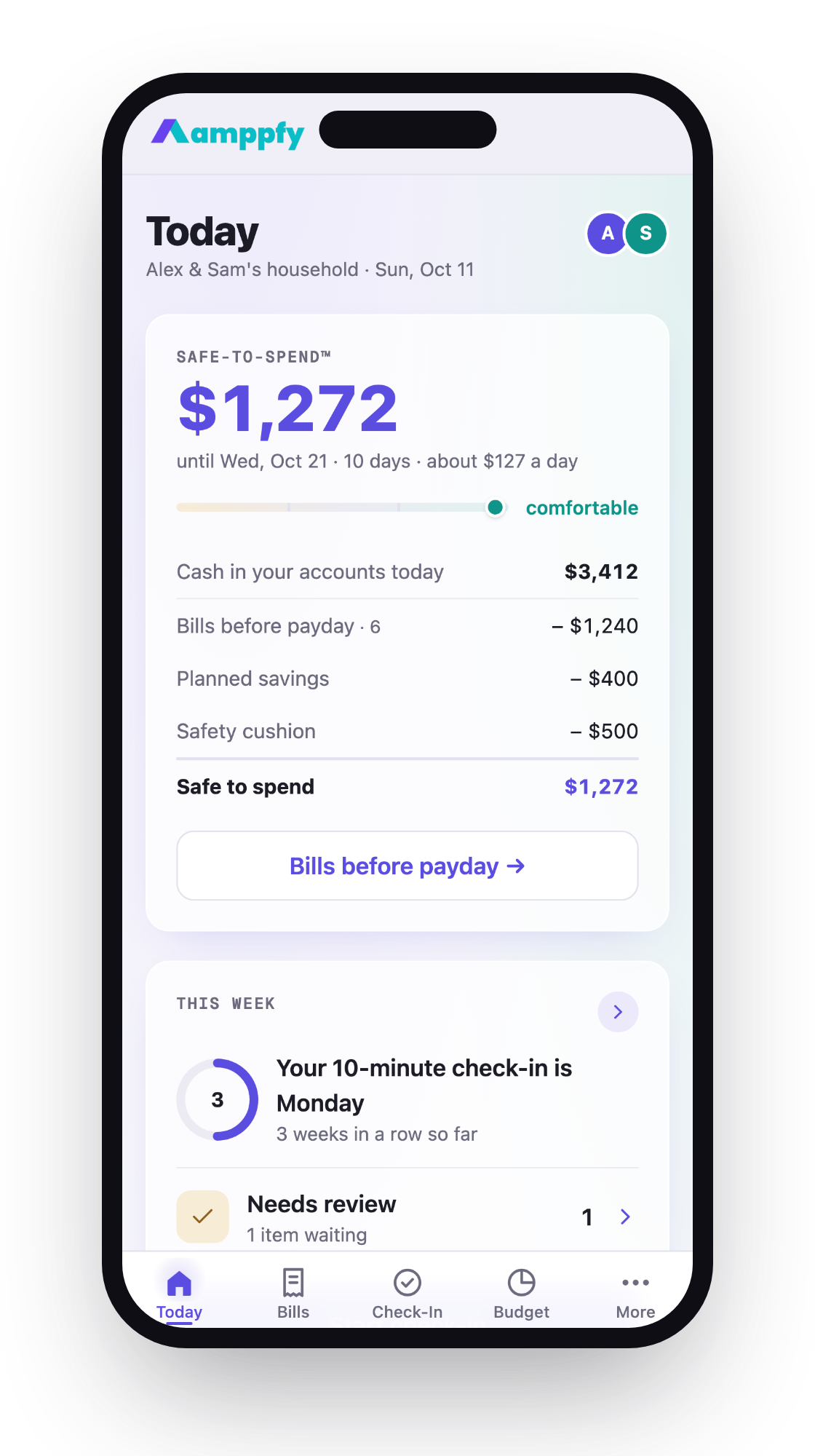
Your old spending habits assumed two incomes. Your new number has to reflect one. Safe-to-Spend is a simple formula:
$3,200 checking balance − $1,450 bills due before payday − $200 savings goal − $300 cushion = $1,250 Safe-to-Spend (https://www.centinelmoney.com/resources/how-to-know-whats-safe-to-spend[3])
That $1,250 is what you can actually use for groceries, gas, coffee, and kid stuff without putting a bill at risk. The cushion is your buffer for timing surprises: a bill that posts a day early, a gas fill-up that’s $15 more than expected.
How to set your cushion
Start with $200 to $500 (https://www.centinelmoney.com/resources/how-to-know-whats-safe-to-spend). If your income is predictable and your bills are steady, lean toward the lower end. If you’re freelancing or your hours vary, go higher. You can adjust it every pay cycle as you learn your new rhythm.
Recalculate every payday
Your Safe-to-Spend shifts with every paycheck. Recalculate it each time you’re paid. Update your checking balance, subtract what’s due before the next check, subtract your savings transfer, subtract your cushion. The whole process takes about two minutes.
Amppfy does this math for you automatically. Enter your balances, bills, and paydays once, and it shows one always-current Safe-to-Spend number with the four-line formula printed underneath. A ten-minute weekly check-in keeps it honest. No bank login required: you type in your balances yourself.
The goal isn’t to restrict your spending. It’s to spend freely within a number you trust. That’s a different feeling than checking your bank balance and guessing.
Child support and shared costs on the calendar
Child support is a bill, not a bonus. Whether you’re paying it or receiving it, it belongs on your bill calendar with a fixed date and amount.
The national average child support obligation is $533 per month, though custodial parents actually receive an average of only $342[4]. If you’re the receiving parent, build your budget around what reliably arrives, not what’s owed. If payments are inconsistent, use the lower number for planning and treat the rest as a welcome adjustment when it shows up.
Handling shared kid expenses
School supplies, sports fees, medical copays: these costs don’t fit neatly into child support. Most custody agreements split them 50/50 or proportionally by income. Track them separately from your regular bills.
A simple approach:
- Create a shared note or spreadsheet with your co-parent.
- Log each expense with the date, amount, and receipt photo.
- Settle up on a fixed schedule: the 1st and 15th, or every payday.
- Add that settlement amount to your bill calendar as a recurring line item.
Roughly half of custodial parents don’t receive the full support they’re entitled to, which creates real budget gaps. If you’re in that position, your next step is documenting the shortfall and contacting your state’s child support enforcement office. Don’t absorb the cost silently: there are systems designed to help.
A 30-day reset plan
You don’t need to rebuild your entire financial life this week. You need a single month of clarity. Here’s a day-by-day structure to get your solo bill calendar running.
Days 1 through 3: Gather
- List every bill with its amount, due date, and payment method.
- Screenshot all autopays on joint and personal accounts.
- Note your next two paydays and expected take-home amounts.
Days 4 through 7: Separate
- Migrate shared autopays to your personal account (see the three-pass method above).
- Cancel or pause subscriptions you no longer need or use.
- Update your address with every biller if you’ve moved.
Days 8 through 10: Calculate
- Run your Safe-to-Spend math for the current pay period.
- Set your cushion amount.
- Identify your lowest-cash day this month: the day your balance dips closest to zero after bills post.
Days 11 through 20: Operate
- Spend within your Safe-to-Spend number.
- Log any shared kid expenses as they happen.
- Check your balance once midweek to confirm bills posted correctly.
Days 21 through 30: Review and adjust
- Compare what you spent against your Safe-to-Spend.
- Adjust your cushion if it was too tight or too generous.
- Set a savings goal for next month, even if it’s $25.
By day 30, you’ll have a working one-income bill calendar. Not a perfect one: a working one. Perfection is a trap. A system that runs is what matters.
Frequently Asked Questions
How do I budget after a divorce when I’ve never managed money alone?
Start with the basics: your checking balance, your bills, and your paydays. You don’t need a complex system. Write down what’s due before your next paycheck, subtract it from what you have, and spend within the difference. Confidence comes from repetition, not expertise. People who were involved in money management during their marriage recover faster financially after divorce, but starting now gets you to the same place.
Should I use a budgeting app or a spreadsheet?
Either works. The best tool is the one you’ll actually open every week. If spreadsheets feel like homework, try an app like Amppfy that shows your Safe-to-Spend number without requiring you to categorize every purchase. If you love spreadsheets, build a simple one with columns for bill name, amount, due date, and paid status. The format doesn’t matter: the weekly habit does.
What if my income doesn’t cover all my bills?
First, confirm the gap is real by listing only bills due this pay period, not the whole month. If there’s still a shortfall, rank your bills: housing, utilities, food, transportation, insurance, then everything else. Contact billers for the lower-priority items and ask about hardship programs or payment extensions. Many utility companies and lenders offer post-divorce accommodations if you ask.
How often should I update my budget on a single income?
Every payday. That’s your natural reset point. Update your checking balance, confirm which bills are due before the next check, and recalculate your Safe-to-Spend. A weekly five-to-ten-minute check-in between paydays catches anything that shifted. Monthly reviews are too infrequent when you’re adjusting to a new income level.
Your next ten minutes
Rebuilding your finances after a separation isn’t about becoming a spreadsheet wizard. It’s about knowing one number: what’s safe to spend before your next paycheck. That number absorbs the stress of guessing, the anxiety of checking your bank balance at the register, and the weight of bills you used to share.
Start today. Open your bank app, list what’s due this pay period, and do the subtraction. That’s your first Safe-to-Spend number. It won’t be pretty, and it doesn’t have to be. It just has to be real.
Take ten minutes this week to set up your bill calendar in Amppfy. Enter your balances, your bills, and your paydays. You’ll see your Safe-to-Spend number with the math right underneath it. One number, one screen, one fresh start.