

Payday morning. You open your bank app, and the balance looks exactly like it did last night. The rent autopay is set for tomorrow, and your phone bill hits Friday. Your stomach drops a little.
Pause before you call anyone. A missing deposit is usually a timing problem, a paperwork problem, or a bank posting problem. All three have a fix, and most can be sorted out in under an hour. The trick is checking things in the right order, so you don’t spend 40 minutes on hold with your bank over something only your payroll team can see.
This is a calm checklist for that hour. It works through the likely causes from most to least common. It tells you exactly who to contact first. It also covers how to plan the next few days if the money really is late, and what to do once it finally shows up.
Grab your last pay stub, your direct deposit form if you have a copy, and your banking app. That’s all you need.
The short answer: check these first
If your direct deposit is not showing up, run these four checks in order. Each one takes a few minutes, and the order matters.
- Employer payroll. Did payroll run on time? Was there a holiday, a missed cut-off, or is this your first deposit at a new job or new account?
- The account and routing number. Compare the numbers on your direct deposit form against your bank’s numbers. One wrong digit can send the money back.
- Your bank’s posting window. Many banks post deposits overnight. Some publish a time and some don’t. Check your bank’s own website for its stated window.
- Who to call. Employer payroll first, then the bank. Payroll can confirm whether the money left and when. Your bank can only confirm what has arrived.
Why payroll before the bank? Your bank can’t see a payment that hasn’t reached it yet. If payroll never sent the file, the bank will truthfully say there’s nothing pending. Then you’ve lost time.
Most late deposits resolve at step 1 or step 3. Step 2 is rarer, but it takes the longest to fix, so it’s worth a careful glance.
Payroll cut-off, holiday, or a new account’s first deposit
Start with the source. Your paycheck travels from your employer’s payroll system to their bank, then through the ACH network, then to your bank. A delay at the very first step pushes everything back.
Payroll cut-off
Payroll providers have submission deadlines. If someone on your employer’s side submitted the payroll after the cut-off, the deposit can slide a full business day. You won’t see this from your end. Only payroll can tell you when the file went out.
Bank holidays
Federal banking holidays stop ACH settlement for the day. The next one is Veterans Day, Wednesday, November 11, 2026[1]. A payroll file that would have settled that day settles the next business day instead, so the deposit can land 24 hours later than usual. If your payday sits near a holiday, that’s often the whole answer.
A new job or a new account
This one surprises people. A new direct deposit setup often takes one to two pay cycles to go live. Your first paycheck at a new job, or your first after switching banks, may arrive as a paper check instead. Some employers mail it, and some hand it out. Ask payroll which applies to you.
If you just changed accounts, don’t close the old one yet. A deposit could still route there for one more cycle.
Wrong account number or a closed account
If payroll confirms the money left on time, look at the numbers next. Pull up the direct deposit form you submitted, or check the employee portal where you entered your banking details. Then compare.
- Routing number: nine digits, identifies your bank. Find your bank’s number in its app or on its website, not from a search result.
- Account number: your specific account. Check it in your bank app, usually under account details.
- Account type: checking versus savings. A mismatch can cause a rejection at some banks.
A single transposed digit is enough to break it. So is an account you closed months ago and forgot was still on file.
Here’s the reassuring part. A payment sent to a closed or invalid account doesn’t vanish. The receiving bank rejects it and sends it back through the ACH network as a return. Under the Nacha rules, the bank doesn’t have to wait until the settlement date to send that return[3]. The money travels back to your employer, who can then reissue it.
The fix:
- Tell payroll the deposit was likely returned and ask them to watch for it.
- Correct your banking details in the portal or on a new form.
- Ask whether they can issue a paper check or a manual payment for this cycle.
Expect this path to take a few business days. It’s slower than a holiday delay, but it’s predictable.
Your bank’s posting window
Your bank’s posting schedule is the last link in the chain. Many banks post incoming ACH deposits overnight, so the money appears when you wake up. Others post in batches during the day. Some publish a specific time on their website. Many don’t publish any time at all. If yours doesn’t, treat that as the honest answer: there is no stated window to hold them to.
There’s one rule that helps. As of October 2026, a Nacha rule requires banks to make funds from non-Same Day ACH credits available by 9:00 a.m. local time[2] on the settlement date. That rule took effect September 18, 2026. So if payroll confirms the settlement date is today and it’s well past 9 a.m. where you live, that’s a fair question to put to your bank.
Occasional network-wide processing delays can happen too, and they push deposits later than normal. Those clear on their own, usually within the day.
| Step | Who to contact | What to ask | What you learn |
|---|---|---|---|
| 1 | Employer payroll or HR | When did payroll submit? What is the settlement date? Is this a paper check cycle? | Whether the money left, and when it should arrive |
| 2 | Employer payroll | Which account and routing number is on file? | Whether a typo or closed account is the issue |
| 3 | Your bank | Is there a pending ACH credit? Was anything returned? | Whether the deposit reached the bank |
| 4 | Your bank | What is your posting window for ACH deposits? | Whether it’s still within normal timing |
Call in that order. Payroll holds the facts your bank can’t see.
Planning the next few days if it is late
Once you know the deposit is late, the goal shifts. You’re no longer solving the mystery. You’re getting from now to the day the money lands without a bill bouncing.
Start with simple arithmetic. Write down three numbers:
- Your current balance
- Every bill set to auto-pay before the new expected deposit date
- The gap between them
Say your balance is $640. Your phone bill of $85 and a $220 car insurance payment both draft before Thursday, when payroll says the deposit will arrive. That’s $305 due. You have $335 of room. Nothing needs to move.
Now say rent of $1,400 drafts tomorrow. That’s a real gap of $760. Here’s the calm order of moves:
- Call or message the biller. Many landlords and utilities will shift a due date by a few days if you ask before it drafts.
- Pause or reschedule autopays you control. Most bank bill-pay tools let you change the send date.
- Move money from savings. That’s what it’s for. You can rebuild it after payday.
- Ask payroll about a manual check. If the delay is on their side, some employers can issue one quickly.
Skip groceries splurges and nonessential subscriptions until the deposit clears. That’s not punishment. It’s just buying a few days of breathing room.
If you’d like more detail on why deposits shift around and how to build a buffer for it, here’s a guide on why your direct deposit lands early or late and how to plan around it.
What is safe to spend once it lands
Relief makes it tempting to treat the fresh balance as spendable. It isn’t, not all of it. A late deposit often means bills stacked up while you waited, and some may still be pending.
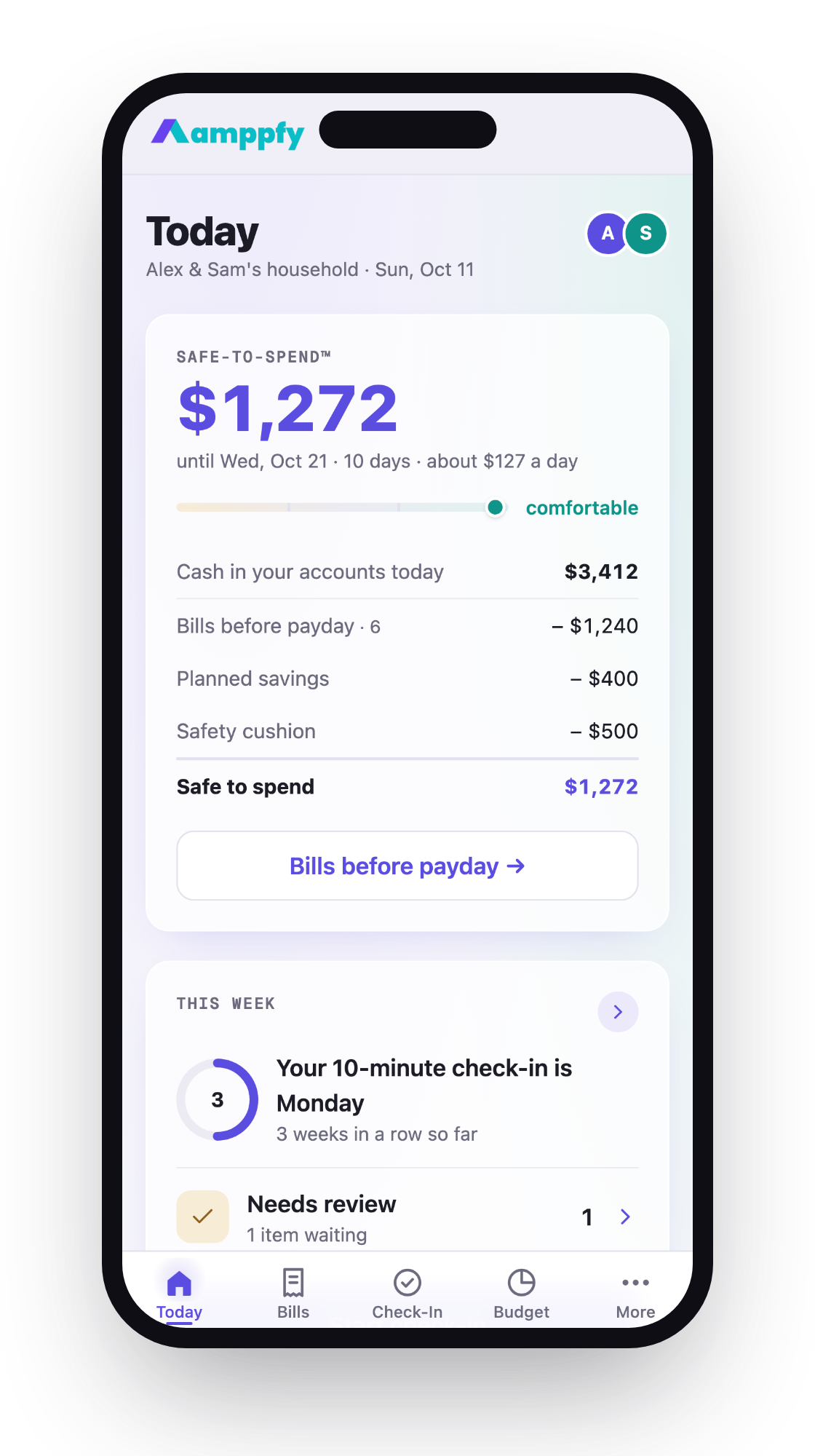
Your Safe-to-Spend™ amount is what’s left after the money that’s already spoken for. Here’s how the math works:
Safe-to-Spend™ = available cash − bills due before next payday − planned savings − safety cushion
Run it with real numbers. Your paycheck of $2,100 lands, bringing your balance to $2,400.
- Available cash: $2,400
- Bills due before next payday (rent $1,400, insurance $220, phone $85): −$1,705
- Planned savings, including refilling what you borrowed: −$300
- Safety cushion: −$150
- Safe-to-Spend™: $245
That $245 is the honest number. The $2,400 on your bank app was never really yours to spend freely.
One more check: if you moved money from savings during the delay, put it back first. Then refill anything you paused. Treat the late week as finished business, not a debt you’ll carry into next month.
FAQ
How long should I wait before calling about a missing deposit?
Check your bank’s stated posting window first. If it publishes none, wait until mid-morning on payday, then contact payroll. They can confirm the settlement date and whether the payment went out.
Can my bank tell me if my employer sent the deposit?
Only once it has arrived at the bank. Before that, your bank has no record of it. That’s why payroll is always the first call.
Why did my first paycheck come as a paper check?
New direct deposit setups often take one to two pay cycles to go live. Until then, many employers issue a paper check so you’re still paid on time.
What happens to money sent to a closed account?
The receiving bank rejects it and returns it to your employer through the ACH network. Your employer can reissue the payment after you update your details, so tell payroll as soon as you spot the error.
The calm version
A late direct deposit feels urgent, but the checklist is short. Check payroll timing first, then the account numbers, then your bank’s posting window. Call payroll before your bank, every time. Most delays clear within a day or two, and the ones that don’t still follow a predictable path back to you.
When the money finally lands, remember one thing. The balance is not what’s safe to spend. Bills due before your next payday come out first, then planned savings, then your cushion. What’s left is the real number.
That’s the math Amppfy does for you. You type in your balances, add your bills and paydays, and it shows one Safe-to-Spend™ number with the four lines printed underneath. It’s free on iPhone and the web. Take ten minutes this week and set up your number in Amppfy, so the next late deposit is just a small detour.