

The 2026 federal pay schedule has two parts. OPM sets the pay periods and the leave year. Your payroll provider sets the day the money actually reaches your account. Many people treat these as the same thing, and that’s where the confusion starts.
This page lays out every 2026 pay period in one place, with pay dates under one provider’s published rule. It also shows how to check your own provider and how to plan bills around a two-week rhythm.
You don’t need a spreadsheet or a long Sunday session. You need the dates, the logic behind them, and about ten minutes to line up your bills. The rest is ordinary arithmetic.
The 2026 federal pay period calendar
OPM’s 2026 leave year runs from January 11, 2026, to January 9, 2027[1], as of October 2026. That span holds 26 pay periods. Each one starts on a Sunday and ends on a Saturday 14 days later.
OPM publishes the leave year and the pay periods. It does not publish paydays. Pay dates vary by payroll provider (NFC, IBC, DFAS, GSA), so check your own provider’s calendar before you rely on any date below. The NFC pay period calendar[2] is one example of a provider-published schedule.
The pay date column uses the Interior Business Center (IBC) rule: the official pay date is the second Tuesday after the period ends, as of October 2026. IBC numbers its earnings year differently from OPM. Its year starts December 14, 2025, so IBC’s period numbers won’t match OPM’s numbers below. IBC also publishes an early-group EFT Friday for each period. Those dates aren’t reproduced here, so get them from IBC’s own calendar.
| OPM pay period | Start (Sunday) | End (Saturday) | IBC official pay date (Tuesday) |
|---|---|---|---|
| 1 | Jan 11, 2026 | Jan 24, 2026 | Feb 3, 2026 |
| 2 | Jan 25 | Feb 7 | Feb 17 |
| 3 | Feb 8 | Feb 21 | Mar 3 |
| 4 | Feb 22 | Mar 7 | Mar 17 |
| 5 | Mar 8 | Mar 21 | Mar 31 |
| 6 | Mar 22 | Apr 4 | Apr 14 |
| 7 | Apr 5 | Apr 18 | Apr 28 |
| 8 | Apr 19 | May 2 | May 12 |
| 9 | May 3 | May 16 | May 26 |
| 10 | May 17 | May 30 | Jun 9 |
| 11 | May 31 | Jun 13 | Jun 23 |
| 12 | Jun 14 | Jun 27 | Jul 7 |
| 13 | Jun 28 | Jul 11 | Jul 21 |
| 14 | Jul 12 | Jul 25 | Aug 4 |
| 15 | Jul 26 | Aug 8 | Aug 18 |
| 16 | Aug 9 | Aug 22 | Sep 1 |
| 17 | Aug 23 | Sep 5 | Sep 15 |
| 18 | Sep 6 | Sep 19 | Sep 29 |
| 19 | Sep 20 | Oct 3 | Oct 13 |
| 20 | Oct 4 | Oct 17 | Oct 27 |
| 21 | Oct 18 | Oct 31 | Nov 10 |
| 22 | Nov 1 | Nov 14 | Nov 24 |
| 23 | Nov 15 | Nov 28 | Dec 8 |
| 24 | Nov 29 | Dec 12 | Dec 22 |
| 25 | Dec 13 | Dec 26 | Jan 5, 2027 |
| 26 | Dec 27 | Jan 9, 2027 | Jan 19, 2027 |
How federal pay periods work
A pay period is the window you work. Payday is when you’re paid for it. The two are always separated by a gap, because payroll needs time to process timecards, deductions, and deposits.
Under the IBC rule, the gap is ten days. A period ends on Saturday. The next Tuesday is the first one, and the Tuesday after that is payday. So the hours you work from January 11 to January 24 arrive on February 3.
Here’s the math in one line:
- Period end (Saturday) + 10 days = IBC official pay date (Tuesday)
Other providers use different rules. That’s why the same pay period can land in your account on a different day than a colleague’s at another agency. If your money arrives on a Friday, your provider or pay group uses a different rule. IBC’s own early pay groups, for example, get an EFT deposit on the first Friday after the period ends, four days before the official Tuesday pay date.
The leave year matters too. It controls when annual leave accrues and when use-or-lose leave must be used. For 2026, that deadline lines up with the end of the leave year on January 9, 2027.
Your 2026 rate also changed early in the year. Federal employees got a 1.0 percent across-the-board increase in General Schedule base rates, effective the first pay period beginning on or after January 1, 2026, which is January 11, 2026, as of October 2026. Locality payments are unchanged from 2025 levels[4]. If you’re planning with an old paycheck amount, swap in your first 2026 stub. It’s a small change, but your plan should use the real number.
Paydays that move: holidays in 2026
Holidays don’t change pay periods. They can change paydays. When a scheduled payday lands on a federal holiday, the deposit has to move to another business day.
Three holidays are worth a glance this year.
Juneteenth
Juneteenth falls on Friday, June 19, 2026. The Federal Reserve is closed that day, so no ACH deposit settles. Under the IBC Tuesday rule nothing moves. If your pay group gets a Friday EFT, the first Friday after OPM pay period 11 (May 31 to June 13) is June 19, so that deposit cannot settle on its usual day. Check your provider’s calendar for the adjusted date.
Independence Day
July 4, 2026, falls on a Saturday. So the federal holiday is observed on Friday, July 3, 2026. Under the IBC Tuesday rule, no payday lands on July 3. If your provider pays on Fridays, check its calendar for the first week of July.
New Year’s Day 2027
January 1, 2027, is a Friday and a federal holiday. Pay groups with Friday deposits have a scheduled EFT on that date (the first Friday after OPM pay period 25, which ends December 26). A deposit cannot settle on January 1, so check your provider’s calendar for the adjusted date. If it moves earlier, to Thursday, December 31, 2026, that puts one extra paycheck inside calendar year 2026.
This matters for a few calm, practical reasons:
- Taxes: an extra check in the calendar year can change your W-2 totals.
- Withholding and TSP: a 27th check in a calendar year may affect how annual contribution limits spread across your pay.
- Bills: the December 31 money arrives a day early, so January’s first bills have a little less runway.
None of this needs a panic. Open your provider’s calendar, confirm the date, and write it down. That takes about two minutes.
Planning bills around a biweekly federal paycheck
Biweekly pay means 26 paychecks a year, not 24. Most bills are monthly. That mismatch is the whole puzzle, and it has a simple fix.
Start by sorting each bill into the paycheck that has to cover it. A bill belongs to the most recent payday on or before its due date. Using the IBC dates, a March 25 bill belongs to the March 17 check. A March 31 bill can use the March 31 check, but only if the deposit lands before the payment pulls.
Here’s a worked example. Say your net pay is $2,400 per check, and your monthly bills look like this:
- Rent: $1,500 due on the 1st
- Car payment: $380 due on the 10th
- Phone and internet: $160 due on the 20th
- Insurance: $210 due on the 25th
In March, the March 3 check covers the car payment. The March 17 check covers phone, internet, and insurance: $370. Rent for April 1 falls just after the March 31 check, so that check covers it. Each check gets a load you can see in advance.
The two “extra” months
In 2026, two months under the IBC schedule hold three paydays: March (3, 17, 31) and September (1, 15, 29). Treat the third check as a bonus that your monthly bills don’t need. You could send it to savings, an emergency fund, or a debt balance.
A weekly check-in, not a daily worry
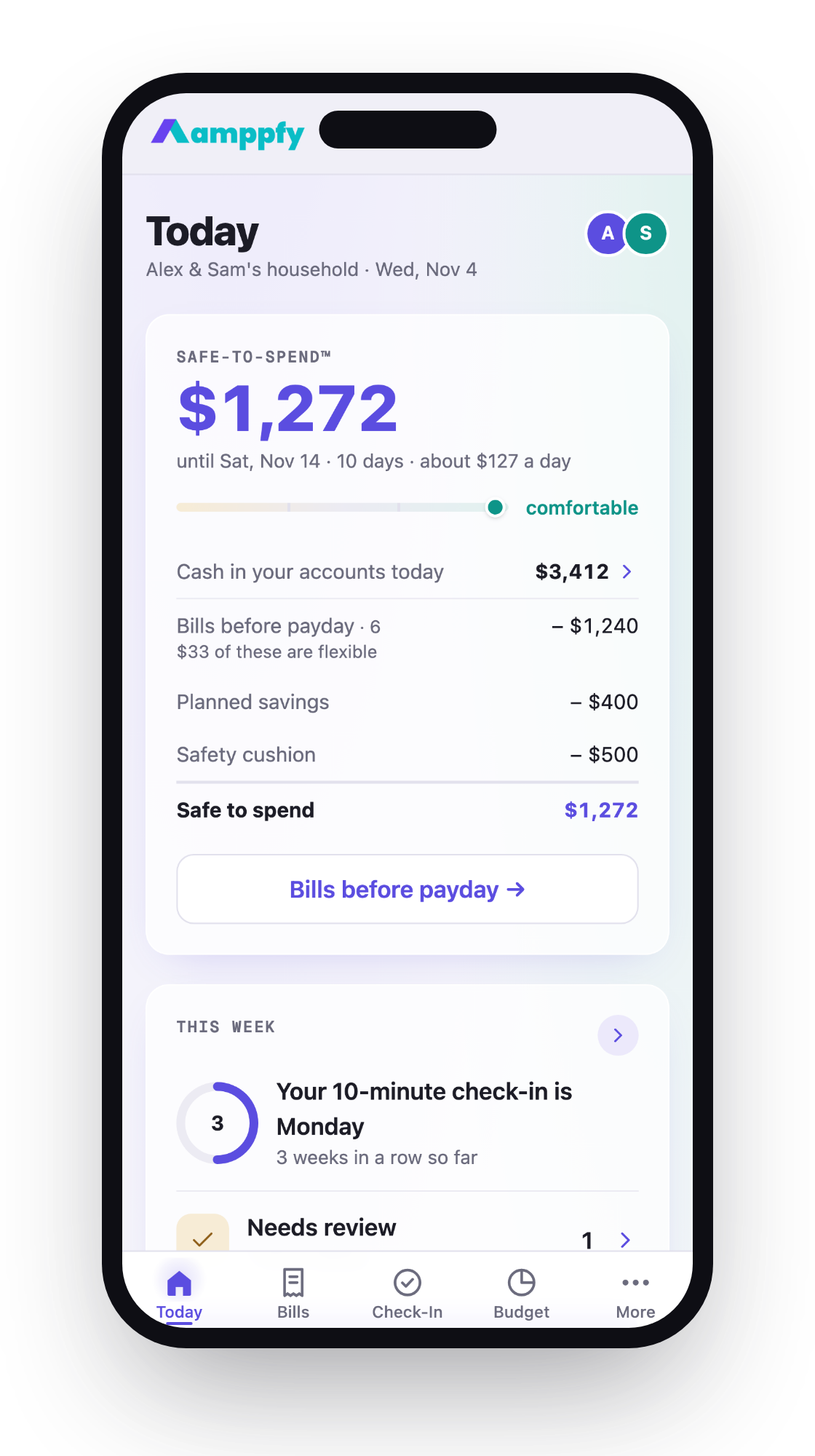
The calm way to run this is a short weekly review. Update your balances, look at the bills due before the next payday, and see what’s left. That’s the logic behind Amppfy’s Safe-to-Spend™ number: cash on hand minus bills due before payday, minus planned savings, minus a cushion you choose. You type your balances in yourself, so there’s no bank login to break.
The 2027 calendar
The full federal pay period calendar for 2027 lists all 26 pay periods with official pay dates. The 2027 leave year begins right where 2026 ends. It starts Sunday, January 10, 2027[3], the first day of the first full pay period of the year. It runs through Saturday, January 8, 2028[3], which covers 26 pay periods. Both dates are on OPM’s leave-year page, as of October 2026.
Pay dates for 2027 will again depend on your payroll provider. The same rule of thumb holds. Find your provider’s calendar, then line up your bills against it.
A few related guides can help you plan ahead:
- Wondering about an extra paycheck next year? Read does 2027 have 27 pay periods.
- Retired, or planning for it? See the OPM annuity payment dates for 2027.
- Want a system for any biweekly schedule? Try how to plan bills around 26 paychecks a year.
One habit carries over well. In the first week of January, take ten minutes to copy your provider’s new paydays into your calendar. Then you’ll have a full year of dates in front of you before the first bill arrives.
FAQ
How many pay periods are in the 2026 federal leave year?
There are 26. The OPM leave year runs from January 11, 2026, to January 9, 2027, as of October 2026. A pay group with Friday deposits could see 27 deposits inside calendar year 2026 if its January 1, 2027 deposit moves back to December 31, but the leave year itself still has 26 periods.
Does OPM publish federal paydays?
No. OPM publishes the leave year and the pay periods only. Your payroll provider (NFC, IBC, DFAS, or GSA) sets the actual pay dates. Check its calendar for your exact deposit day.
Why doesn’t my IBC pay period number match the table?
IBC numbers its earnings year differently. Its year starts December 14, 2025, so its period numbers are offset from OPM’s. The work dates and pay dates are the same. Only the label differs.
When did the 2026 raise show up?
The 1.0 percent increase took effect with the first pay period beginning on or after January 1, 2026, which started January 11, as of October 2026. Under the IBC rule, that period’s pay arrived on February 3. Locality payments are unchanged from 2025 levels.
Your federal pay calendar comes down to three steps. Use OPM’s pay periods, your provider’s paydays, and a short list of bills placed under each check. Watch the holiday spots in June, July, and at year end, and enjoy the three-paycheck months when they come.
If you’d like to see that plan on one screen, set up your paydays and bills in Amppfy’s bills and paydays view. It’s free on iPhone, Android, and the web. A partner can join with their own login, and private accounts stay private. Spend ten minutes this week entering your next three paydays.