

Your banking app shows a new line near the top: a deposit, with “pending” next to it. The amount looks right. Payday is supposed to be today. But your available balance hasn’t moved, and rent comes out tomorrow morning.
This moment is common, and it’s usually not a problem. A deposit in pending status is money on its way. It’s not money that vanished. The confusion comes from two numbers on the same screen telling slightly different stories.
The goal here is plain. You’ll learn what that label means and which rules decide when the money unlocks. You’ll see how weekends shift the timing, and how to plan around the gap without stress. You’ll also learn why the balance you see once it clears still isn’t the number to spend from.
If you’ve ever refreshed your bank app five times before 9 a.m. on payday, this is for you. The answer is calmer than it feels.
The short answer
A pending direct deposit is money your bank can see coming but hasn’t finished processing. You usually can’t spend it yet. Once it settles, it moves into your available balance.
For electronic direct deposits like paychecks, federal rules set a ceiling on the wait. Under Regulation CC, the federal funds availability rule, electronic payments received for deposit must be available no later than the first business day after the banking day they’re received[1]. Many banks release funds sooner, based on their own policy.
There’s also a network-level rule for the ACH system that carries most paychecks. As of September 18, 2026, banks must make standard ACH credit funds available for withdrawal by 9:00 AM local time on the settlement date[2]. The organization behind that rule put it simply: faster availability “provides a real benefit to receivers of ACH credits, such as employees”[3].
Here’s what that means for you, as of October 2026:
- Pending = seen, not spendable (in most cases)
- Available = spendable now
- Typical wait = hours, sometimes up to the next business day
- Your bank’s policy = can be faster than the federal floor, never slower
If your deposit shows pending on a weekday morning, the most likely outcome is that it clears that day.
What ‘pending’ means for a deposit
Think of a pending deposit like a package marked “out for delivery.” The tracking says it’s coming. You just can’t open it yet.
When your employer runs payroll, they send a file through the ACH network a day or more ahead. Your bank receives notice that money is coming on a set date. Some banks show this as pending right away. Others wait until settlement and show nothing until it’s available.
That’s the key difference from a pending purchase. A pending purchase is money leaving your account. The merchant has placed a hold, and your available balance usually drops right away, even before the charge is final. A pending deposit works the other way: money arriving that usually doesn’t add to your available balance until it settles.
So the two can feel lopsided. Spending shows up fast. Income shows up slow. That’s normal, and it’s by design. Banks protect themselves from releasing money that might bounce back.
If you want the purchase side explained, see this guide on how pending transactions work and how to plan around them. This article stays focused on money coming in.
One more distinction. Check deposits follow different rules than direct deposits. As of October 2026, the first $275 of a day’s check deposits must be available by the next business day, and banks may hold the part of a check deposit above $6,725 longer[4]. Paychecks sent electronically don’t get those extended holds in the same way.
Bank-by-bank summary table: when a pending deposit becomes spendable
Every bank sets its own funds availability policy within the federal limits, and the only source that counts for a bank’s timing is that bank’s own site. Here is what each one publishes, as of October 2026. None of them gives a clock time for when a pending deposit becomes available; where a bank says nothing about timing at all, the row says “Not published.”
| Bank | What the bank publishes about timing (as of October 2026) | Federal ceiling for electronic direct deposit |
|---|---|---|
| Chime | Early direct deposit up to 2 days early; funds generally available the day the payment file is received. No clock time[5] | Next business day at the latest |
| Cash App | Up to 2 days early compared to many banks. No clock time[6] | Next business day at the latest |
| Wells Fargo | Early Pay Day up to 2 business days early, not guaranteed; the day and time depend on when the bank gets the deposit information. No clock time[7] | Next business day at the latest |
| Chase | Secure Banking: eligible deposits up to 2 business days early; timing depends on the payer. No clock time[8] | Next business day at the latest |
| Bank of America | Electronic payments such as direct deposit are typically available the same day they are received. No early-pay feature on its deposit-holds page. No clock time[9] | Next business day at the latest |
| Capital One | 360 Checking Early Paycheck up to 2 days early; may land 2 days early, 1 day early, or on payday. No clock time[10] | Next business day at the latest |
| SoFi | Up to 2 days before the scheduled payment date; may vary. No clock time[11] | Next business day at the latest |
| Ally | Eligible paychecks up to 2 days before payday; no signup. No clock time[12] | Next business day at the latest |
The right-hand column is the part you can count on. It comes from Regulation CC’s funds availability rules. No bank on this list can legally hold an electronic paycheck longer than that.
To find your own bank’s exact timing, look for these in your app or on its website:
- Funds availability policy: usually in the account agreement or disclosures.
- Early pay or “get paid early” terms: some banks release deposits before settlement. Eligibility rules vary.
- Deposit cut-off time: this decides which business day a deposit counts toward.
It takes about five minutes. Do it once, and you’ll know your rhythm for every payday after.
What changes on weekends and holidays
The ACH network settles on business days only. Saturdays, Sundays, and federal holidays don’t count. That’s the single biggest reason a deposit seems late.
Here’s a common pattern. Your payday falls on a Monday holiday. Your employer knows this and usually sends payroll to settle the Friday before. If they don’t, your deposit settles Tuesday. Either way, a pending entry might sit on your screen all weekend without moving.
Same-day processing has limits too. Same Day ACH entries submitted by the 4:45 p.m. ET deadline of the third daily window settle at 6:00 p.m. ET the same day[13]. Miss the cutoff, and it rolls to the next business day.
A quick way to plan for this:
- Look at the calendar for your next two paydays.
- Mark any holiday that lands on or just before payday.
- Assume the later date if you’re not sure. If money arrives early, that’s a bonus.
The arithmetic is simple. One holiday can add one business day. A holiday weekend can stretch a Friday payday wait to Tuesday. Knowing that ahead of time turns a scare into a non-event.
Planning bills around a pending deposit
The real stress isn’t the pending label. It’s a bill that hits before the deposit clears. Fixing that is a scheduling problem, not a money problem.
Start with a quick check. Look at bills set to auto-pay within one business day of payday. Those are the only ones at risk.
Say your paycheck is $2,400 and settles Friday. Your phone bill of $85 auto-pays Friday at midnight. Your available balance Thursday night is $140. On paper, you’re fine: $140 minus $85 leaves $55. But if your $60 streaming and gym renewals also hit that night, you’re at negative $5 for a few hours.
Three calm fixes:
- Move due dates. Most utilities and card issuers let you pick a due date. Set them two or three days after payday.
- Keep a small buffer. Even $100 left in checking absorbs timing gaps like the one above.
- Pay manually on deposit day. For a bill you can’t move, pay it once the money shows available.
This doesn’t require a full budget overhaul. It’s one pass through your bills, maybe ten minutes. After that, payday timing stops being something you watch.
A month calendar that marks your lowest-cash day helps here. You’ll see the tight spot before it happens, not after.
What is safe to spend once it clears
The deposit clears. Your available balance jumps. It’s tempting to treat that bigger number as spending money. It isn’t, quite.
Your available balance is everything in the account right now. It doesn’t know about rent on the 1st or the car payment on the 10th. Those bills still have claims on that money.
How the math actually works
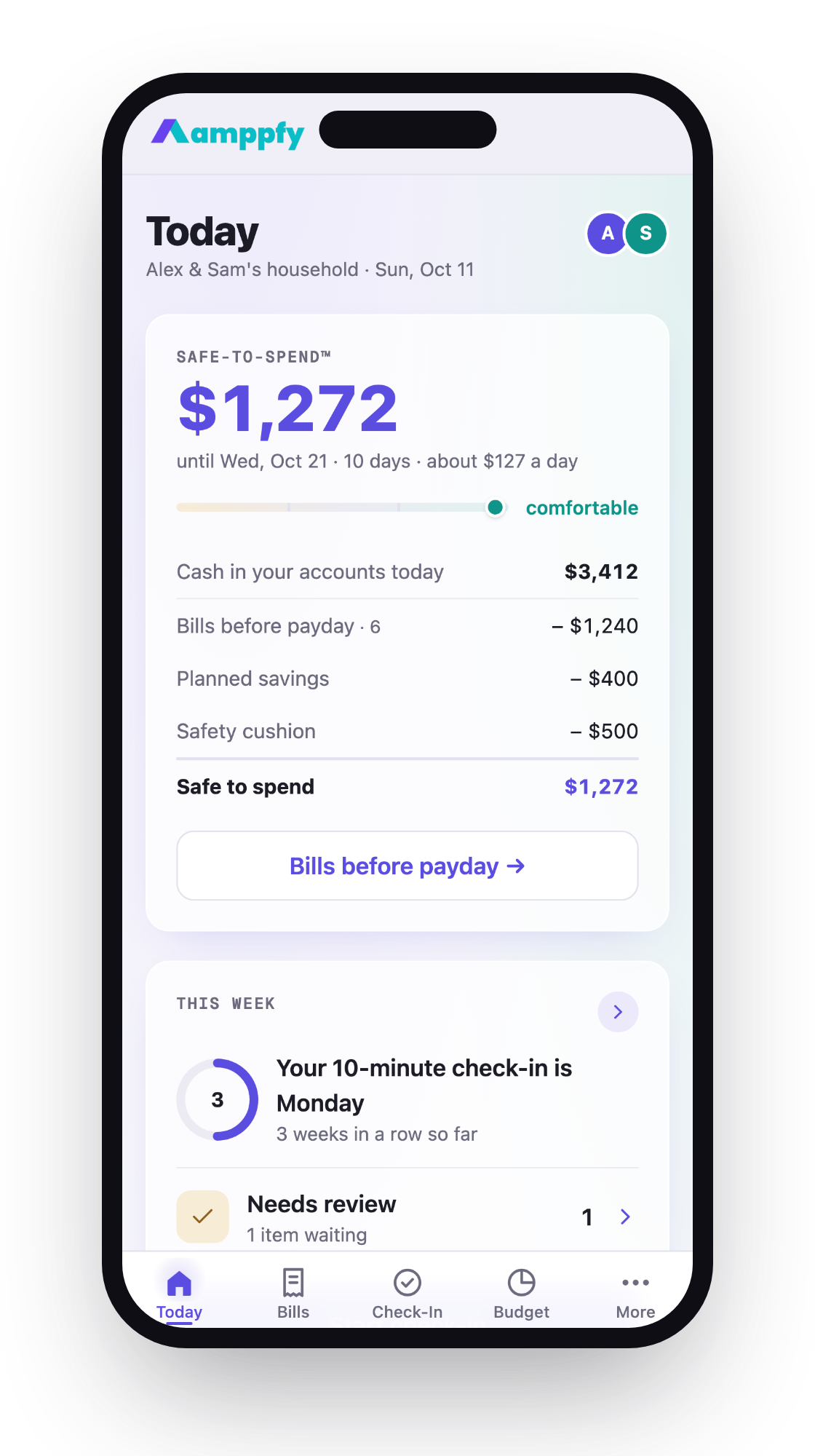
The number that matters is what’s left after the near-term claims come off. Here’s the formula:
Safe-to-Spend™ = available cash − bills due before next payday − planned savings − cushion
Take a real example:
| Line | Amount |
|---|---|
| Available after deposit clears | $2,640 |
| Bills due before next payday (rent, phone, insurance) | −$1,610 |
| Planned savings | −$300 |
| Cushion you choose | −$200 |
| What’s left to spend | $530 |
That $530 is your honest figure. It’s well below $2,640, but it’s real. You can spend it without wondering about Thursday.
The bills line only counts what’s due before the next paycheck. Later bills will be covered by later income. That keeps the number fresh and focused on now.
FAQ
Can I spend a pending direct deposit?
Usually not. Most banks keep pending deposits out of your available balance until they settle. Some offer early access, so check your own bank’s published terms.
Why does my deposit show pending but my friend’s at another bank is already available?
Banks set their own policies within federal limits. Some release funds as soon as the payroll file arrives. Others wait for the settlement date. Both are allowed.
What if my deposit is still pending after the next business day?
That’s past the federal ceiling for electronic payments under Regulation CC. Contact your bank first, then your employer’s payroll team to confirm the send date.
Can a pending deposit be reversed?
It can happen, for instance if payroll sent the wrong amount. It’s uncommon. If you’re unsure, wait until the deposit is available before spending against it.
Once it lands
A pending deposit is just money in transit. Federal rules cap the wait for electronic paychecks at the next business day. Network rules now push availability to the morning of settlement. Weekends and holidays are the main reason it ever feels slow.
The part people miss comes after. Once the deposit lands, your balance is not what’s safe to spend. Bills due before your next payday come out first. Then your planned savings. Then a cushion you pick. What remains is yours.
Amppfy does this arithmetic for you. You type in your balances, no bank login, and it shows one Safe-to-Spend™ number with the math printed underneath. Bills calendar, heads-ups, and a weekly 10-minute check-in keep it current. It’s free on iPhone and the web.
Take ten minutes this week and set up your Safe-to-Spend™ number in Amppfy. Next payday, you’ll know exactly what you have.