You open your bank app on a Tuesday morning and spot a charge you didn’t make. Maybe it’s $14.99 from a company name you’ve never seen. Maybe it’s $79 from something that looks like gibberish. Your stomach drops. Before you panic, know this: most unfamiliar charges on a bank statement turn out to be something mundane, not fraud. A forgotten subscription, a merchant’s legal name, or a purchase your partner made. The fix is usually straightforward once you know where to look.
Decoding the Merchant Name
The first thing to do with an unrecognized charge on your bank statement is figure out who actually billed you. That sounds obvious, but merchant names on statements rarely match the brand you know.
Why the Name Looks Wrong
Banks display a merchant’s “descriptor,” which is often the parent company’s legal name, not the storefront or app you used. A charge from “PAYHELLOCORP” might be your meal-kit service. “GOOGCLOUDSVC” might be extra Google Drive storage. Here are common reasons a charge looks unfamiliar:
- The merchant uses a parent company name or payment processor name.
- The charge posts days after the purchase, so you forget the context.
- A pre-authorization hold converts to a final charge at a slightly different amount.
- A family member or authorized user made the purchase on a shared account.
How to Decode It
- Copy the exact descriptor from your statement.
- Paste it into a search engine with quotes around it.
- Check your email for receipts matching the date and amount.
- Ask anyone who shares access to the account or card.
- Call the number listed next to the charge, if one appears.
Most banks now let you tap a transaction for extra details: a phone number, a partial address, or a category tag. Use those clues before assuming the worst. A 2026 report found that people lost $3.5 billion to imposter scams in 2025 alone[1], so real fraud does happen. But confirming the merchant first saves you from disputing your own gym membership.
One newer wrinkle: expired or closed cards can still generate charges. Security researchers discovered that cancelled cards can be revived through smartphone relay software, causing “zombie” charges on accounts you thought were closed. If you see a charge on an old card, contact your bank immediately.
Common Culprits: Trials, Annual Renewals, Family Plans
Once you’ve decoded the merchant name, you’ll often land on a subscription you forgot about. You’re not alone: in 2026, 47% of consumers cancelled at least one subscription due to sheer fatigue from managing too many recurring charges.
Here are the most common sources of mystery charges:
| Charge Type | Why It Surprises You | Typical Amount |
|---|---|---|
| Free trial conversion | You signed up months ago and forgot to cancel | $8.99 – $26.99/mo (https://truescho.com/en/blog/streaming-price-increases-2026[2]) |
| Annual renewal | You only see it once a year, easy to forget | Varies |
| Family or shared plan | A partner or kid added a service to your card | Varies |
| Price increase | Same subscription, higher price, no memory of the notice | Up to $15 more than expected (https://www.thestreet.com/entertainment/disney-raises-monthly-prices-for-millions-of-subscribers[3]) |
| In-app purchase | A game or app charged for a feature upgrade | $8.99 and up (https://ponly.com/fortnite-prices/[4]) |
| Bundled service | One subscription includes a second service billed separately | $19.99 – $32.99/mo (https://www.ign.com/articles/best-streaming-bundle-packages[5]) |
Annual renewals are especially sneaky. You sign up in January, forget by December, then see a charge the following January with no memory of the original purchase. Price hikes compound the confusion: the amount doesn’t match what you remember agreeing to.
Family plans create a different problem. If your teenager’s phone is linked to your Apple ID or Google account, their app purchases show up on your statement. Same goes for a partner who added your card to a streaming service months ago.
Cancel First, Then Dispute if Needed
You’ve identified the charge. Now what? The order of operations matters here.
Step 1: Cancel the Subscription
If the charge is from a legitimate service you no longer want, cancel it directly with the merchant. Don’t skip this step and go straight to a bank dispute. Disputing a valid subscription charge without cancelling first can result in the merchant simply billing you again next month.
Good news on the cancellation front: roughly 30 US states now require companies to make cancelling as easy as signing up. Starting October 1, 2026, New York City will enforce a ban on “subscription traps” with fines up to $525 per user for companies that make cancellation difficult. If a company is giving you the runaround, check whether your state has a click-to-cancel law.
Step 2: Request a Refund from the Merchant
After cancelling, ask the merchant for a refund on the most recent charge. Many companies will refund one billing cycle if you ask politely and promptly. Keep a record of the cancellation confirmation and any refund promise.
Step 3: Dispute with Your Bank if Needed
If the merchant won’t refund you, or if the charge is genuinely fraudulent, file a dispute with your bank. For credit cards, federal law caps your liability for unauthorized charges at $50. Debit cards have different rules and tighter deadlines, so act fast.
One critical deadline: to preserve your full legal rights on a credit card error, you must submit a written dispute within 60 days of the first statement containing the charge. Don’t sit on it.
Putting the Money Back into Your Number
Getting the refund is half the battle. The other half is making sure your spending picture reflects reality right now, not after the bank processes the reversal.
A refund or dispute credit can take 5 to 10 business days to appear in your account. During that window, your available balance looks lower than it should. If you’re living paycheck to paycheck or managing bills on a tight timeline, that gap matters.
Here’s how to keep your spending on track while waiting:
- Note the refund amount and expected return date.
- Adjust your mental “available cash” to include the pending refund.
- Don’t spend the refund before it posts. Treat it as expected, not confirmed.
- Check your account every few days until the credit appears.
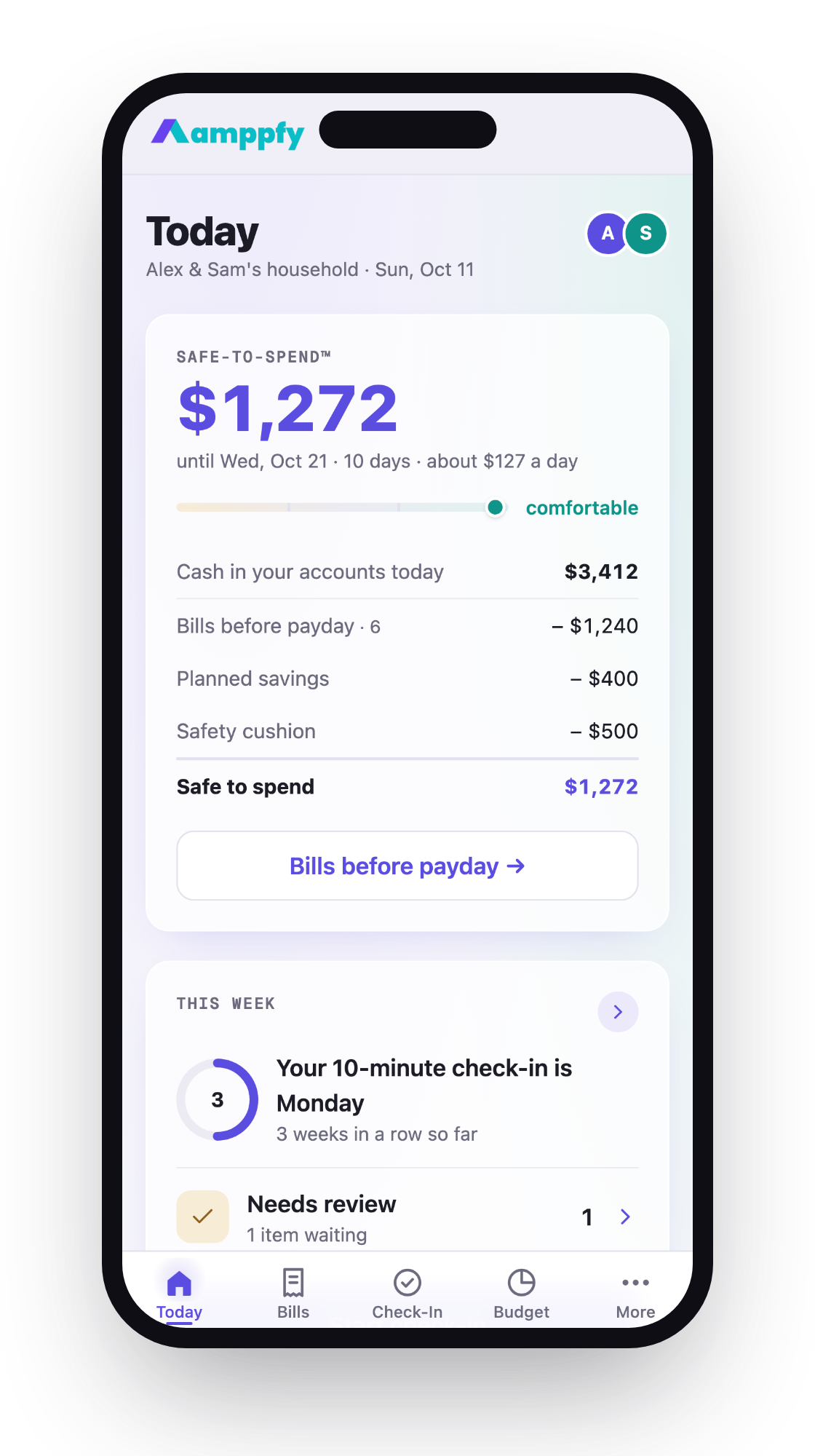
This is where knowing your Safe-to-Spend™ number helps: available cash, minus bills due before payday, minus planned savings, minus a safety cushion. If a mystery charge knocked that number down, you want to know exactly how much room you actually have. Amppfy’s subscriptions list shows next-charge dates for every recurring bill, so a surprise renewal is less likely to catch you off guard.
Once the refund posts, update your balance. That 30-second update keeps your Safe-to-Spend number honest without waiting for bank sync delays.
Preventing the Next One with a Subscriptions List
The best way to handle an unrecognized charge on a bank statement is to prevent it from surprising you in the first place. That means building a simple subscriptions list and reviewing it regularly.
What to Put on Your List
- Service name and the descriptor that appears on your statement
- Billing amount and frequency (monthly, annual, quarterly)
- Next charge date
- Which card or account it bills to
- Who in your household uses it
A 10-Minute Monthly Review
Pick one day each month. Pull up your list. Cross-reference it against your latest statement. Cancel anything nobody’s used in 30 days. This takes about 10 minutes and can save you hundreds per year.
Red Flags to Watch For
- A charge from a merchant not on your list
- A billing amount that’s higher than what your list shows
- Two charges from the same service in one billing cycle
- Any charge on a card you’ve stopped using
If you spot any of these, run through the decode-cancel-dispute steps above. The faster you act, the easier the resolution.
Frequently Asked Questions
How long do I have to dispute an unrecognized charge?
For credit cards, you have 60 days from the date of the first statement showing the charge to submit a written dispute and preserve your full rights under federal law. Debit card timelines are shorter and vary by bank, so check with your institution right away. Waiting too long can limit your ability to recover the money.
Will my bank refund me for a subscription I forgot to cancel?
Usually not. Banks distinguish between unauthorized charges (fraud) and authorized charges you simply forgot about. If you signed up for a service and it billed you according to its terms, the bank will likely direct you to the merchant for a refund. Cancel the subscription first, then request a refund from the company.
Can I get charged on a credit card I already closed?
Yes. Some recurring billers retry closed cards, and recent research shows that expired or cancelled cards can sometimes be charged through smartphone relay exploits. If you see a charge on a closed account, contact your bank immediately to flag it as unauthorized.
Should I cancel my card every time I see a charge I don’t recognize?
Not right away. Most mystery charges turn out to be legitimate purchases you forgot about or merchant names you didn’t recognize. Search the descriptor, check your email for receipts, and ask family members first. Cancel the card only if you confirm the charge is fraudulent or if you see multiple unauthorized transactions.
Take 15 Minutes This Week
A strange charge on your statement is usually a puzzle, not a crisis. Decode the merchant name. Check your email and ask your household. Cancel what you don’t want. Dispute what isn’t yours. Then build a simple subscriptions list so the next one doesn’t catch you off guard.
If you want a single place to track every subscription, bill, and upcoming charge alongside your Safe-to-Spend number, Amppfy is free and takes about 10 minutes to set up. Start with just your balances and your next payday. You’ll know exactly what’s safe to spend before your next check hits.