You’re paying for things you don’t use. The average U.S. household now spends roughly $273 per month on subscriptions[1], and most people guess their total is closer to $86. That gap between what you think you’re spending and what you’re actually spending is real money leaving your account every month. Deciding which subscriptions to cancel doesn’t require a spreadsheet or a weekend audit. It takes one honest question and about ten seconds per service.
The one question: did you use it in the last 30 days?
Pull up your bank or credit card statement. Look at every recurring charge from the past month. For each one, ask yourself: did I actually use this in the last 30 days?
Not “might I use it someday.” Not “I used it a lot last winter.” Did you open the app, watch the show, read the newsletter, or use the product in the last 30 days? Yes or no.
That’s the test. It works because subscriptions survive on inertia, not intent. You signed up during a free trial, forgot to cancel, and now you’re one of the 70% of consumers who’ve been locked into a paid plan[2] after a trial lapsed. Each forgotten trial costs about $34 on average.
Here’s how to run the test quickly:
- Open your most recent credit card or bank statement.
- Highlight every recurring charge.
- Mark each one “used” or “unused” based on the last 30 days only.
- Set a timer. Spend no more than 10 seconds deciding per line item.
The 30-day window matters. It’s short enough to reflect your actual habits, not your aspirations. A yoga app you haven’t opened since February isn’t serving you in September. A meal-kit service you skipped three weeks in a row is costing you without feeding you.
If you hesitate on a charge, that hesitation is your answer. You’d know instantly if you used Netflix last night. The ones that make you pause are almost always the ones draining money quietly.
Keep, pause, or cancel: three outcomes
Not every subscription that fails the 30-day test deserves immediate cancellation. You have three options for each one, and sorting them correctly saves you from re-subscribing fees and setup hassle later.
| Outcome | When to choose it | Example |
|---|---|---|
| Keep | Used it multiple times in the last 30 days | Streaming service you watch weekly |
| Pause | Didn’t use it recently but will need it within 60-90 days | A fitness app you’ll restart after vacation |
| Cancel | Haven’t used it in 30+ days and have no specific plan to return | That second cloud storage plan you forgot about |
The “pause” category is where most people recover real money. By moving 3-5 services to pause status, the average household can recover $80 to $150 per month[3] without giving up access to primary entertainment. Many services like Hulu, Spotify, and even some gym memberships let you pause for one to three months and pick back up without losing your profile or history.
Cancellation is for the clear-cut cases:
- You subscribed to watch one show and finished it.
- You have two services that do the same thing (two cloud storage plans, two music apps).
- The price increased beyond what you’d pay if you were signing up fresh today.
That last point is worth a hard look in 2026. Netflix Premium rose to $26.99 per month in March[4], and YouTube Premium hit $15.99 in April. If your primary screen is 1080p or your internet can’t sustain 4K, paying for a premium tier is wasted money[5]. Drop to a standard plan instead.
The ones worth keeping even if you forgot
Some subscriptions earn their spot even when you don’t think about them daily. These fall into a few specific categories.
Services that prevent a larger cost
- Identity theft monitoring: you won’t “use” it until you need it, and by then it’s already paid for itself.
- Roadside assistance: a single tow costs more than a full year of coverage.
- Password managers: the security value exists whether you log in to the app or not.
Services with family-wide value
A subscription your partner or kids use regularly still passes the test, even if you personally haven’t opened it. Check with everyone in the household before canceling shared accounts. One person’s “I never use that” is another person’s daily routine.
Annual subscriptions mid-cycle
If you’re six months into a yearly plan, canceling now usually doesn’t trigger a refund. Flag it on your calendar for the renewal date instead. Mark the date, set a reminder, and make your keep-or-cancel decision one week before the charge hits.
The key distinction: “worth keeping” means it’s either actively used by someone in your household or it’s preventing a specific, identifiable cost. “I might need it” is not the same as “it’s protecting me from a $500 tow bill.”
How cancelling shows up in what you can spend
Here’s where the math gets satisfying. Say you cancel two streaming services ($16 and $27) and pause a fitness app ($15). That’s $58 back in your monthly budget. Over a year, it’s $696.
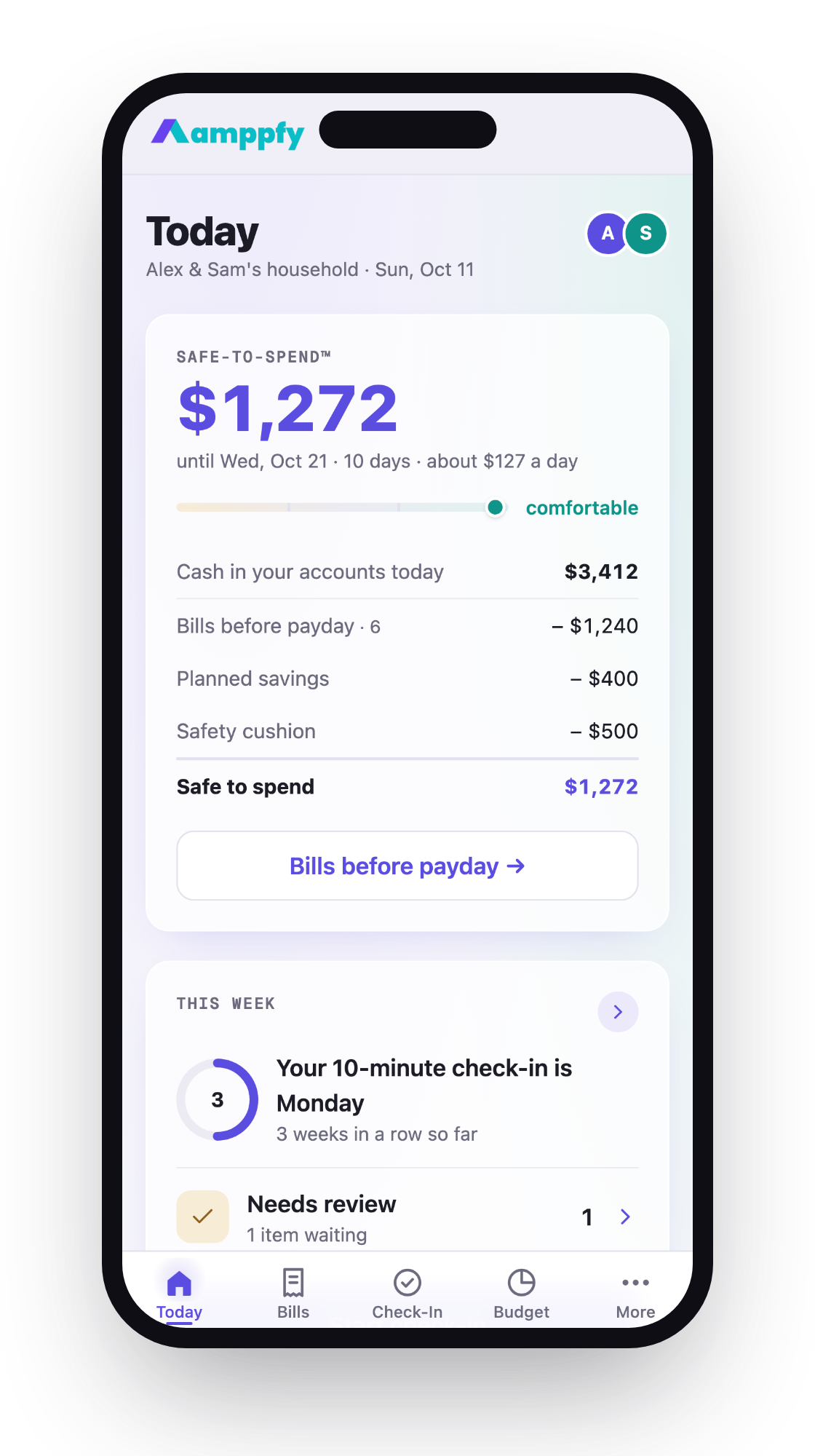
But the real question isn’t “how much did I save?” It’s “what can I safely spend now?” Those two numbers aren’t the same. Your Safe-to-Spend™ number: available cash, minus bills due before payday, minus planned savings, minus a safety cushion: changes the moment a recurring charge disappears.
Here’s a before-and-after example:
| Before canceling | After canceling | |
|---|---|---|
| Cash in checking | $2,400 | $2,400 |
| Bills due before payday | $1,800 | $1,742 |
| Savings set aside | $200 | $200 |
| Safety cushion | $100 | $100 |
| Safe-to-Spend | $300 | $358 |
That $58 difference is real, spendable money you can see right now. It’s not theoretical annual savings on a bar chart. It’s cash you can use this pay period.
Amppfy’s subscriptions list shows your next charge dates so you can spot which ones hit before payday. When you cancel or pause a service, your Safe-to-Spend updates to reflect the change. Ten minutes, and you know exactly where you stand.
U.S. adults are projected to waste an average of $252 annually on unused subscriptions in 2026. That’s $21 a month sitting in services you don’t touch. For most households, recovering even half of that amount shifts the Safe-to-Spend number enough to feel different between paychecks.
Making the test a weekly habit
A one-time purge feels great. But subscriptions creep back. Free trials auto-convert. Prices increase quietly. New services launch with “just $4.99 a month” pricing that adds up fast. Nearly 47% of consumers have actively canceled at least one subscription in 2026, up from 31% in 2024. The trend is clear: people are paying attention. The ones who stay ahead build a recurring check-in.
Here’s a simple weekly routine:
- Pick one day each week. Sunday evening or Monday morning works well.
- Open your subscription list or bank statement.
- Scan for any new charges you don’t recognize.
- Run the 10-second test on anything that looks unfamiliar.
- Check upcoming renewal dates for the next two weeks.
This takes five minutes or less. Pair it with your weekly money check-in and you’ll catch free trials before they convert, spot price hikes before the second month hits, and keep your recurring charges aligned with what you actually use.
The goal isn’t to live without subscriptions. It’s to pay only for the ones that earn their spot every month.
Frequently Asked Questions
How do I find all my active subscriptions in one place?
Start with your bank and credit card statements from the last 90 days. Filter for recurring charges. Check your Apple or Google account settings for app subscriptions, since many charges route through those platforms. Write every recurring charge in one list. This process takes about 15 minutes the first time and reveals services you’d completely forgotten.
Should I cancel a subscription I only use seasonally?
Pause it instead of canceling if the service allows it. Many streaming and fitness apps offer pause options for one to three months. If pausing isn’t available, cancel and re-subscribe when the season returns. You’ll usually get a “come back” discount that’s better than the current rate anyway.
What happens to my data or account history if I cancel?
Most services keep your profile and history for 6 to 12 months after cancellation. Spotify saves your playlists. Netflix holds your viewing history and profiles. Check the service’s cancellation FAQ before pulling the trigger. Download anything you want to keep: playlists, workout history, saved recipes: before your access ends.
Is it better to downgrade to a cheaper plan or cancel entirely?
Downgrade if you use the service at least twice a month. Cancel if you don’t. A $7 basic plan still wastes money if you never open the app. But dropping from a $27 premium tier to a $7 standard tier on a service you watch weekly saves you $240 a year while keeping something you value.
Your 10-Second Rule Starts Now
Figuring out which subscriptions you should cancel comes down to one honest question and a few minutes of your time. Run the 30-day test on every recurring charge. Sort each one into keep, pause, or cancel. Watch your spendable cash shift the same week.
Build the habit weekly, and subscription creep stops being a problem. You’ll catch new charges early, avoid forgotten trials, and keep your money pointed at things you actually use. If you want one number that shows exactly how those changes affect what’s safe to spend before payday, Amppfy is free to start and takes about 10 minutes to set up.