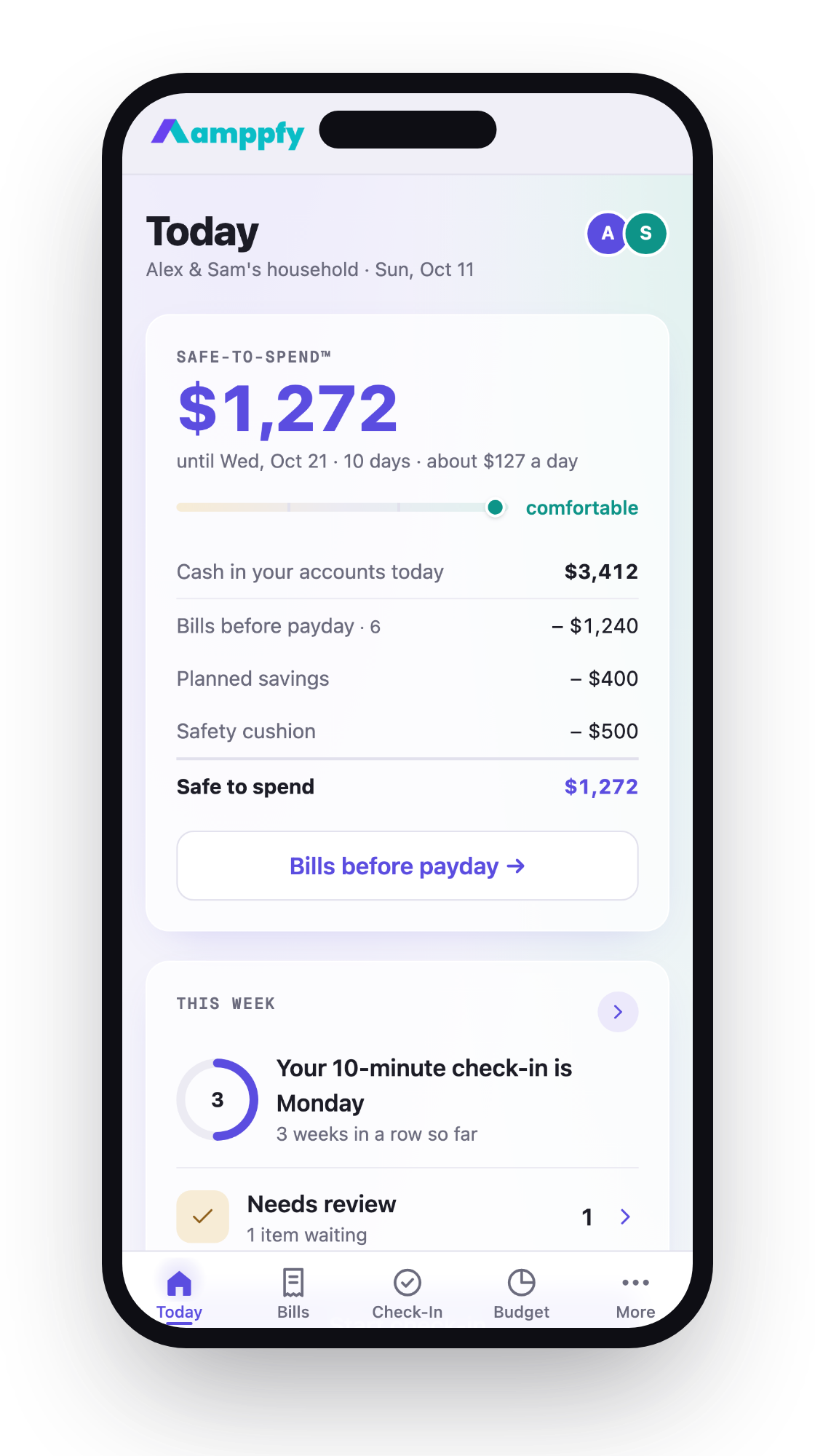


You’ve got money in your account right now. You also have bills landing before your next paycheck. The gap between those two numbers is the only figure that actually matters this week. Roughly 63% of Americans live paycheck to paycheck[1] as of mid-2026, and nearly 74% of workers have at least one major bill due right before their next payday[2]. That means most of us are running the same mental math every few days: what’s safe to spend and what isn’t.
Why Only Bills Due Before Your Next Paycheck Should Count
Most budgeting advice tells you to list every bill for the entire month. That’s fine for planning, but it’s terrible for deciding whether you can grab dinner tonight. Your rent might be $1,948 (the typical U.S. rent in September 2026[3]), but if it’s already paid, it shouldn’t weigh on your spending decisions right now.
The only bills that affect your available cash are the ones hitting between today and your next paycheck. Everything else is future noise.
Here’s why narrowing the window helps:
- It stops phantom scarcity. Seeing a full month of obligations makes your balance look tighter than it is this week.
- It prevents the “four-day squeeze.” The average American feels financially tight about four days before payday, often because they spent money earmarked for a bill that’s actually due next cycle.
- It makes the math doable. One subtraction: cash minus bills due before payday. That’s your Safe-to-Spend™ number: available cash, minus bills due before payday, minus planned savings, minus a safety cushion.
Think of your pay cycle as a container. Only the bills inside that container belong in your calculation. Bills outside it belong in the next container. Mixing them creates confusion and unnecessary stress.
How to List Your Bills by Due Date, Not by Month
A monthly bill list is a reference document. A due-date-ordered list is a decision tool. Here’s how to build one that actually helps.
Step 1: Gather Every Recurring Charge
Pull up your bank and credit card statements from the last 90 days. Write down every recurring charge with its exact due date. Include subscriptions, insurance premiums, loan payments, and utilities. The median monthly utility bill hit $363 in July 2026[4], so don’t overlook those charges.
Step 2: Sort by Calendar Day
Arrange every bill by the day of the month it’s due, not by category. Here’s an example for someone paid on the 1st and the 15th:
| Due Date | Bill | Amount |
|---|---|---|
| 3rd | Car insurance | $187 |
| 5th | Internet | $65 |
| 8th | Electric | $142 |
| 10th | Streaming bundle | $24 |
| 12th | Credit card minimum | $85 |
| 18th | Rent | $1,948 |
| 22nd | Phone | $55 |
| 28th | Student loan | $312 |
Step 3: Draw the Payday Line
If you’re paid on the 15th, draw a line between the 12th and the 18th. Everything above that line belongs to your current pay cycle. Everything below belongs to the next one.
This simple cut is the whole trick. You stop carrying the mental weight of bills that aren’t yours to worry about yet. Your spending decisions get sharper because they’re based on what’s actually leaving your account before more money arrives.
Rolling Bills Forward So the List Never Goes Stale
A static list goes stale within days. The electric bill you paid yesterday shouldn’t sit on your “due” list through the end of the cycle. You need a system that moves paid bills out and upcoming bills in.
The Manual Approach
Check off each bill the day you pay it. At the start of every pay cycle, reset the list. Move any bill you didn’t pay into the new cycle’s list. This takes about two minutes if you do it on payday.
The Automatic Approach
Some tools handle this for you. Amppfy, for example, rolls bills forward on their own after each due date passes. Your Safe-to-Spend number updates without you touching it. The weekly check-in takes about ten minutes: you confirm your balances, mark anything paid, and move on.
Here’s what rolling forward looks like in practice:
- Payday lands on the 1st. Five bills sit between the 1st and the 14th.
- You pay the car insurance on the 3rd. Four bills remain.
- You pay internet on the 5th. Three bills remain.
- Your Safe-to-Spend number climbs after each payment because fewer obligations sit ahead.
- On the 15th, the next cycle’s bills load in automatically.
The key principle: your list should always reflect what’s still owed, not what was owed at the start of the cycle. A stale list is worse than no list because it gives you false information.
What to Do When a Bill and Payday Land on the Same Day
This happens more often than you’d expect, and it creates real confusion. If your paycheck deposits at 6 a.m. and your auto-pay pulls at 8 a.m., you’re fine. But if the order flips, you could face a failed payment and a late fee between $30 and $43[5] on a credit card.
Here’s a simple rule: if a bill and payday share the same calendar date, count that bill in the current cycle, not the next one.
Why? Because you can’t guarantee the deposit will clear before the charge hits. Banks process transactions in batches, and the order varies. Treating same-day bills as “already covered by the incoming paycheck” is a gamble.
Practical steps for same-day conflicts:
- Check your deposit timing. Most direct deposits land between 4 a.m. and 6 a.m. Call your payroll department or check your bank’s posting schedule.
- Check your auto-pay timing. Some billers pull funds at midnight, others mid-morning. Log into each account and note the pattern.
- Build a one-day buffer. If your rent auto-pays on the 1st and you’re paid on the 1st, keep enough from the prior cycle to cover it. Treat it as a bill due before payday, not after.
The worst outcome isn’t the fee itself. It’s the cascading effect: a bounced payment triggers a late charge, which eats into money you planned for another bill, which creates another shortfall. One buffer day prevents the chain reaction.
A Simple Weekly Glance That Keeps It Current
The best system is one you actually use. A ten-minute weekly check keeps your bill list honest and your Safe-to-Spend number accurate.
What to Check Each Week
- Open your bank app. Note your current balance for each account. This takes about 30 seconds per account.
- Compare your balance against your remaining bills for this pay cycle. Subtract them.
- Subtract your planned savings contribution and any cushion you’ve set aside.
- The result is what you can actually spend this week without creating a problem.
A Weekly Snapshot Table
| Item | Amount |
|---|---|
| Checking balance | $2,340 |
| Bills still due this cycle | -$503 |
| Savings goal this cycle | -$150 |
| Safety cushion | -$100 |
| Safe-to-Spend | $1,587 |
That four-line subtraction is the entire system. No categories. No color-coded charts. Just one number you can trust.
If you want this math done for you automatically, Amppfy shows this exact calculation on one screen. It’s free, starts with just your balances, and works for couples who share bills but keep separate accounts. But whether you use an app or a notebook, the weekly glance is what makes the system stick.
Warning Signs Your List Needs Attention
- Your Safe-to-Spend number is negative before mid-cycle. Something’s misaligned.
- You forgot a quarterly bill (insurance, HOA dues). Add it now before it surprises you.
- A biller changed your due date. This happens after rate increases: utility companies filed for $9.4 billion in rate hikes in Q1 2026 alone, and new rates sometimes come with new billing dates.
Frequently Asked Questions
Should I include minimum credit card payments or the full balance in my bill list?
Use the minimum payment as your “bill due” amount. That’s the number that must leave your account to avoid a late fee. If you want to pay more, treat the extra as a choice, not an obligation. This keeps your Safe-to-Spend number realistic rather than artificially tight.
What about bills that vary each month, like electric or water?
Use your highest bill from the last three months as your estimate. You’d rather overestimate and have a few dollars left over than underestimate and come up short. Once the actual bill posts, update the number.
How do I handle biweekly pay with monthly bills?
Split your monthly bills across two pay cycles based on due dates. Bills due on the 1st through the 14th come from your first paycheck. Bills due on the 15th through the 31st come from your second. Some months you’ll have three paychecks: the “extra” check is a great time to fund savings or pay down debt.
What if I share bills with a partner but we have separate accounts?
Assign each shared bill to one person’s pay cycle. Both of you should see the same total obligation so neither assumes the other is covering something. Tools built for couples handle this by showing one shared Safe-to-Spend number while keeping individual balances private.
Keep It Simple, Keep It Weekly
The entire concept fits in one sentence: subtract only the bills due before your next paycheck from your current balance. Everything else can wait. The debt-to-disposable-income ratio sits near 80% for the average household, which means most of your paycheck is spoken for. Knowing exactly which dollars are spoken for this cycle, and which aren’t, is the difference between confidence and guessing.
Pick your tool: a spreadsheet, a notebook, or an app like Amppfy. Spend ten minutes this week building your first due-date-ordered list. Draw the payday line. Do the subtraction. That single number will tell you more than any monthly budget ever did.