Two budgeting apps that households often compare are Simplifi by Quicken and Monarch Money. Both promise to answer the same basic question: how much can you safely spend before your next paycheck? But they approach monthly planning in very different ways. One leans on automation and bank syncing. The other gives you more manual control and collaboration tools. If you’re comparing Simplifi vs Monarch, the details of how each handles your monthly plan, pricing, and household access matter more than star ratings.
The short answer
Simplifi costs less and centers on a quick “left to spend” view for you and up to one other person. Monarch costs more and lets you invite your partner or other household members, each with their own login.
Here’s a quick side-by-side:
| Feature | Simplifi by Quicken | Monarch Money |
|---|---|---|
| Monthly spending view | Spending Plan: what’s left to spend per day for the rest of the month | Custom budget categories |
| Bank syncing | Yes, 14,000+ institutions; built around it | Yes, 13,000+ institutions; built around it |
| Household members | 1 additional person via spaces and sharing | Invite household members at no extra cost (no limit stated on its site) |
| Price (annual) | $3.99/mo first year, then $6.99/mo, billed annually | $99.99/year ($8.33/mo), or $14.99 month to month |
| Free trial | None; 30-day money-back guarantee | 7 days (payment method required) |
| Net worth tracking | Yes | Yes |
| Reports | Pre-built reports and filters | Reports across accounts, categories, and household members |
If you’re a solo budgeter who wants the simplest path, Simplifi gets you there for less money. If you and a partner (or a larger household) want separate logins and more reporting, Monarch’s higher price buys that. And if you’d rather skip bank syncing altogether and just see one Safe-to-Spend™ number based on balances you type in yourself, that’s a different approach entirely, one that apps like Amppfy take.
The monthly spending plan in each
This is where the two apps feel most different in daily use.
Simplifi’s “left to spend” approach
Simplifi builds a Spending Plan automatically. It takes your income, subtracts bills and subscriptions, plus any planned spending and savings goals you add, then shows how much you have left to spend per day for the rest of the month. That number updates as transactions sync from your bank. You don’t build category-by-category budgets unless you want to.
This works well if you don’t want to assign every dollar a job. The downside: it depends entirely on bank sync accuracy. If a transaction categorizes wrong or a pending charge disappears, your “left to spend” number drifts.
Monarch’s category budgets
Monarch takes a more traditional approach. You set budgets for groceries, dining, gas, and whatever else matters to you. Transactions flow in from linked accounts and land in categories. You monitor each one through the month.
The upside is granularity. You can see exactly where money goes and adjust mid-month. The downside is time. Categorizing transactions, splitting them, fixing mismatches: that’s real weekly work. Monarch handles some of it automatically, but you’ll still spend time reviewing.
Which planning style fits you?
If you want a single spending number without fussing over categories, Simplifi’s method is faster. If you want to know you spent $312 on groceries versus $280 on dining out, Monarch gives you that breakdown. Neither is wrong. They just suit different brains.
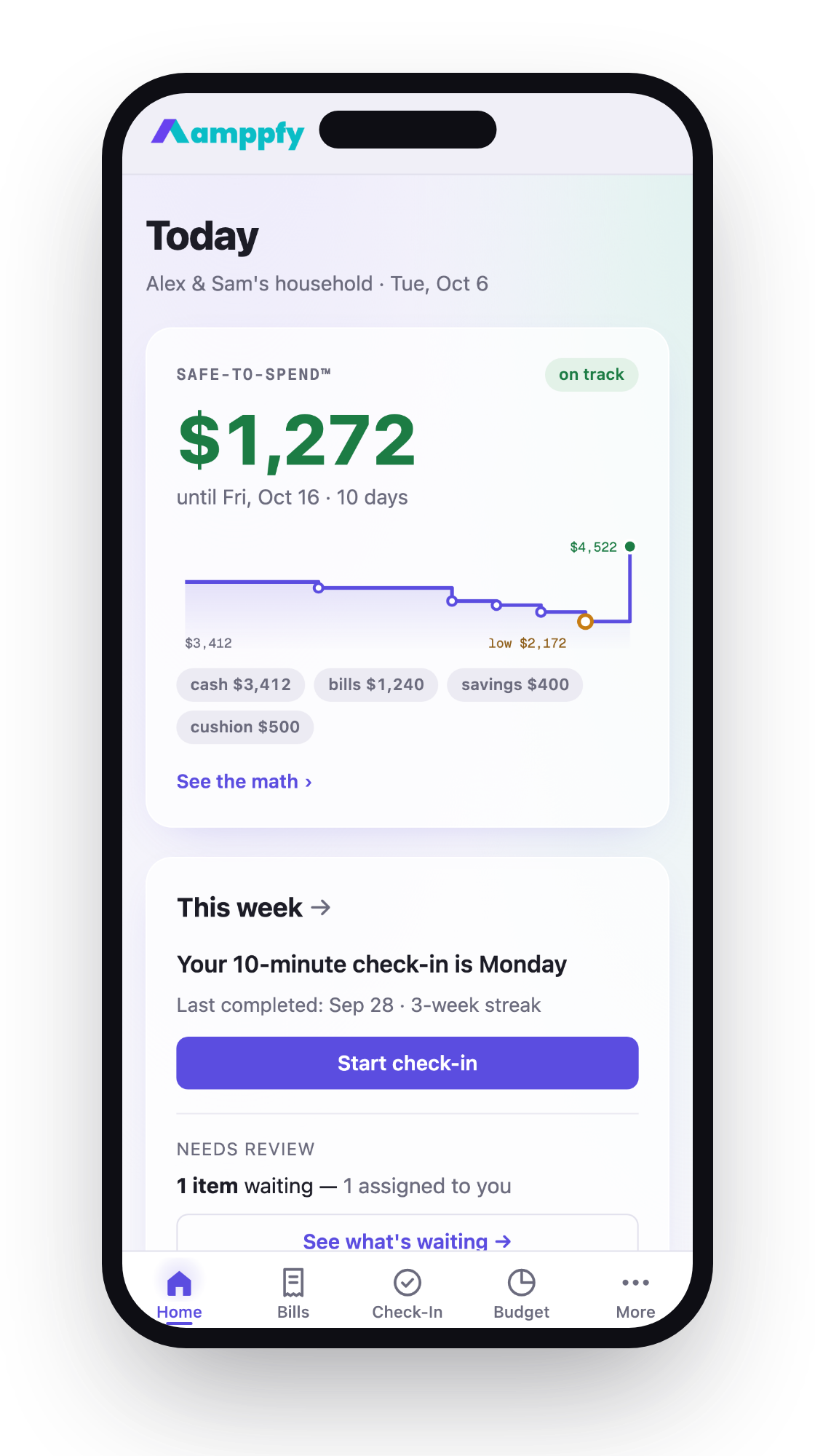
Both apps are built around a working bank sync. If you’ve been burned by broken connections or prefer not to share bank credentials, a manual-balance approach gives you a safe-to-spend number without linking anything. You enter your balances, and the math stays visible: cash minus bills minus savings minus cushion.
Pricing and plans
Price is a real factor when you’re paying monthly or annually for something that’s supposed to help you save money.
As of October 2026, Simplifi costs $3.99 per month for the first year, then $6.99 per month, billed annually (about $47.88 for the first year and $83.88 a year after that). There’s no monthly billing and no free trial: Quicken charges the full amount up front and offers a 30-day money-back guarantee.
As of October 2026, Monarch Money Core costs $99.99 per year or $14.99 per month[1], and Plus costs $199.99 per year. New users get a 7-day free trial with a payment method on file.
| Simplifi | Monarch | |
|---|---|---|
| Annual price | ~$47.88 first year, then ~$83.88/yr | $99.99/yr (Core) |
| Monthly billing | Not offered (billed annually) | $14.99/mo |
| Intro pricing | $3.99/mo for the first year | Code WELCOME: 30% off Core for one year |
| Free trial | None (30-day money-back guarantee) | 7 days |
| Household logins | 1 extra person | Household members at no extra cost |
The math is straightforward. At regular annual rates, Simplifi costs about $16 a year less than Monarch Core, and about $52 less in the first year. Monarch lets you add more than one household member at no extra cost, which can matter if more than two people need access.
Both apps depend on bank sync, which means both are affected by the shifting rules around data sharing. The CFPB finalized its Personal Financial Data Rights Rule in October 2024 and opened a reconsideration of it in August 2025[2]. In the meantime, the reliability of bank connections still varies by institution. If your bank’s sync breaks, neither app can show you accurate numbers until it’s fixed.
Reports and net worth
Both Simplifi and Monarch track net worth and generate spending reports. The depth differs.
Simplifi keeps reporting simple. You get pre-built reports and filters with categorized breakdowns of spending, saving, and income, plus some customization, and a net worth view that updates as account balances sync. It’s enough to spot trends: “We spent more on dining in March than February.”
Monarch puts more weight on reporting. Its Shared Views filters let you switch between personal, partner, and household perspectives across transactions, accounts, net worth, and reports, so you can answer questions like “How much did we spend on kids’ activities in Q1?” Plus adds forecasting and advanced investment analysis.
For couples, both work. In Monarch, each household member gets their own login and the same level of visibility. Simplifi lets you share your account with one other person through its spaces and sharing feature, while Monarch lets you add household members at no extra cost.
If you just want a month-by-month net worth number and basic spending trends, either app covers you. If you want to slice data multiple ways or share access with more than one other person, Monarch offers more of that.
One note on net worth tracking more broadly: any app that knows your account balances can calculate net worth. The question is how much effort it takes to keep those balances current. Synced apps update automatically but break when connections fail. Manual-entry apps like Amppfy stay accurate as long as you update your balances, which takes about 30 seconds per account during a weekly check-in.
Who each one is best for
Choosing between Simplifi and Monarch comes down to three questions: How many people need access? How detailed do you want your reports? And how much are you willing to pay?
- Pick Simplifi if you’re budgeting solo or with one partner, you prefer a simple “what’s left” number over category tracking, and you want the lower price point. It’s the lighter tool. Upkeep stays light as long as bank sync cooperates.
- Pick Monarch if your household has more than two people who need their own logins, you want detailed category budgets and custom reports, and you don’t mind paying more for those features. Monarch is the deeper tool with more flexibility.
- Consider a manual approach if you’ve quit budgeting apps before because of broken bank connections, price hikes, or too much upkeep. You enter your balances yourself and see one number: what’s safe to spend before payday. No sync issues. No subscription surprises.
Neither Simplifi nor Monarch is a bad choice. They’re built for different people with different tolerances for complexity and cost. The worst option is the app you stop using after two months because it felt like homework.
Frequently Asked Questions
Can I use Simplifi or Monarch without linking my bank accounts?
Both apps are designed around bank syncing. Neither describes a fully manual workflow on its site. If you’d rather not share bank credentials, look for an app that starts with balances you type in yourself. That’s a fundamentally different design.
Does Monarch Money work for couples with separate finances?
Partly. Monarch lets you add household members at no extra cost, each with their own login, and its Shared Views let you mark accounts and transactions as mine, theirs, or ours. Members share the same level of visibility, though, so it isn’t a way to keep an account private from your partner. Simplifi allows one additional person, which covers a couple but not a larger household.
Is the price difference between Simplifi and Monarch worth it?
That depends on what you need. The gap, about $16 a year at regular annual rates, buys you more household logins, more reporting, and category budgets in Monarch. If you’re a single person who just wants a spending number, Simplifi’s lower price makes more sense.
What happens if my bank sync breaks in either app?
Your spending data stops updating until the connection is restored. This can take hours or days depending on the issue. Adding transactions by hand as a workaround defeats the purpose of automatic tracking. Sync reliability varies by bank and by the data aggregator each app uses.
Finding the right fit for your household
The Simplifi vs Monarch decision is really about matching the tool to your habits. Simplifi is leaner and cheaper for one or two people. Monarch costs more and is built for households that want detail. Both require working bank connections to deliver on their promises.
If you want to try a different approach, you can see your own Safe-to-Spend™ number before payday without linking a bank account. Get Amppfy free on iPhone or the web: enter your balances, bills, and payday once (about ten minutes), and the number updates every time you do.