You check your bank balance, see a number, and feel fine. Then rent hits, the car insurance auto-pays, and suddenly you’re short. Both PocketGuard and Rocket Money promise to fix that gap between what’s in your account and what’s actually yours to spend. But they solve the problem differently, charge differently, and suit different people. This comparison breaks down the real differences so you can pick the one that fits your paycheck, your habits, and your household.
The Short Answer
PocketGuard and Rocket Money are both built around connecting your bank accounts and showing you where your money goes. The core difference is focus. PocketGuard centers your entire experience around one spendable number. Rocket Money centers yours around bill tracking and subscription management.
If your main frustration is “I don’t know what I can safely spend right now,” PocketGuard is built around that question. If your main frustration is “I’m paying for stuff I forgot I signed up for,” Rocket Money is built around that one.
Here’s a quick side-by-side, with prices as of October 2026:
| Feature | PocketGuard | Rocket Money |
|---|---|---|
| Core focus | One spendable number (Leftover) | Bill and subscription management |
| Bank sync | Yes (manual tracking also possible) | Yes |
| Free tier | No (7-day free trial) | Yes, limited features |
| Paid price | $12.99/mo, $74.99/yr, or $149.99 lifetime | $7-$14/mo (Premium); $15/mo (Premium+) |
| Bill negotiation | “Lower your bills” listed; details not on its site | Yes (success fee, none on Premium+) |
| Debt payoff planner | Yes | Not listed on its site |
| Partner support | Not listed on its site | Account sharing on Premium and Premium+ |
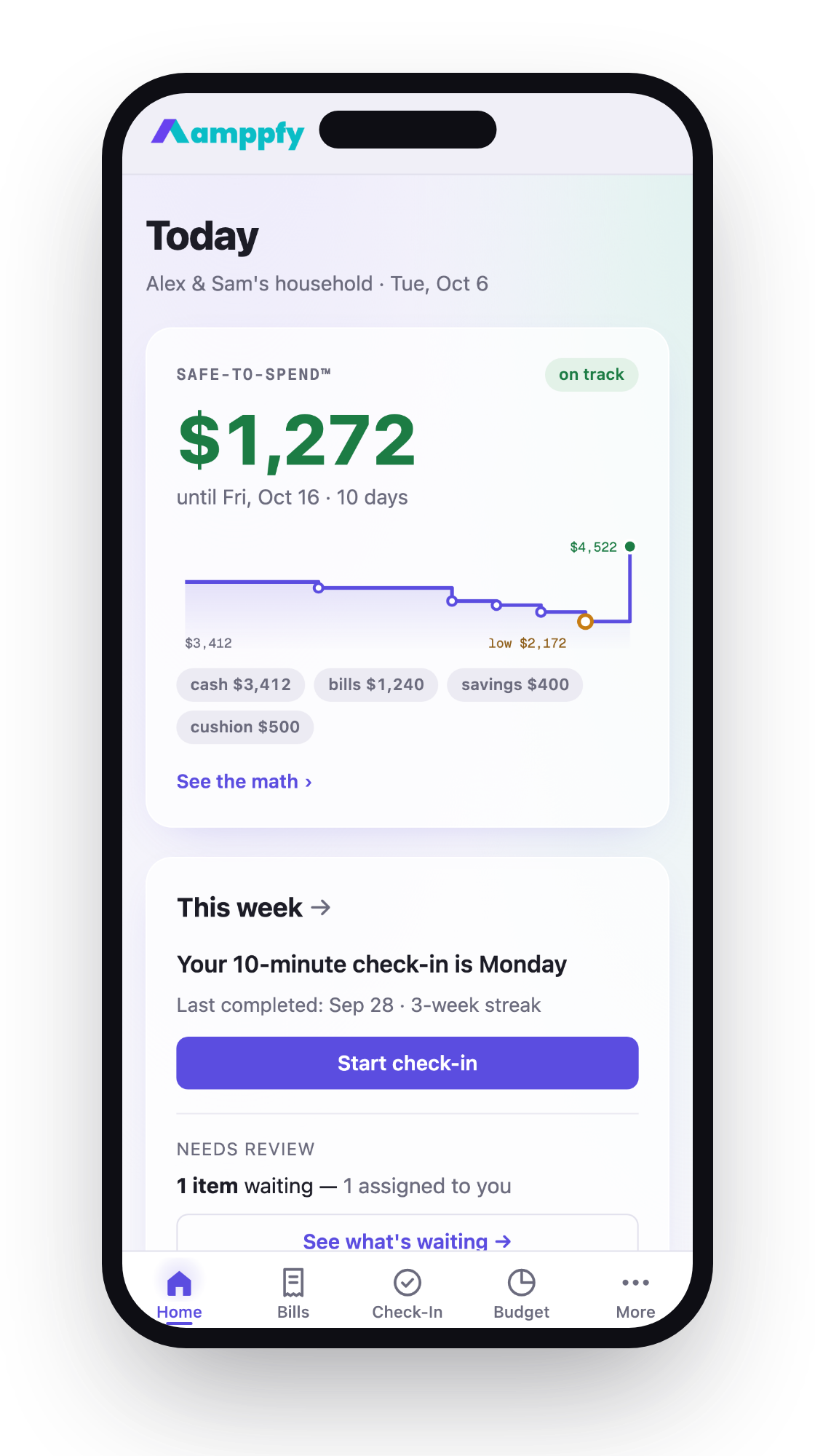
If your household runs on a “yours, mine, ours” system, check how each app handles a partner before you both sign up. Amppfy is one free option built around a shared number: you invite your partner by email, each of you gets your own login, and you both see the same Safe-to-Spend™ number. Shared accounts and bills are visible to both of you; anything you keep private stays private.
The Spendable Number in Each App
This is where the PocketGuard vs. Rocket Money comparison gets interesting. Both apps show you a number, but the math behind each one is different.
PocketGuard’s “Leftover”
PocketGuard’s main number is called “Leftover.” It shows how much money you have left to spend after budgeting for necessities[1]: bills, debt payments, savings, and goals come out first. What’s left is your spendable amount.
That formula updates as transactions flow in through bank sync. If you spend $40 at a restaurant, the number drops by $40. It’s responsive and automatic, which is its biggest strength and its biggest risk: if a transaction miscategorizes or a pending charge disappears temporarily, the number can mislead you.
Rocket Money’s Approach
Rocket Money’s site describes spend tracking and category budgets rather than one leftover number. You can see how much you’ve spent in each category versus your target, but you need to do the mental math yourself to figure out what’s left for the rest of the pay period.
That works fine if you think in categories. It’s less helpful if you just want one answer to “can I buy this right now?”
How the Math Actually Works
A worked example makes the difference clear. Say you bring home $3,400 on the 1st and the 15th.
- PocketGuard might show: $3,400 income – $1,100 bills – $350 savings goal – $200 debt payment = $1,750 Leftover
- Rocket Money might show: $800 left in dining, $200 left in shopping, $150 left in entertainment, and you’d add those up yourself
Amppfy takes a similar single-number approach but adds a safety cushion you choose: $3,400 cash – $1,100 bills – $350 savings – $500 cushion = $1,450 Safe-to-Spend™ (an example). The four-line math prints right under the number so you can see exactly why it is what it is.
Pricing and Plans
Rocket Money has a free tier. PocketGuard doesn’t: it offers a free 7-day trial, then a paid plan.
PocketGuard Plus
PocketGuard has no permanent free tier. New users get a free 7-day trial.
As of October 2026, PocketGuard Plus runs $12.99 per month, $74.99 per year, or $149.99 one time for lifetime access. Plus includes the Leftover number, bill tracking, and a debt payoff planner.
Rocket Money Free vs. Premium
Rocket Money’s free tier covers subscription tracking, upcoming bills, spend tracking, and up to two custom budget categories. Having Rocket Money cancel subscriptions for you requires Premium, and so does web access: the free tier is phone-only.
As of October 2026, Rocket Money Premium is “pay what you think is fair,” from $7 to $14 per month[2]. Premium+ costs $15 per month and adds Rowan, Rocket Money’s AI-powered financial assistant. Bill negotiation carries a success fee of 35% to 60% of the first year’s savings on Free and Premium, and no fee on Premium+.
Cost Comparison Table
| Plan | Monthly Cost | Annual Cost |
|---|---|---|
| PocketGuard Plus (lifetime) | n/a | $149.99 one time |
| PocketGuard Plus | $12.99 | $74.99 |
| Rocket Money Free | $0 | $0 |
| Rocket Money Premium | $7-$14 | $84-$168 (paid monthly) |
| Rocket Money Premium+ | $15 | $180 (paid monthly) |
If you’re comparing PocketGuard against Rocket Money purely on price, PocketGuard Plus is cheaper at the annual rate. Rocket Money’s flexible pricing is appealing at the $7 tier but can climb higher than PocketGuard if you choose the upper end or Premium+.
Bills and Subscriptions
Both apps track bills. Rocket Money does more with them.
Rocket Money’s Subscription Tools
Rocket Money centers on finding forgotten subscriptions. Once you connect your accounts, it finds recurring charges and groups them in one list. Its concierge can negotiate some bills on your behalf, and on Premium it will cancel subscriptions for you. That’s a genuine time-saver if you’ve accumulated streaming services, gym memberships, or annual renewals you forgot about.
The trade-off: on Free and Premium, Rocket Money keeps 35% to 60% of the first year’s savings from a successful negotiation. You’re paying for the convenience, not just the software.
PocketGuard’s Bill Tracking
PocketGuard tracks bills and recurring charges and factors them into your Leftover number. Its pricing page also lists cancelling subscriptions and lowering bills, without describing how that works, so check the details in the app before counting on it.
For some people, that’s enough. If your bills are stable and you know what you’re paying for, you don’t need a negotiation service. You need a tool that subtracts those bills from your cash and tells you what’s left.
What About Couples?
Rocket Money includes account sharing on Premium and Premium+. PocketGuard’s site doesn’t describe a partner feature. If your household has two incomes feeding into shared expenses, check how sharing works in each app before you both sign up.
Who Each One Is Best For
Picking between these two apps comes down to your biggest frustration with money right now.
PocketGuard fits you if:
- You want one number that tells you what’s safe to spend today
- You’re working on debt and want a payoff planner
- You’re comfortable with bank sync and don’t mind the occasional miscategorized transaction
- You’re willing to pay for Plus after the 7-day trial
Rocket Money fits you if:
- You suspect you’re paying for subscriptions you’ve forgotten about
- You want someone to negotiate your cable, internet, or phone bills
- You prefer category-based budgeting over a single spendable number
- You want flexible pricing and are happy at the $7/mo tier
Neither fits perfectly if:
- You want one shared number with a partner without paying for a subscription
- You don’t want to connect your bank accounts to a third-party app
- You’ve quit budgeting apps before because of sync issues or upkeep
For that last group, a manual-entry approach can work. You type in your balances yourself, skip the bank login entirely, and still get a clear answer on what’s safe to spend. That’s the model Amppfy uses, with a weekly check-in of about ten minutes to keep the number honest.
Frequently Asked Questions
Can I use PocketGuard and Rocket Money at the same time?
Yes. Some people use Rocket Money to find and cancel old subscriptions, then switch to PocketGuard for daily spending awareness. There’s no conflict between the two. Just know you’d be paying for two subscriptions if you use both paid tiers.
Does Rocket Money show a “safe to spend” number like PocketGuard?
Not in the same way. Rocket Money’s site describes spend tracking and category budgets. You can piece together a spendable number from those categories, but it doesn’t describe a single leftover figure like PocketGuard’s Leftover.
Does PocketGuard have a free tier?
No. PocketGuard offers a free 7-day trial. After that, Plus costs $12.99 per month, $74.99 per year, or $149.99 for lifetime access.
What happens if bank sync breaks in either app?
Both apps use third-party connections to pull transaction data from your bank. When sync breaks, your spending data goes stale, and your numbers become unreliable until the connection is restored. This can happen with any bank-sync app, not just these two. If sync issues frustrate you, a manual-balance approach removes that dependency entirely.
Choosing the Right Fit for Your Household
The comparison between PocketGuard and Rocket Money really comes down to one question: do you need to know what’s left to spend, or do you need help managing what you’re already paying for? PocketGuard answers the first question. Rocket Money answers the second.
If neither app quite matches how your household works, especially if you share expenses with a partner or prefer not to link bank accounts, it’s worth trying a different approach. Get Amppfy free on iPhone or the web: enter your balances, bills, and payday once, which takes about ten minutes, and your Safe-to-Spend™ number is always there. No sync to break, no subscription to cancel.