

You told yourself the credit card was just a bridge. A couple hundred dollars to cover groceries or gas before Friday’s deposit hits. Then you’d pay it off. But the balance didn’t go away, and now the card is part of your paycheck cycle. Breaking that pattern isn’t about willpower or guilt: it’s about changing the math so your cash actually lasts until payday. That’s what this guide is about: practical steps to stop relying on a credit card to reach your next check.
How the bridge becomes a permanent balance
The pattern usually starts small. You charge $80 for groceries on Wednesday because payday is Friday. You pay it off. No interest, no harm. But then a $200 car repair lands mid-cycle, and the payoff doesn’t happen in full. Next month, you’re carrying $200 and adding another $80 on top. The balance creeps.
Here’s why it sticks: your paycheck arrives, but it now has to cover both current bills and last cycle’s card charges. That leaves less cash for the current cycle, which means you reach for the card again. It’s a loop, not a one-time event.
The average APR on accounts carrying a balance rose to 22.15% in Q2 2026[1]. At that rate, a $500 revolving balance costs you roughly $110 a year in interest alone. That’s money that could cover a bill or two on its own.
The card also hides the real timing problem. Your bills don’t land evenly across the month. Rent, insurance, and a car payment might all hit in the first week after payday, leaving almost nothing for weeks two through four. The card fills that gap, but it does so at a cost you don’t feel until the statement arrives.
Recognizing this loop is the first real step. You’re not bad with money. Your cash flow has a structural gap, and the card has been plugging it.
Finding the real gap: what the card is actually covering
Before you can ditch the card, you need to know exactly what it’s paying for. Pull your last two credit card statements and sort the charges into three buckets:
- Recurring bills you charged because cash was low (utilities, insurance, subscriptions)
- Groceries, gas, and household supplies (the “just getting to payday” charges)
- Unplanned expenses (car repair, medical copay, a kid’s school fee)
This sorting tells you two things. First, it shows the dollar amount of your timing gap: the total you charge between the day your cash runs out and the day your next check lands. Second, it separates predictable charges from surprises. You fix those differently.
| Bucket | Example charges | Typical fix |
|---|---|---|
| Bills charged on credit | Electric, phone, streaming | Shift due dates closer to payday |
| Daily spending on credit | Groceries, gas, coffee | Reduce or pre-fund with cash |
| Unplanned costs | Repairs, medical, fees | Build a small cushion over time |
Most people find that 60-70% of their bridge spending falls in the first two buckets. Those are fixable right now, without earning more money. Call your utility company and ask to move your due date. Most will do it for free. Shift as many bills as possible to land within five days of payday so the money is spoken for before it disappears.
The third bucket, unplanned costs, is what makes people feel like budgets don’t work. You can’t predict a flat tire. But you can set aside a small amount each check to absorb it. We’ll get to that.
The step-down plan: shrink the bridge by one bill per cycle
Going cold turkey rarely works. If you stop using the card tomorrow, you’ll likely overdraft your checking account or miss a bill. A step-down approach is more realistic: each pay cycle, you move one expense off the card and back onto cash.
Pick the easiest charge first
Look at your sorted list from the previous section. Find the smallest recurring charge you’ve been putting on the card. Maybe it’s a $15 streaming service or a $40 phone bill. Move that one charge to your debit card or checking account this cycle. Pay it directly from cash.
Adjust your paycheck math
Here’s the one-line formula that keeps you honest:
$3,200 paycheck – $1,400 bills – $200 savings – $300 cushion = $1,300 for everything else
Each cycle, the “bills” number grows by whatever you moved off the card. The “everything else” number shrinks by the same amount. That’s the trade-off, and it’s a fair one because you’re no longer paying 22% interest on those charges.
Repeat each cycle
Cycle one: move one bill off the card. Cycle two: move another. By cycle four, you’ve reclaimed four charges. Most people can clear the recurring-bill bucket in two months. The daily-spending bucket takes longer because it’s variable, but by then you’ve freed up enough cash flow that the card isn’t necessary for groceries.
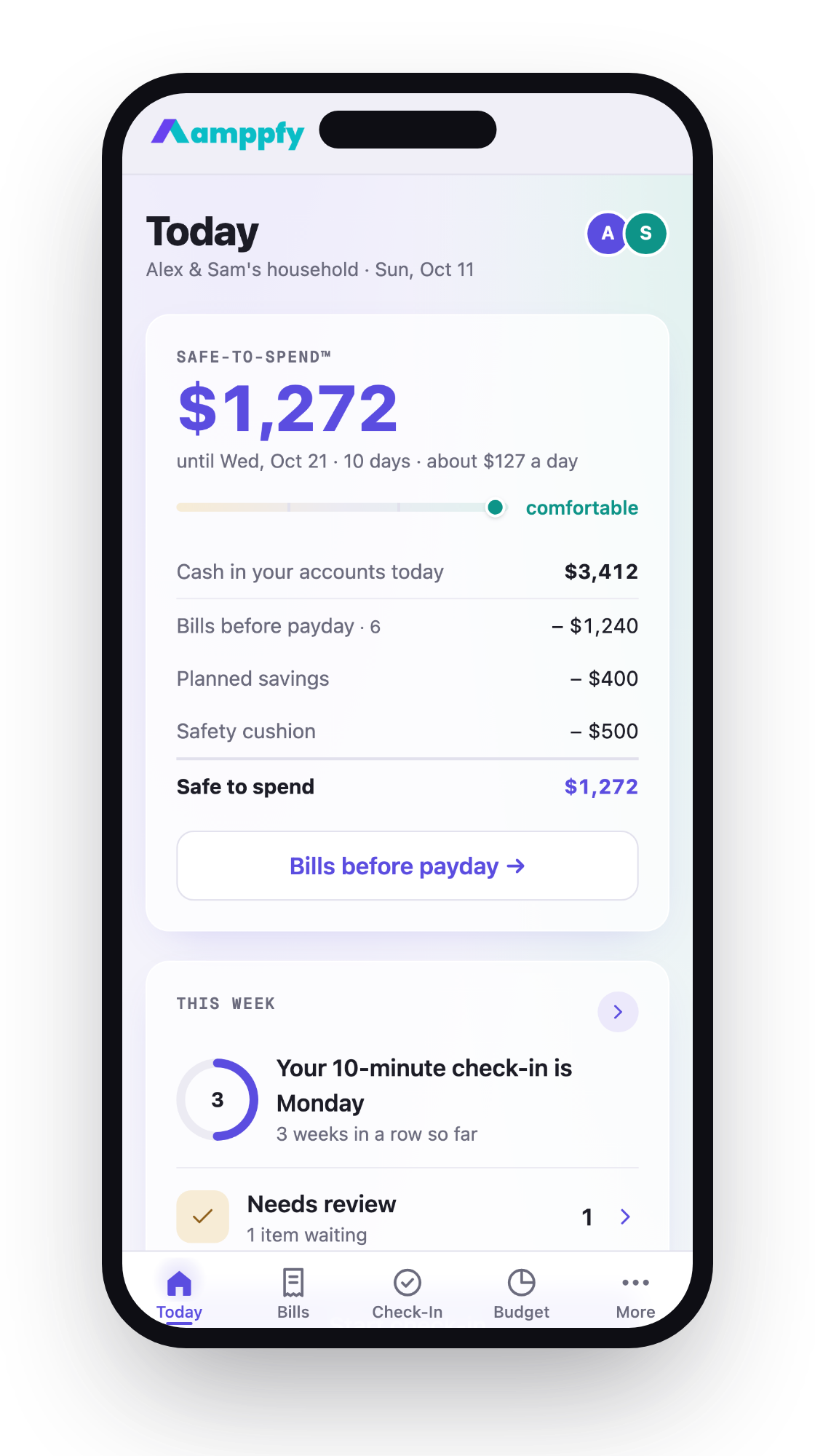
A tool like Amppfy can speed this up. You enter your balances, bills, and paydays, and it shows a single Safe-to-Spend™ number: what’s actually available after bills, savings, and your chosen cushion are subtracted. That number updates as you move charges around, so you can see the effect of each shift in real time.
Keeping a cushion so the card stays in the drawer
The reason most people slide back to the card is a surprise expense with no backup plan. A $300 vet bill or a $150 car registration you forgot about. Without cash reserves, the card is the only option.
You don’t need a massive emergency fund to break the cycle. You need a small buffer: enough to absorb one or two hits without reaching for plastic. Start with a target of $500. That covers most common surprises.
Here’s how to build it without feeling squeezed:
- Set aside $25-$50 per paycheck into a separate savings account
- Treat it as a bill, not optional savings: put it in your bills list with a due date
- Don’t touch it for planned expenses: this is for the stuff you didn’t see coming
As of early 2026, 29% of Americans reported having more credit card debt than emergency savings[2]. That stat isn’t meant to scare you. It means you’re not alone, and even a modest cushion puts you ahead of nearly a third of the country.
Once you hit $500, keep going if you can. A $1,000 cushion handles most non-catastrophic surprises: a broken appliance, an ER copay, a last-minute school expense. The goal isn’t perfection. It’s having enough cash that the credit card isn’t your emergency plan.
If you’re building this cushion as a couple, Amppfy lets both partners see the same Safe-to-Spend number with their own login. You’re both working from the same math without needing a joint spreadsheet or a Sunday budget meeting.
A worked example over four pay periods
Meet Jess. She earns $3,200 every two weeks. Her bills total $1,400 per cycle. She’s been charging about $350 on her credit card between paydays: $40 for her phone, $60 for electric, $100 for gas, and $150 for groceries.
Here’s what her step-down looks like:
| Pay period | Moved off card | Card spending | Cushion balance | Safe-to-Spend |
|---|---|---|---|---|
| Cycle 1 | Phone ($40) | $310 | $25 | $1,335 |
| Cycle 2 | Electric ($60) | $250 | $75 | $1,275 |
| Cycle 3 | Gas ($100) | $150 | $125 | $1,175 |
| Cycle 4 | Groceries ($150) | $0 | $175 | $1,025 |
By cycle four, Jess isn’t using her credit card at all between paydays. Her Safe-to-Spend dropped from $1,335 to $1,025, but that number is real. It’s not inflated by borrowed money she’ll owe later. And she’s got $175 in a cushion that didn’t exist before.
The math each cycle: $3,200 paycheck – $1,400 original bills – $40 to $250 shifted bills – $25 to $50 cushion deposit = Safe-to-Spend.
Jess’s card balance, which had been hovering around $800, starts dropping because she’s no longer adding to it. At 22% APR, she was paying roughly $15/month in interest. That money now goes toward the balance itself.
Two things made this work for Jess. She moved her electric bill’s due date to the day after payday (one phone call). And she started buying groceries the day she got paid instead of waiting until the fridge was empty. Small timing shifts, big results.
Frequently Asked Questions
What if I can’t cover all my bills without the card right now?
That’s exactly why the step-down plan exists. You don’t have to move everything at once. Pick the smallest charge, move it to cash, and leave the rest on the card for now. Each cycle, move one more. Progress matters more than speed, and even shifting $40 off the card breaks the pattern of full reliance.
Should I cut up the card or close the account?
Neither, usually. Closing a card can affect your credit score by changing your utilization ratio. A better approach is to remove the card from your phone’s digital wallet and leave the physical card somewhere inconvenient: a drawer, a lockbox, your car’s glove compartment. The goal is friction, not destruction.
How do I handle irregular expenses like car insurance paid every six months?
Divide the total by the number of paychecks between now and the due date. If your six-month premium is $600 and you get paid biweekly, that’s about $46 per check. Treat it like a bill and set it aside each cycle. When the premium comes due, the cash is already there.
What’s the difference between a cushion and an emergency fund?
A cushion is a small buffer (typically $500-$1,000) meant to absorb routine surprises so you don’t reach for the card. An emergency fund is larger, usually three to six months of expenses, designed for major disruptions like job loss. Build the cushion first. It solves the immediate problem of credit card reliance between paychecks.
Break the cycle one paycheck at a time
The credit card bridge works until it doesn’t. Once the balance starts growing, every paycheck arrives already spoken for, and the cycle feeds itself. The fix isn’t dramatic. Move one bill off the card. Shift a due date. Set aside $25. Do it again next cycle.
You don’t need to earn more money or overhaul your life. You need your cash to outlast your bills, and that’s a timing problem with a timing solution. If you want a tool that shows you exactly what’s safe to spend after every bill, savings goal, and cushion is accounted for, Amppfy is free and takes about ten minutes a week. Start with your next paycheck.