Close Menu

    Subscribe to Updates

    Get the latest creative news from FooBar about art, design and business.

    What's Hot

    Switching From a Linked Budget App to a Manual One

    October 6, 2026

    Budget App Privacy: Questions to Ask Before You Sign Up

    October 6, 2026

    How to Choose a Budget App: Seven Questions Before You Download

    October 6, 2026
    Facebook X (Twitter) Instagram
    Amppfy
    • Safe to Spend™ App
      • Amppfy on iPhone — one clear number with the math under itYour number, in your pocketFree on iPhone, with the same account on the web.
        • Download on the App Store
        • Prefer the web? Sign up free ›
      • The app
        • OverviewOne clear number for what’s safe to spend before payday
        • Safe-to-Spend™The four-line math, always shown
        • Weekly check-inTen minutes a week keeps it honest
      • Features
        • Bills & paydaysEvery bill and payday on one calendar
        • GoalsSavings that fund themselves first
        • For couplesTwo logins, one number you both trust
        • SubscriptionsWhat you pay monthly, and what cancelling gives back
        • Calendar & heads-upsYour month at a glance, a heads-up before bills land
        • Net worth & payday nudgeThe whole picture, month by month
        • BudgetWhere the month’s money goes, month by month
      • Trust & help
        • Security & privacyJust your balances, optional two-step verification
        • Help centerSetup, the number, check-ins, FAQ
        • Open the web appSame account, any browser
    • Personal Finance
      • Money Basics
        • How to Master Money Management
        • Psychology of Money Habits
        • How to Set Financial Goals
        • Money Management for Every Life Stage
        • Beyond Budgeting: Advanced Money Skills
        • Financial Literacy
        • Money Management
        • Know Your Money
        • Cash Flow
      • Financial Wellness
        • Understand Your Money Relationship
        • Build a Healthy Money Mindset
        • 7 Money Tips for Financial Freedom
        • Take the Money Health Quiz
        • Monthly Financial Reviews
        • Money Habits
        • Money Mindset
        • Financial Goals
        • Financial Independence
      • Side Hustles & Extra Income
        • 8 Realistic Side Hustles
        • How to Make Money Online
        • Passive Income Ideas That Work
        • Passive Income 101: Ideas That Scale
        • Spot a Bad Passive Income Deal
        • Start Freelance Writing: First $1,000
        • Budgeting with Irregular Income
        • Side Hustle Ideas
        • Passive Income
        • Gig Economy
      • Major Money Decisions
        • Plan a Major Purchase Without Debt
        • Car Buying: Save, Finance, or Lease?
        • Used Car Buying & Negotiation Tips
        • What to Save For vs. Finance
        • Life Insurance 101: Coverage Needs
        • Term vs. Whole Life Insurance
        • Buying a Car
        • Major Purchase Planning
        • Home Improvement
        • Life Insurance
      • Money Tools & Calculators
        • Net Worth Calculator
        • Cost of Living Calculator
        • Compound Interest Calculator
        • Monthly Budget Calculator
        • Savings Goal Calculator
        • Emergency Fund Calculator
        • Savings Calculator
        • Do Money Management Tools Work?
        • Spend Tracking
        • Net Worth
    • Savings
      • Budgeting Tips
        • The 50/30/20 Rule Explained
        • How to Make a Monthly Budget
        • How to Budget Money in 5 Steps
        • The Envelope Method Explained
        • Best Budgeting Apps Compared
        • Common Budgeting Mistakes
        • Budgeting for Couples
        • Start a Budget
        • Budget Methods
        • 50/30/20 Budgeting
      • Ways to Save
        • Save $500 This Month
        • 14 Ways to Cut Monthly Expenses
        • How to Save Money on Groceries
        • Lower Your Utility Bills
        • Budget Swaps for Big Purchases
        • Save Money on Car Insurance
        • Cut Expenses
        • Groceries Savings
        • Smart Saving Strategies
      • Emergency Fund
        • How Much Emergency Fund to Save
        • How to Build an Emergency Fund
        • Start a Rainy Day Fund
        • Sinking Funds vs. Emergency Fund
        • Emergency Fund Essentials
        • Where to Keep Your Emergency Fund
        • Best Emergency Fund Tips
        • Emergency Savings
        • Emergency Buffer
      • Savings Goals & Plans
        • How to Create a Savings Plan
        • How to Set Savings Goals
        • Track Spending Without Spreadsheets
        • 529 College Savings on a Budget
        • Saving During a Recession
        • Budget a Debt-Free Vacation
        • Vacation Budgeting
        • Family Budgeting
        • Savings Goals
        • Recession Saving
      • Savings Tools & Planning
        • Budget Calculator
        • Savings Goal Calculator
        • Emergency Fund Calculator
        • Savings Calculator
        • Compound Interest Calculator
        • Savings Buckets
        • Sinking Funds
        • Maximize Your Savings
        • Savings Tips
        • Savvy Saver
    • Debt
      • Get Out of Debt
        • Debt Snowball vs. Avalanche
        • Pay Off Credit Card Debt Fast
        • Beginner’s Credit Card Payoff Plan
        • Build a Debt Payoff Calendar
        • Use Windfalls to Crush Debt
        • Debt Free Journey
        • Debt Payoff
        • Credit Card Debt
      • Student & Auto Loans
        • Student Loans 101
        • Get Out of Student Loan Debt
        • Income-Driven Repayment Plans
        • Best Student Loan Repayment Option
        • Auto Loans: Shop & Save on Interest
        • Pay Off Your Auto Loan Early
        • Student Loans
        • Auto Loans
        • Auto Loan Debt
      • Debt Consolidation
        • Debt Consolidation Pros & Cons
        • Is Consolidating Debt Right for You?
        • Balance Transfers to Pay Off Debt
        • HELOC to Pay Off Credit Cards
        • 401(k) Rollover to Pay Down Debt
        • How to Refinance a Personal Loan
        • Before You Take a Personal Loan
        • Personal Loans
        • Personal Loan Refinance
      • Managing Debt
        • Navigating Medical Debt
        • Budgeting with a High-Interest Loan
        • Build a Debt-Repayment Fund
        • Debt Payoff for Single Parents
        • Save for a Wedding Without Debt
        • Medical Debt
        • Single Parent Debt
        • Personal Loan Debt
      • Debt Relief & Protection
        • When Bankruptcy Is an Option
        • Avoid Predatory Lenders & Scams
        • Negotiate with Creditors: Scripts
        • Budgeting Around Wage Garnishment
        • Debt Relief
        • Bankruptcy
        • Creditor Negotiation
        • Predatory Lenders
        • Wage Garnishment
    • Credit
      • Credit Scores
        • Credit Score 101
        • Check & Improve Your Credit Score
        • Credit Utilization: A Simple Fix
        • Check Your Credit Score Free
        • Rebuild Credit After a Setback
        • How Credit Scores Are Calculated
        • What Credit Scores Mean
        • Credit Health
      • Credit Reports
        • Read & Dispute Your Credit Report
        • Dispute Template That Works
        • How Long Negative Marks Last
        • Remove Negative Items
        • What to Expect as Items Age Off
        • Understanding Credit Utilization
        • Credit Basics
        • Checking Your Credit Score
      • Building Credit
        • Best Starter Credit Cards
        • Secured vs. Unsecured Cards
        • Secured Cards & Credit-Builder Loans
        • Build Credit as a Gig Worker
        • Boost Your Score Before a Mortgage
        • Borrow Now vs. Wait
        • Build Credit
        • Credit Cards for Beginners
        • Credit for Gig Workers
      • Credit Cards
        • Best Rewards Credit Cards
        • Credit Card Hacks: Intro APRs
        • Balance Transfers Explained
        • Earn Rewards Without Debt
        • Responsible Card Use & Rewards Tips
        • Lost or Stolen Card: What to Do
        • Credit Card Rewards
        • Balance Transfer Cards
      • Credit Protection & Safety
        • Identity Theft Checklist
        • Truth About Credit Freezes
        • How to Freeze & Thaw Your Credit
        • Credit Monitoring vs. Freezes
        • Credit Protection
        • Credit Freeze
        • Fraud Awareness
        • Financial Safety
    • Investing
      • Start Investing
        • Investing 101: Beginner’s Guide
        • Start Investing with $100
        • Start with $50/Month
        • Scared of the Market? Start Here
        • Open a Brokerage Account
        • Invest While Paying Down Debt
        • How to Start Investing
        • Start with Little Money
        • Fear of Investing
      • Investing Strategy
        • Roth IRA vs. Traditional IRA
        • Dollar-Cost Averaging Explained
        • DCA vs. Lump-Sum Investing
        • 5 Simple Starter Portfolios
        • Asset Allocation Beyond 60/40
        • How to Rebalance Your Portfolio
        • Diversify Your Portfolio
        • Investing Mistakes to Avoid
        • Investment Strategies
        • Diversification
      • Stocks
        • How the Stock Market Works
        • How to Make Money in Stocks
        • How to Read Stock Charts
        • Analyze Stocks in 5 Steps
        • P/E Ratio for Beginners
        • Bullish vs. Bearish Explained
        • How Stock Trading Works
        • Stock Market Basics
        • Stock Analysis
        • Stock Trading Strategies
      • Funds & Wealth Building
        • Beginner’s Guide to Index Funds
        • Best S&P 500 Index Funds
        • Mutual Funds vs. ETFs
        • How to Invest in ETFs
        • Dividend Investing for Beginners
        • Build a Dividend Income Stream
        • Maximize Your 401(k) Match
        • Build a Retirement Portfolio
        • Index Funds
        • Dividend Investing
      • Brokerages & Platforms
        • Vanguard vs. Fidelity
        • Fidelity vs. Schwab
        • Robinhood vs. E*Trade
        • Robo-Advisors vs. Human Advisors
        • Robo-Advisor or DIY Investing?
        • How Brokerage Fees Affect Returns
        • Manage Multiple Brokerage Accounts
        • Brokerages
        • Investment Platforms
        • Robo Advisors
    • Home
      • Home Buying
        • First-Time Homebuyer Checklist
        • How Much Down Payment You Need
        • How Much Home Can You Afford?
        • Renting vs. Buying
        • True Costs of Homeownership
        • Qualify as a First-Time Buyer
        • Buying a Fixer-Upper
        • First-Time Home Buyer
        • Home Affordability
      • Mortgage
        • First-Time Buyer’s Mortgage Guide
        • Fixed vs. Adjustable Mortgage
        • How to Refinance a Mortgage
        • Mortgage Payoff Strategies
        • Winning in a High-Rate Market
        • Mortgage Amortization Calculator
        • Down Payment Assistance Programs
        • Mastering Refinance Rate Locks
        • Mortgage Rates
        • Mortgage Refinance
        • Debt-to-Income Calculator
      • Real Estate Investing
        • Real Estate Crowdfunding Platforms
        • Rental Property Cash Flow
        • REITs for Passive Income
        • REITs vs. Direct Ownership
        • Fix-and-Flip Opportunities
        • Airbnb & Short-Term Rental ROI
        • Buying a Multi-Family Property
        • 1031 Exchange to Defer Taxes
        • Real Estate Investing
        • Rental Property
      • Home Insurance
        • Homeowners Insurance Guide
        • Compare Home Insurance Quotes
        • Best Home Insurance Companies
        • Choose Your Deductible
        • Renters vs. Homeowners Insurance
        • File a Property Insurance Claim
        • Home Insurance Coverage Basics
        • Home Insurance Rates
        • Home Insurance Claims
      • Home Equity & Ownership
        • Smart Ways to Use Home Equity
        • Save for a Down Payment
        • Down Payment Strategies
        • Estimate Property Appreciation
        • Home Equity
        • HELOC Payoff Strategy
        • Home Down Payment
        • Home Ownership
        • Home Renovation
    • Bank
      • Banking Basics
        • Open Your First Bank Account
        • Online Banks vs. Traditional Banks
        • How to Avoid Bank Fees
        • How to Switch Banks
        • Read Your Bank Statement
        • Second-Chance Checking Accounts
        • Get Better Rates from Your Bank
        • Banking Basics
        • How to Choose a Bank
        • Compare Banks
      • Checking Accounts
        • Best Checking Accounts
        • Choose the Right Checking Account
        • Overdraft Protection Guide
        • Stop Paying Overdraft Fees
        • The True Cost of Checking Fees
        • Mobile Check Deposits
        • How Long Checks Take to Clear
        • Checking Accounts
        • Best Checking Account
      • Savings Accounts & CDs
        • High-Yield Savings Explained
        • Best High-Yield Savings Account
        • Savings Accounts vs. CDs
        • What Is a CD?
        • Money Market vs. Savings Account
        • HYSA vs. Treasury Bills
        • How Savings Interest Is Calculated
        • Savings Account Minimum Balances
        • Savings Account
      • Bank Smarter
        • Top Banks for High-APY Savings
        • How Much Cash in Each Account
        • How Many Savings Accounts to Have
        • Managing Multiple Bank Accounts
        • Where to Put Your Money
        • When to Save vs. When to Invest
        • Savings Account Fees to Avoid
        • Banking Tips
        • Digital Banking
      • Banking Safety & Security
        • Set Up Bank Account Alerts
        • Avoid Check Scams
        • Missing Debit Card: Next Steps
        • When to Stop a Check Payment
        • Bank Fees
        • Debit Cards
        • Joint Bank Accounts
        • Banking How-To Guides
    • Sign In
    • Sign Up
    Amppfy
    Home » Budgeting and Saving » Honeydue Alternatives: Money Apps for Couples
    Budgeting and Saving

    Honeydue Alternatives: Money Apps for Couples

    Compare couples' money apps that replace Honeydue's shared dashboard, then switch without losing the history you've built together.
    Thomas T.By Thomas T.October 6, 2026Updated:October 6, 20268 Mins Read
    Facebook Twitter LinkedIn Email Copy Link
    Honeydue Alternatives: Money Apps for Couples
    Share
    Facebook Twitter LinkedIn Email Copy Link

    Couples share groceries, rent, and streaming passwords. Sharing a clear picture of money shouldn’t be harder than any of those. If Honeydue has been your go-to app for managing finances together, you may have noticed gaps: maybe a linked account stopped updating, one of you wanted a web version, or the app just stopped fitting the way you split things. You’re not alone in looking around. This guide walks through alternatives to Honeydue, what each one actually does, and how to move on without losing the data you’ve already built.

    Why People Look for a Honeydue Alternative

    Honeydue earned its following by giving couples a shared dashboard. It shows balances and bills, sends bill reminders to either partner, and lets you react to or ask about a transaction right in the app. But several pain points push people to search for a replacement.

    • Bank connections that drop. Linked accounts can stop updating. You open the app expecting current numbers and find data from last Tuesday.
    • No web app. Honeydue runs on iPhone and Android only. If one of you does the money at a laptop, there’s no browser version to open.
    • Different comfort levels with automation. Some money apps now include AI assistants that can start subscription cancellations or dispute charges for you. Some couples want that. Others would rather keep every decision in their own hands.
    • Couples don’t all merge money. Plenty of couples keep at least some money separate. An app built around one fully shared picture doesn’t match every household.

    The core issue is simple: your money setup changed, and the app didn’t change with it.

    Amppfy app icon

    Amppfy

    Free on iPhone and the web

    Know what’s safe to spend before payday

    Your balances, bills, and payday. Ten minutes to one clear number, with the math shown under it. Learn more ›

    Download on the App Store

    Prefer the web? Sign up free ›

    Free  ·  No credit card  ·  Just your balances

    Amppfy dashboard on an iPhone showing the Safe-to-Spend™ number with the math under it

    What to Look for in a Replacement

    Not every money app works for two people. Before you pick one, run through this short checklist.

    Partner access without extra work

    Both of you need to see the same information. That means shared views, not a screenshot texted at 10 p.m. Look for apps where a partner gets their own invite and sees the same spending picture, without doubling the setup effort.

    Privacy controls

    You may share rent and groceries but keep personal accounts separate. The right app lets you choose what’s visible and what stays private.

    Low weekly upkeep

    If the app demands an hour every Sunday, you’ll quit by March. Keep the weekly upkeep short, or the app becomes a chore, not a tool.

    A clear spending number

    Balances lie. Your checking account says $4,200, but rent is due Friday, your car insurance auto-pays Monday, and you’re saving $300 for a trip. What’s actually safe to spend? The best replacement answers that question in one glance.

    The Alternatives, Compared

    Here’s a side-by-side look at apps worth considering as Honeydue alternatives. Prices and features reflect what each company lists on its own site as of October 2026.

    Feature Honeydue Rocket Money Monarch Money Amppfy
    Price Free (optional monthly tip) Free tier; Premium $7-$14/mo (you choose); Premium+ $15/mo $14.99/mo or $99.99/yr (Core); 7-day trial Free
    Partner access Built for two; you choose what to share Second login on Premium Invite a partner at no extra cost Invite a partner by email
    Bank connections Optional; manual accounts supported Yes, accounts are linked Yes No: you enter balances by hand
    AI assistant Not listed Rowan, on Premium+ Not listed No
    Bills Bill reminders for you or your partner Upcoming bill tracking Recurring bills on a calendar Bills calendar with paydays; heads-ups when a bill is due soon
    Platforms iPhone, Android iOS, Android; web on paid tiers iOS, Android, web iPhone, web

    A few things stand out. Rocket Money’s Premium+ tier includes Rowan, an AI assistant that can answer questions about your spending, get a subscription cancellation started, or dispute a charge. That’s useful if you want it. If the idea of an app acting on your behalf makes you uneasy, that’s a reasonable concern.

    Monarch Money is a full budgeting app with linked accounts, category budgets, recurring-bill tracking, and net worth. You can invite a partner at no extra cost, and it runs on iOS, Android, and the web.

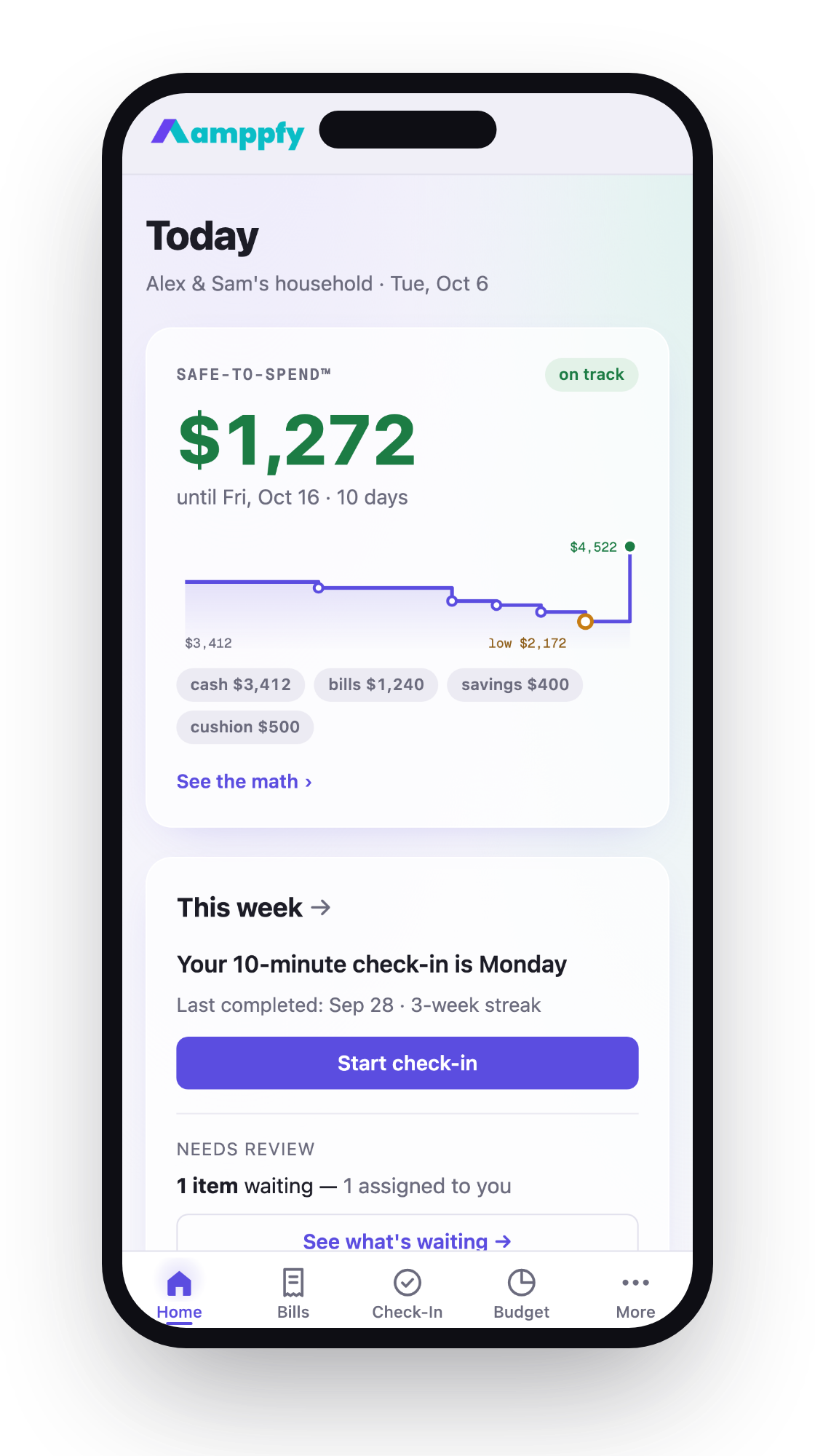
    Amppfy takes a different approach entirely. There’s no bank login. You type in your balances, and the app shows one Safe-to-Spend™ number with the math printed underneath, for example: $3,412 cash − $1,240 bills − $400 savings − $500 cushion = $1,272. It also has a bills calendar with your paydays, savings goals, and a net worth page, and you invite your partner by email. Each of you gets your own login: shared accounts and bills are visible to both, and anything you keep private stays private. Typing in a balance takes about 30 seconds per account, and the weekly check-in takes about ten minutes.

    Which One Fits Which Household

    There’s no single best app for every couple. Your money structure determines the right fit.

    Fully merged finances

    You share one checking account, one savings account, and split nothing. Monarch or Rocket Money Premium gives both of you a login to the same linked accounts. Rocket Money adds bill negotiation (with a success fee unless you’re on Premium+). The trade-off: you’re paying a monthly or yearly fee.

    Hybrid setup (some shared, some separate)

    Many couples land here. You split rent and groceries from a joint account but keep personal spending separate. With Monarch, you can link the joint accounts and invite your partner. With the manual-balance app, you enter only the balances you both want counted, and you both work from the same Safe-to-Spend™ number.

    Fully separate finances

    You Venmo each other for half the electric bill and that’s about it. A lightweight tool works best. A manual-entry app means neither partner needs to share bank credentials, and each of you can see what’s safe to spend before payday.

    One partner manages everything

    Some households have a “money person.” That’s fine. In Monarch or Rocket Money Premium, the manager links the accounts and invites the other partner to look in. Rocket Money’s Premium+ AI features may be more than you need.

    There’s no right amount of merging. Pick the structure that keeps both of you informed and comfortable.

    How to Switch Without Losing Your History

    Moving apps feels risky when you’ve built months of data. Here’s how to do it cleanly.

    1. Save what you can. Check your current app for any export option. Honeydue’s site doesn’t describe an export feature, so screenshot your bill list, recurring charges, and any shared notes.
    2. Photograph your bills calendar. Open your current app’s calendar view and take screenshots of the next three months. This gives you a reference when re-entering due dates in the new app.
    3. List your recurring charges. Write down every subscription and bill with its amount, due date, and which account pays it. This saves you from missing a payment during the switch.
    4. Set up the new app on a non-bill-heavy day. Don’t switch on the 1st of the month when rent, insurance, and five subscriptions all hit. Pick a quiet stretch, mid-cycle, so you can test without pressure.
    5. Run both apps for two weeks. Keep Honeydue open alongside your new pick. Compare what each shows. Once you trust the new app’s numbers, delete the old one.

    If your new app uses manual entry instead of bank sync, you skip the portability question entirely. You’re starting fresh with current balances, and the app builds history from there.

    Frequently Asked Questions

    Can my partner use a different phone platform than me?
    Yes, with most apps. Honeydue, Rocket Money, and Monarch all have iOS and Android apps, and Monarch also runs on the web. Amppfy runs on iPhone and the web, so a partner on Android can use the web app.

    Will I lose my Honeydue data if I switch?
    Possibly. Honeydue’s site doesn’t describe an export tool. Before you delete the app, screenshot your bills, recurring charges, and any transaction notes you want to keep. If you’ve linked bank accounts, your transaction history also lives with your bank.

    Do I need to share my bank login with my partner?
    Not with any of the apps listed here. Rocket Money and Monarch connect to banks with your own credentials and let you add a partner separately. The manual-balance app doesn’t connect to your bank at all: you enter balances yourself. No app on this list requires you to hand your bank password to another person.

    Is it worth paying for a couples money app?
    It depends on what you need. Free options cover the basics: Honeydue for shared tracking and bill reminders, or the manual-balance app for a spending number, bills, goals, and partner access. Paid tiers on Rocket Money add bill negotiation and, on Premium+, an AI assistant. If you’re spending $8 a month but saving $40 through canceled subscriptions, the math works. If you just need to know what’s safe to spend before Friday, free does the job.

    Finding the Right Fit for Your Household

    The best replacement for Honeydue is the one both of you will actually open. That means low setup time, a clear answer to “what can we spend,” and privacy where you want it. Test one app for two weeks before committing. Run it alongside your current setup. Trust the numbers before you let go of the old tool.

    If you want to see your own Safe-to-Spend™ number before your next payday, Amppfy is free on iPhone and the web. Enter your balances, bills, and payday once, then update the balances when they change. Get the app free and try it for two weeks alongside whatever you’re using now.


    Amppfy app icon

    Amppfy

    Free on iPhone and the web

    Know what’s safe to spend before payday

    Your balances, bills, and payday. Ten minutes to one clear number, with the math shown under it. Learn more ›

    Download on the App Store

    Prefer the web? Sign up free ›

    Free  ·  No credit card  ·  Just your balances

    Amppfy dashboard on an iPhone showing the Safe-to-Spend™ number with the math under it
    budgeting tips Budgeting Tools Couples Budgeting Joint Accounts Joint Bank Accounts
    Share. Facebook Twitter LinkedIn Email Copy Link
    Previous ArticleFree YNAB Alternatives That Still Help You Plan Ahead
    Next Article Empower Alternatives for Tracking Net Worth Without Linking Accounts
    Thomas T.

    Thomas is a Personal Finance Writer and Financial Content Strategist with over 10 years of experience helping individuals make smarter financial decisions. He specializes in topics such as budgeting, debt management, saving strategies, and financial behavior, translating complex financial concepts into clear, actionable guidance. His work focuses on empowering readers to build sustainable financial habits and confidently navigate their financial lives, combining data-driven insights with practical, real-world advice.

    More Like This

    Switching From a Linked Budget App to a Manual One

    By Thomas T.October 6, 2026

    Budget App Privacy: Questions to Ask Before You Sign Up

    By Thomas T.October 6, 2026

    How to Choose a Budget App: Seven Questions Before You Download

    By Thomas T.October 6, 2026
    Amppfy app icon

    Amppfy

    Free on iPhone and the web

    Know what’s safe to spend before payday

    Your balances, bills, and payday. Ten minutes to one clear number.

    Download on the App Store

    Prefer the web? Sign up free ›

    Amppfy dashboard on an iPhone showing the Safe to Spend number with the math under it
    Helpful Resources

    Switching From a Linked Budget App to a Manual One

    October 6, 2026

    Budget App Privacy: Questions to Ask Before You Sign Up

    October 6, 2026

    How to Choose a Budget App: Seven Questions Before You Download

    October 6, 2026

    Budget App vs. Spreadsheet: Which Keeps You On Track?

    October 6, 2026

    Financial Clarity. Everyday Confidence.

    Facebook X (Twitter) YouTube LinkedIn
    Calculators

    Emergency Fund Calculator

    Compound Interest Calculator

    Interest Rate Calculator

    Net Worth Calculator

    Mortgage Calculator

    How Much Home Can I Afford

    Debt-to-Income Ratio Calculator

    Cost of Living Calculator

    Savings Calculator

    Savings Goal Calculator

    Monthly Budget Calculator

    Latest Resources

    Switching From a Linked Budget App to a Manual One

    October 6, 2026

    Budget App Privacy: Questions to Ask Before You Sign Up

    October 6, 2026

    How to Choose a Budget App: Seven Questions Before You Download

    October 6, 2026

    Budget App vs. Spreadsheet: Which Keeps You On Track?

    October 6, 2026
    About & Legal

    About Amppfy

    Documentation

    Editorial Policy

    EULA

    Terms of Use

    Acceptable Use Policy

    Privacy Policy

    Cookie Policy

    Disclaimer

    Do Not Sell or Share My Personal Information

    Acceptable Use Policy

    Disclaimer: Amppfy is committed to keeping its information transparent, accurate, and up-to-date. The information on Amppfy is provided for educational and informational purposes only and should NOT be considered financial, investment, tax, or legal advice. You should consult a qualified financial professional before making any financial decisions. This information may differ from what you find on the specific product or service provider’s website. All information, content, software, tools, products, or services on Amppfy are presented without warranty or guarantee. Please review the specific provider’s terms and conditions when evaluating products or services. By accessing Amppfy or using our AI generator tools, you acknowledge that you have read, understood, and agreed to our EULA, Terms of Use, Acceptable Use Policy, Privacy Policy, Cookie Policy, and Disclaimer. Amppfy.com uses cookies. For more information, visit Amppfy’s Cookie Policy. Amppfy may be compensated through third-party advertisers and affiliates. For more information, visit Amppfy’s Disclaimer.

    Copyright© 2026 Amppfy | All Rights Reserved

    Type above and press Enter to search. Press Esc to cancel.

    Advertiser Disclosure: Products may include affiliate links related to financial products or services. We may earn a commission at no additional cost to you. Our content remains independent and focused on helping you make informed financial decisions.
    Fact Checked
    Financial Disclaimer

    This content is for informational and educational purposes only and should not be considered financial advice. Personal finance decisions—including budgeting, saving, investing, credit, mortgages, taxes, and debt management—depend on your individual circumstances. Always consult a qualified financial professional before making financial decisions.

    Editorial Standards and Content Integrity

    Our editorial process ensures accuracy, clarity, and trust across all personal finance topics, including budgeting, saving, investing, and debt management. Content is created using credible sources such as government agencies, academic research, and established financial institutions, and may incorporate insights from industry experts when relevant. Each article is reviewed for accuracy, timeliness, and relevance before publication and updated as needed to reflect changes in financial guidelines and best practices, with the goal of providing clear, evidence-based information to help readers make informed financial decisions.

    Learn more about our editorial policy and guideline.
    Amppfy app icon

    Amppfy

    Free on iPhone and the web

    Know what’s safe to spend before payday

    Download the app and enter your balances, bills, and payday. About ten minutes to one clear number: what’s safe to spend before payday.Your balances, bills, and payday. Ten minutes to one clear number. Learn more ›

    Download on the App Store
    Scan with your iPhone to get the app

    Free  ·  No credit card  ·  Just your balances

    Prefer the web? Sign up free ›

    Amppfy app icon

    Amppfy

    Free on iPhone and the web

    Know what’s safe to spend before payday

    Enter your balances, bills, and payday once. About ten minutes to one clear number, with the math shown under it.

    Download on the App Store
    Scan with your iPhone to get the app

    Prefer the web? Sign up free ›

    Free  ·  No credit card  ·  Just your balances