Every year, the same question comes up around October or November: can we actually afford to fly everyone home? Between airfare, luggage fees, ground transportation, and someone to watch the dog, family travel costs can quietly balloon past what your checking account can absorb in a single pay cycle. The good news is that the math isn’t mysterious. You can break it into pieces, spread those pieces across paychecks, and land at the airport with the money already set aside. This guide walks through booking timing, paycheck-level savings plans, hidden costs, and a full worked example for a family of four so you can build a realistic travel budget well before the holidays arrive.
Booking windows and when costs land
Airline pricing follows patterns, and knowing those patterns gives you a real advantage. A 2024 study by the Bureau of Transportation Statistics found that domestic airfares tend to be lowest when purchased roughly 47 to 60 days before departure. Waiting until two weeks out often means paying 20% to 40% more per seat.
Peak vs. off-peak pricing
Holiday weeks are peak by definition. Thanksgiving week and the December 20-26 window carry the steepest premiums. Flying on the actual holiday (Thanksgiving Day, Christmas Day) or the day after often costs less than flying the Wednesday or Saturday before.
How to use the calendar
- Set a fare alert 90 days before your trip through Google Flights or your preferred airline app.
- Compare midweek departures (Tuesday, Wednesday) against weekend flights.
- Check nearby airports. A 90-minute drive to a secondary hub sometimes saves $100 or more per ticket.
- Book domestic flights about 7 to 8 weeks out for the best balance of availability and price.
Lock in or wait?
Some airlines let you hold a fare for 24 hours at no cost. Others offer fare-lock add-ons for $10 to $20 per ticket. If you’re within your target booking window and the price looks right, lock it. Fares don’t reliably drop as departure approaches during holiday periods. Waiting for a deal that never comes is more expensive than booking a fair price on time.
The key takeaway here: your booking date is a financial decision. Mark it on your calendar the same way you’d mark a bill due date.
Turning the trip into a per-paycheck goal
A $2,400 trip feels heavy as a lump sum. Spread across 12 biweekly paychecks, it’s $200 per pay period. That reframe turns a stressful expense into a predictable line item.
Step-by-step savings plan
- Estimate your total trip cost (airfare, bags, rides, lodging, meals, pet care). Round up by 10% for surprises.
- Count the paychecks between now and your booking date.
- Divide the total by that number. That’s your per-paycheck savings target.
- Move that amount on payday, before you spend anything else.
A quick example
Say your estimated trip cost is $2,600 and you have 13 paychecks before you need to book. $2,600 / 13 = $200 per paycheck. If you get paid biweekly, that’s roughly $100 per week tucked away.
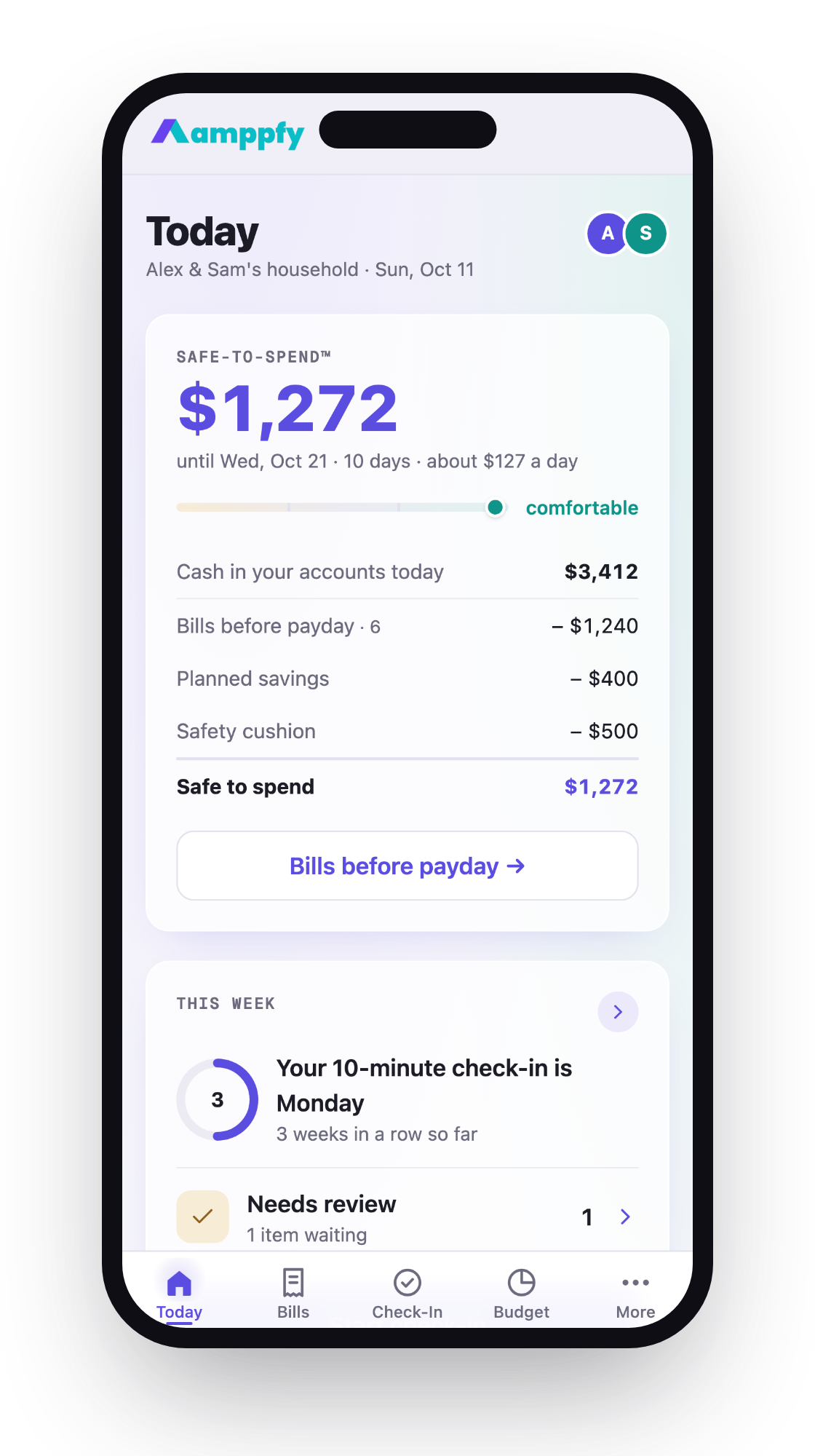
The trick is treating this transfer like a bill, not a wish. If your rent is due, you pay it. Your travel goal works the same way. Amppfy’s savings goals feature lets you assign a dollar amount to a goal and deducts it from your Safe-to-Spend™ number on each payday. You see what’s actually available after the goal is funded, not before.
What if you start late?
Starting six weeks out instead of six months out just means a bigger per-paycheck number. Run the same division. If the result feels too tight, look at the cost side: can you shift to a cheaper departure day, skip a checked bag, or split lodging costs with family at the destination? Adjusting the plan beats skipping it entirely.
Costs beyond the ticket: bags, rides, pet care
Airfare gets all the attention, but the expenses around the flight often add 30% to 50% to your total. Here’s where the real budget for family travel costs tends to hide.
| Expense | Typical Range (Family of 4) | Notes |
|---|---|---|
| Checked bags | $140 – $280 round trip | $35-$70 per bag each way; varies by airline |
| Airport parking | $80 – $200 for 5-7 days | Off-site lots or ride-share can cut this in half |
| Ground transport at destination | $60 – $200 | Rental car vs. ride-share vs. family pickup |
| Pet boarding or pet sitter | $150 – $400 for 5-7 days | Depends on animal size and facility |
| Travel snacks and airport meals | $50 – $120 | Pack snacks; airport food is priced like a theme park |
| Car seat or stroller gate-check | $0 – $25 | Most airlines allow free gate-check, but confirm |
How to shrink these costs
- Pack in carry-ons only. A family of four saving $35 per checked bag each way keeps $280 in pocket.
- Use packing cubes and limit each person to 3-4 outfits. You can do laundry at Grandma’s house.
- Ask a neighbor or friend about pet-sitting swaps instead of boarding.
- Bring refillable water bottles and sandwiches through security (food is allowed; liquids over 3.4 oz are not).
These aren’t glamorous savings. They’re practical ones. And they’re the difference between a trip that fits your budget and one that quietly lands on a credit card.
Paying for travel without a balance afterward
The goal is simple: arrive home from your trip with no new debt from the experience. That means the money should be saved and spent, not charged and carried.
Credit cards aren’t the enemy here. Earning points on a purchase you’ve already saved for is smart. The problem starts when the card becomes the funding source instead of the payment method. According to the Federal Reserve Bank of New York’s Q4 2025 Household Debt report, credit card balances hit $1.21 trillion nationally, with average APRs above 22%. Carrying a $2,500 trip balance at 22% APR and paying $100 per month means you’d pay roughly $300 in interest before it’s gone. That’s a hidden surcharge on your holiday.
A better sequence
- Save the money in a separate holding spot (a savings account, a goal inside your budgeting tool, even an envelope).
- Book and pay with a rewards credit card if you have one.
- Pay the card statement in full from your saved funds before interest accrues.
This way, you collect the points and pay zero interest. The order matters.
What if you’re short?
If your savings goal comes up $300 short by booking time, you have options that don’t involve revolving debt:
- Reduce costs (cheaper flight day, fewer checked bags, ask family to split a meal).
- Delay the booking by one paycheck if fares allow.
- Cover the gap from your Safe-to-Spend balance if it’s genuinely available after bills and cushion.
Amppfy shows your available cash minus bills, savings goals, and your chosen cushion in one number. If the gap fits inside that number without zeroing it out, you’re fine. If it doesn’t, you know before you book, not after.
A worked example for a family of four
Here’s a full scenario. The Garcias are a family of four in Dallas, flying to Chicago for Thanksgiving 2026. Both parents are paid biweekly. They start planning in mid-July, giving them roughly 9 paychecks before their target booking date of September 15.
Estimating total costs
| Item | Estimated Cost |
|---|---|
| 4 round-trip tickets (DFW to ORD) | $1,400 |
| 1 checked bag | $70 |
| Airport parking (6 days, off-site lot) | $90 |
| Ride-share from ORD to grandparents’ house | $55 |
| Pet sitter for the cat (6 days) | $120 |
| Airport meals and snacks | $65 |
| 10% buffer | $180 |
| Total | $1,980 |
The per-paycheck math
$1,980 / 9 paychecks = $220 per paycheck. If both parents contribute equally, that’s $110 each per pay period. Moved on payday, it never sits in the checking account long enough to get spent on something else.
How their Safe-to-Spend looks
On a typical payday, one parent’s numbers might look like this:
$3,412 cash – $1,240 bills – $110 travel goal – $400 other savings – $500 cushion = $1,162 Safe-to-Spend
That $1,162 is what’s genuinely available for groceries, gas, and daily life. The travel money is already spoken for.
Booking day
By September 15, they’ve saved $1,980. They book four tickets at $350 each ($1,400 total) on a rewards card, pay the card immediately from savings, and hold the remaining $580 for bags, parking, pet care, and food. No balance carried. No interest paid. Points earned.
If fares had jumped to $425 per seat ($1,700 total), they’d still be covered, thanks to that 10% buffer. The buffer exists precisely for this scenario.
Frequently Asked Questions
How far in advance should I start saving for holiday flights?
Six months is comfortable. Four months is workable. Even two months helps if you’re willing to save a larger amount per paycheck. The earlier you start, the smaller each contribution needs to be. A $2,000 trip saved over 12 paychecks is about $167 each. The same trip over 4 paychecks is $500 each. Start when you can, and adjust the per-paycheck number to match your timeline.
Should I use a travel credit card to book family flights?
Yes, but only if you already have the cash saved. Use the card as a payment tool to earn points or miles, then pay the full statement balance before interest kicks in. If you don’t have the cash saved, the card becomes a loan at 22%+ APR, which adds hundreds of dollars to your trip cost over time.
What’s the biggest hidden cost of family travel?
Checked baggage fees add up fast for families. Four checked bags round-trip at $35 each way totals $280. Pet care during the trip is another common surprise, ranging from $120 to $400 depending on the animal and duration. Build both into your estimate from the start so they don’t catch you off guard.
How do I budget for family travel if my income varies?
Use your lowest typical paycheck as your baseline. Set a per-paycheck savings amount based on that floor. On months where you earn more, you can add extra to the goal. This approach prevents you from committing to a savings rate you can’t sustain during a slow period.
Start your trip fund this paycheck
Flying home shouldn’t mean coming back to a credit card hangover. The formula is straightforward: estimate the full cost, divide by your remaining paychecks, and move the money on payday before anything else gets a chance at it. Every dollar you save now is a dollar that won’t cost you 22% later.
Open Amppfy and set up a travel savings goal this week. It takes about five minutes. Your Safe-to-Spend number adjusts automatically, so you always know what’s left for daily life after your trip fund is covered. Ten minutes a week keeps the whole picture honest, and you’ll board that plane knowing the money is already handled.