

Payday lands. You open your bank app and see a number. Is that number yours to spend? Not quite. Some of it already belongs to rent, the car payment, and the phone bill that hits next Tuesday.
Most people on a regular pay cycle know this feeling. You check your balance often, maybe daily, and still can’t say how much is actually free between now and the next deposit. The balance is honest about what’s in the account. It’s silent about what’s already spoken for.
That gap is what this guide closes. You’ll take a textbook idea that usually gets measured over a year and shrink it down to a single pay period. The result is a number you can glance at before you buy groceries, say yes to dinner, or order the thing in your cart.
There’s no complicated spreadsheet here. It’s four lines of arithmetic, and you can do it on the back of a receipt. Once you see how the pieces fit, the number stops feeling like a guess and starts feeling like something you can trust.
What Safe-to-Spend™ means
Discretionary income per paycheck is the money left from one deposit after taxes and necessities are covered. Safe-to-Spend™ is that same idea, made current and practical: the amount you can spend today without shorting a bill or a goal before your next payday.
Two textbook terms sit underneath it. They sound alike but mean different things:
- Disposable income: your gross pay minus taxes. It’s roughly your take-home amount.
- Discretionary income: disposable income minus necessary living expenses like housing, utilities, food, and transportation.
The line between them matters: to find your spendable amount, you have to separate disposable income from discretionary income. Your take-home pay is not your fun money. Your fun money is what remains after the essentials.
The trouble with the textbook version is time. It’s usually framed monthly or yearly, which doesn’t match how cash actually moves. Your rent doesn’t care about your annual income. It cares whether the money is there on the 1st.
Safe-to-Spend™ fixes that by working one pay period at a time. It only counts bills due before your next paycheck, because later bills will be covered by later deposits. It also sets aside your planned savings and a small cushion, so the number you see is already protected.
Necessities take a real share. In 2024, housing and transportation made up over half of household spending[1], out of an average of $78,535 a year. That’s why your take-home pay and your spendable amount can feel so far apart.
The four-line math, worked
Here’s the whole formula. Four lines, top to bottom:
| Line | What it is |
|---|---|
| Cash | What’s in your checking and spending accounts right now |
| Bills before payday | Every bill due between today and your next deposit |
| Planned savings | What you’ve committed to move into goals this period |
| Cushion | A buffer you choose for surprises |
Now a worked example. Say it’s the Friday after payday and you’re looking ahead two weeks:
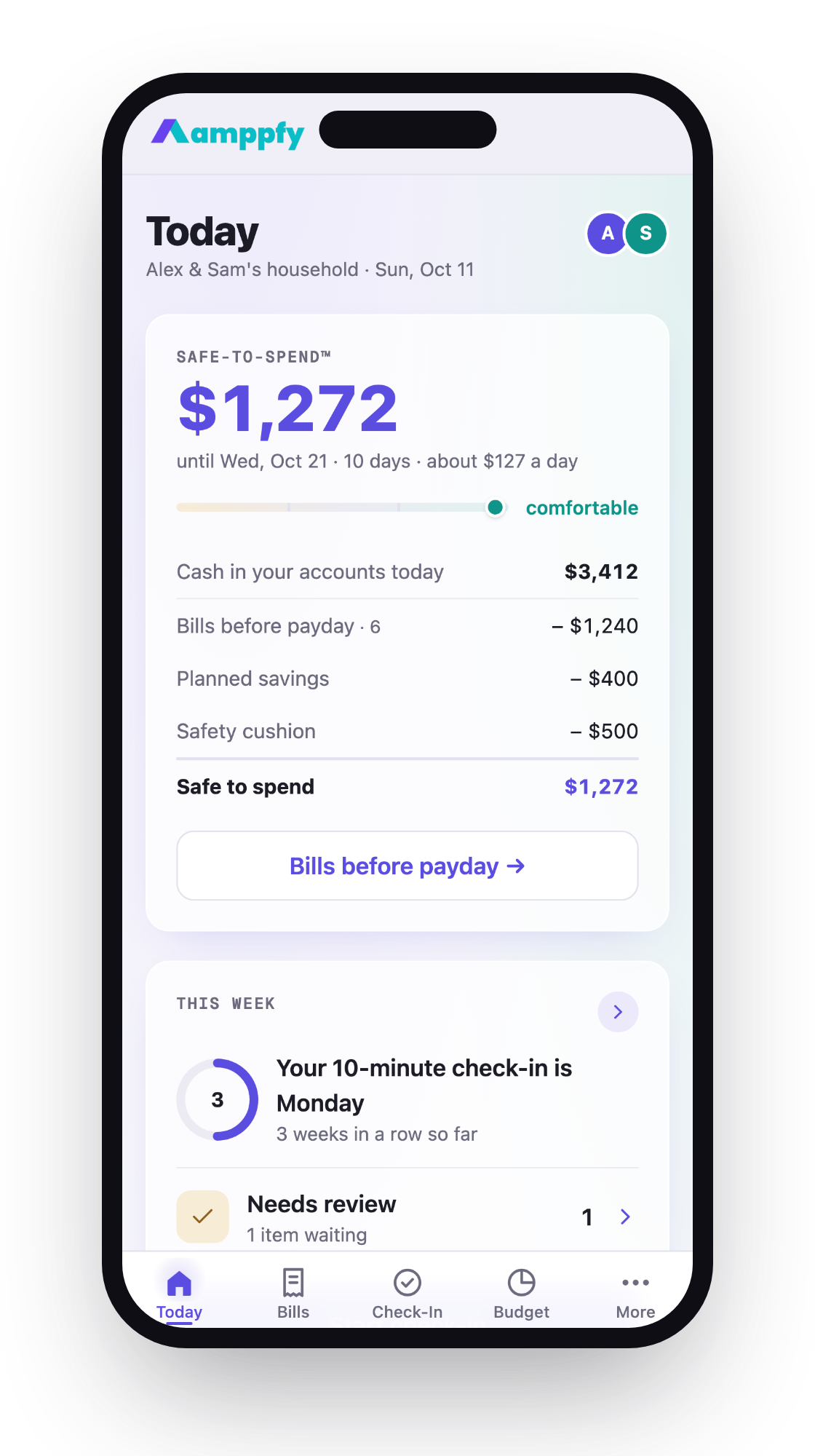
$3,412 cash − $1,240 bills due before payday − $400 planned savings − $500 cushion = $1,272 Safe-to-Spend™.
Walk through it line by line. You start with $3,412 across your checking accounts. Rent isn’t due this cycle, but car insurance, electric, internet, phone, and a credit card minimum are. Those add up to $1,240, so you subtract them first.
Next comes $400 for savings. Maybe that’s $250 toward an emergency fund and $150 toward a summer trip. You treat it like a bill, because it is one: a bill you owe your future self.
Last, the $500 cushion. It covers the pharmacy run or the tire that picks the wrong week. It isn’t spent. It just isn’t counted as spendable.
What’s left is $1,272. That’s your discretionary income per paycheck in its most usable form. It has to cover groceries, gas, takeout, gifts, and anything else until the next deposit. If your next payday is 14 days out, that’s about $90 a day. Divide it, glance at it, and you have a pace.
The math is the comfort. If you can see each line, you can trust the result.
Where the number goes wrong
The formula is simple. The mistakes usually hide in what you put into it. Three spots cause most of the trouble.
Bills that land just after payday
The most common error is counting the wrong bills. Some people subtract every bill for the month and end up with a number that’s too small. Others forget a bill due the day before payday and end up with one that’s too big.
The rule is narrow on purpose: only bills due before your next deposit count. A bill due the day after payday will be paid from that paycheck. If you’re paid every other week, watch the two months a year with a third paycheck, since bill timing shifts. This guide on planning bills around 26 paychecks a year walks through that rhythm.
Watch for one more trap: autopays with a processing delay. If a payment is scheduled before payday but posts after, count it anyway. Treat the due date as the date it leaves.
Savings that only happens if there’s money left
Skipping the savings line feels harmless. It isn’t. Savings that waits for leftovers usually stays at zero.
The Consumer Financial Protection Bureau found that guaranteed rules, like saving a set amount every payday, were linked to roughly 1.5 to 3.5 times the likelihood of reaching savings milestones within a year[2], compared with contingent rules like purchase round-ups. Subtract savings before you see your spendable number, and it happens by default.
A cushion that’s too thin or too thick
A cushion of zero means every surprise becomes a scramble. A cushion of $3,000 means you’ll feel broke while holding cash, and you’ll start ignoring the number. Pick something that covers one ordinary surprise, like a copay or a minor repair. Many people start around $200 to $500 and adjust after a month.
Doing it by hand vs letting an app do it daily
Doing it by hand is fine. The math doesn’t change, and nothing about it requires software. A notes app, a sticky note, or a single spreadsheet tab all work.
Here’s a simple manual routine that takes about ten minutes:
- Write down the balance of each spending account.
- List bills due before your next payday, using due dates from your statements.
- Write your planned savings for this period.
- Write your cushion.
- Subtract lines 2, 3, and 4 from line 1.
- Divide the result by the days until payday for a daily pace.
The catch is that your number goes stale the moment you swipe a card. By Wednesday, the figure you worked out on Friday is wrong. You either redo it, or you stop trusting it and drift back to checking a balance that doesn’t tell the whole story.
An app only repeats the math daily. That’s its whole job. It doesn’t know anything you don’t, and it shouldn’t hide the steps.
| By hand | With an app | |
|---|---|---|
| Math | Same four lines | Same four lines |
| Freshness | When you redo it | Updated as balances and dates change |
| Bill timing | You check due dates | Bills roll forward on their own |
| Couples | Share a note or text | Both see one number |
| Time | About 10 minutes per redo | About 10 minutes per week |
Amppfy is built around this exact calculation. It’s free on iPhone and the web (as of October 2026). You type in balances yourself, with no bank login, and the four-line math is printed under the number so you can check it at a glance. A bills calendar marks your lowest-cash day before payday, and you get a heads-up the day before a bill is due. If you share costs with a partner, they get their own login and see the same number while private accounts stay private.
Whichever route you choose, the habit matters more than the tool. Recheck the number once a week, and it stays honest.
FAQ
Is discretionary income the same as my take-home pay?
No. Take-home pay is closer to disposable income: what’s left after taxes. Discretionary income subtracts necessities on top of that. Your spendable amount per paycheck goes one step further and also sets aside savings and a cushion.
Should I include bills due right after payday?
No. Only count bills due before your next deposit. The bill due two days after payday will be paid from that paycheck. Including it now makes your number too low and can push you to ignore it.
What if my Safe-to-Spend™ comes out negative?
Then bills due before payday plus your savings and cushion exceed your cash. Start by shrinking the cushion or pausing this period’s savings, not skipping a bill. If it’s still negative, call the biller about moving a due date closer to payday. Many will adjust it once you ask.
How often should I recalculate?
Once a week is enough for most people. Pick a fixed time, like Sunday evening or the morning after payday. Update balances, check upcoming bills, and redo the four lines. Ten minutes keeps the number current without turning it into a chore.
Your bank balance tells you what’s there. Your spendable number tells you what’s free. The difference is three lines: bills before payday, planned savings, and a cushion you choose. Get those right and the guesswork fades.
Start small. Take ten minutes this week, write down your four lines, and see what your real number is. You might find you have more room than you thought, or you’ll catch a bill before it catches you. Either way, you’ll know.
If you’d rather have the math redone for you each day, with every line visible, you can see how Safe-to-Spend™ works in Amppfy. Or keep a sticky note. The arithmetic works the same either way.