

You’ve probably seen the 50/30/20 rule everywhere: 50% to needs, 30% to wants, 20% to savings. It’s clean. It’s simple. And if you’re living paycheck to paycheck, it’s almost useless. When rent, groceries, and utilities already eat most of your income, splitting what’s left into tidy percentages feels like advice written for someone else. That doesn’t mean you can’t budget. It means you need a method built around your actual pay cycle, not a pie chart from a personal finance textbook.
Why Percentages Fail When Needs Are 70% of Income
The 50/30/20 rule assumes your essential expenses fit neatly into half your paycheck. For millions of households, that math doesn’t hold. According to the Bureau of Labor Statistics’ 2024 Consumer Expenditure Survey, the average American household spent over 82% of pre-tax income on housing, transportation, food, healthcare, and insurance alone. If you earn $2,800 a month and rent is $1,400, you’ve already hit 50% before a single grocery run.
The rule also treats all months the same. Your car insurance might hit in March. School supplies spike in August. A co-pay lands whenever it wants. Percentages don’t flex for real life. They just sit there, judging.
Here’s the deeper problem: when your needs consume 65-75% of take-home pay, the 50/30/20 split leaves you with impossible choices. You’d need to cut essentials you can’t cut, or you’d label things as “wants” that are actually necessities, like a second pair of work shoes or internet for your kid’s homework. The framework breaks, and you blame yourself instead of the framework.
A budget that works paycheck to paycheck doesn’t start with percentages. It starts with what’s actually due before your next payday. That’s a completely different question, and it leads to a completely different method.
Budget by Paycheck, Not by Month
Monthly budgets assume you have all your money on the first of the month. Most people don’t. If you’re paid biweekly or semi-monthly, your cash arrives in chunks. Bills don’t care about your pay schedule. They land when they land.
Align Bills to Pay Periods
Grab your last two months of bank statements. List every recurring bill with its due date. Now sort them by which paycheck covers each one. Your first paycheck of the month might handle rent, car insurance, and a streaming service. Your second covers the electric bill, phone, and groceries for the back half of the month.
This is cycle-based budgeting. Each paycheck gets its own mini-plan. You’re not asking “can I afford this month?” You’re asking “can I afford this before Friday the 17th?”
Why This Works Better for Tight Budgets
- You see shortfalls before they happen, not after.
- You stop borrowing from next week’s grocery money to cover this week’s electric bill.
- You can move a bill’s due date (most companies let you) to match a lighter pay period.
The shift is small but powerful. Instead of one overwhelming monthly number, you deal with two or three smaller, manageable windows. Each window has its own answer to the question: what’s actually safe to spend right now?
Bills, Savings, Cushion, Then the Rest
Forget categories like “needs” and “wants” for a moment. When money is tight, your paycheck needs a sequence, not a split. Think of it as a waterfall: money flows through each level before anything reaches the bottom.
The Paycheck Waterfall
- Bills due before your next payday. These are non-negotiable. Rent, utilities, minimum debt payments, childcare. Pay these first, mentally or literally.
- Savings, even $10. A small, automatic transfer the day after payday. It doesn’t have to be 20%. It has to be something. Even $10 per paycheck builds $260 a year.
- Cushion. This is the buffer between you and an overdraft. It’s not savings. It’s the amount you refuse to touch so one surprise doesn’t wreck everything. Start with $50 if that’s what you can manage.
- The rest is yours. Groceries, gas, a coffee, a birthday gift. This is your actual spending money, and knowing the real number removes the guessing.
The math looks like this:
| Step | Category | Example Amount |
|---|---|---|
| 1 | Bills due this cycle | $820 |
| 2 | Savings transfer | $25 |
| 3 | Cushion (don’t touch) | $75 |
| 4 | Safe to spend | $130 |
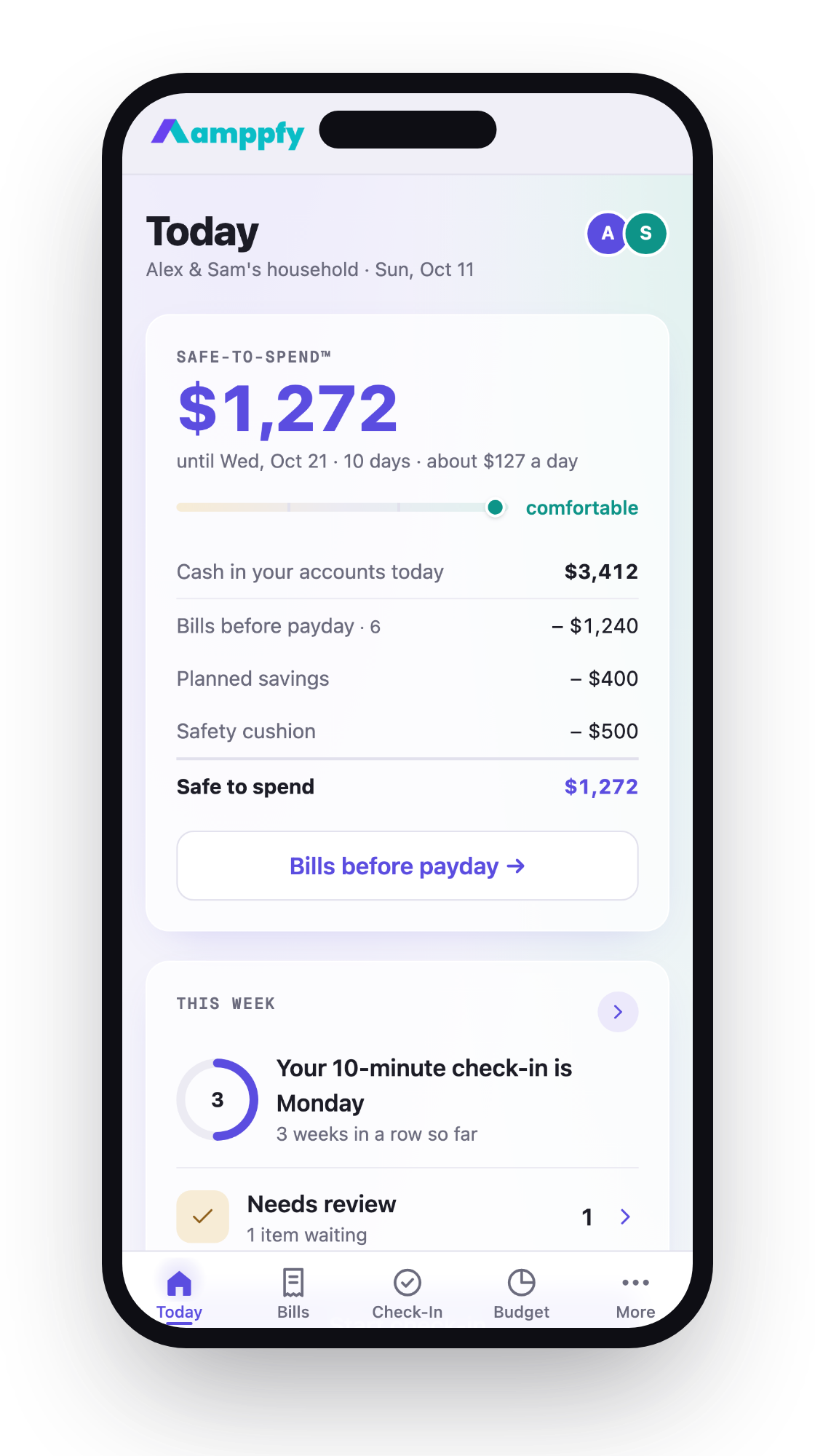
That last line is your Safe-to-Spend™ number. It’s what’s left after everything that matters is covered. Amppfy calculates this automatically each cycle: $1,050 paycheck − $820 bills − $25 savings − $75 cushion = $130. You see the math, not just a vague “you’re doing fine.”
This sequence works whether you earn $1,800 or $5,800. The amounts change. The order doesn’t.
A Worked Example on $2,100 Take-Home
Let’s make this concrete. Say you bring home $2,100 per month, paid on the 1st and the 15th. That’s $1,050 per paycheck.
Paycheck 1 (Lands on the 1st)
| Item | Amount |
|---|---|
| Rent | $750 |
| Renter’s insurance | $15 |
| Savings transfer | $15 |
| Cushion | $50 |
| Safe to spend until the 15th | $220 |
That $220 covers groceries, gas, and incidentals for about two weeks. Tight, but clear. No guessing required.
Paycheck 2 (Lands on the 15th)
| Item | Amount |
|---|---|
| Electric bill | $95 |
| Phone bill | $55 |
| Car insurance | $110 |
| Minimum credit card payment | $35 |
| Savings transfer | $15 |
| Cushion | $50 |
| Safe to spend until the 1st | $690 |
Paycheck 2 is lighter on fixed costs, so more flows to spending. You might use some of that $690 for a haircut, a kid’s field trip, or stocking up on household supplies. The point is you know the number before you spend a dollar.
What This Reveals
The 50/30/20 rule applied to $2,100 would tell you to spend $1,050 on needs, $630 on wants, and $420 on savings. But rent alone is $750, which is 71% of one paycheck. The percentage model immediately falls apart. The cycle-based approach doesn’t pretend your situation fits a formula. It works with the cash you actually have, on the days you actually have it.
If you want this math done for you each pay period, Amppfy runs it in the background. You enter your balances, bills, and paydays once. It shows your Safe-to-Spend number with the four-line breakdown underneath, updated every time you refresh a balance.
Growing Toward the Percentages Over Time
The 50/30/20 rule isn’t wrong. It’s a destination, not a starting point. If your needs eat 70% of income today, the goal isn’t to force yourself into 50% by next month. It’s to nudge that number down over time.
Three Realistic Ways to Shift the Ratio
- Reduce one fixed cost per quarter. Call your car insurance company and ask about a lower rate. Switch phone plans. Refinance if rates drop. One $40 monthly savings shifts your ratio by nearly 2%.
- Increase income by one stream. A side gig, overtime, or a raise negotiation. Even an extra $200 a month moves your needs ratio from 70% to about 64% on a $2,100 base.
- Automate savings increases. Every time a bill drops or income rises, bump your savings transfer by $5 or $10. You won’t feel it. Over 12 months, that’s $60-$120 more per year, compounding quietly.
The Federal Reserve’s 2024 Survey of Household Economics and Decisionmaking found that 37% of adults couldn’t cover a $400 emergency expense with cash. You don’t fix that with a percentage chart. You fix it with $15 transfers that stack up, paycheck after paycheck, until one day you check your emergency fund and it’s $780 and growing.
Track your ratios every few months. Not to grade yourself, but to see the trend. When your needs finally dip below 60%, then 55%, the 50/30/20 framework starts to fit. Until then, use the waterfall.
Frequently Asked Questions
Is the 50/30/20 rule bad advice?
Not inherently. It’s a useful target for people whose essential costs already fit within 50% of income. But for anyone living paycheck to paycheck, it creates guilt without offering a path forward. A cycle-based approach meets you where you are and gives you a real spending number for each pay period. Use the 50/30/20 split as a long-term goal, not a week-one requirement.
How do I budget when my income changes every month?
Use your lowest recent paycheck as the baseline for your waterfall. Bills and cushion stay the same. On months when you earn more, the extra flows into savings or catching up on a goal. This prevents the trap of spending to your best month and scrambling during your worst.
What if I can’t save anything right now?
Start with $5. Seriously. The habit matters more than the amount. A $5 automatic transfer per paycheck builds $130 in a year. That’s not life-changing, but it’s the difference between having something set aside and having nothing. Once a bill gets paid off or income ticks up, increase the transfer.
How do couples handle cycle-based budgeting together?
Each partner maps their own paycheck waterfall. Shared bills get assigned to whichever paycheck they align with best. The key is agreeing on one Safe-to-Spend number that reflects household reality. Amppfy lets both partners see the same number with their own login, so nobody has to text “did you pay the electric bill?” at 11 p.m.
Your Budget Should Match Your Pay Cycle, Not a Textbook
Applying the 50/30/20 rule when you’re living paycheck to paycheck is like wearing shoes two sizes too small and blaming your feet. The framework isn’t built for your situation yet. What works right now is simpler: know what’s due before your next payday, set aside even a tiny savings transfer, keep a cushion you don’t touch, and spend what’s left without guilt.
That’s cycle-based budgeting. It takes about 10 minutes a week to maintain, and it replaces anxiety with a single clear number. If you want to try it without building spreadsheets, download Amppfy for free at amppfy.com/app/ and set up your first paycheck waterfall this week. Your numbers, your pace, no judgment attached.