Most people who’ve tried a budgeting app know the routine: download it, connect your bank, sort a few transactions, then quietly abandon it two weeks later. The problem isn’t willpower. It’s that tracking what already happened doesn’t change what happens next. A spending plan flips the order. You decide where your money goes before you spend it. That single shift turns a backward-looking report into a forward-looking tool. If you’ve ever wondered about the real difference between a spending plan and a budget, the answer is simpler than you think: one reacts, the other leads.
A budget tracks, a plan decides
The words “budget” and “spending plan” get used interchangeably, but they describe two different activities. A budget is a record. It tells you what you spent last month on groceries, gas, and streaming services. A spending plan is a set of decisions. It tells your next paycheck where to go before you touch it.
| Budget | Spending Plan | |
|---|---|---|
| Timing | After money is spent | Before money is spent |
| Primary action | Categorize transactions | Assign dollars to priorities |
| Emotional tone | Judgment on past choices | Clarity about future choices |
| Update trigger | End of month review | Each payday or income event |
| Core question | “Where did it go?” | “Where should it go?” |
Research supports this distinction. Proactively classifying funds before spending, sometimes called “mental budgeting,” improves financial decision-making and reduces stress[1] compared to reactive tracking. The plan comes first because it shapes behavior. The budget comes second, if you need it at all, as a check on whether the plan held up.
Think of it this way: a budget is a security camera. A spending plan is a lock on the door. Both have value, but only one prevents the problem.
When you compare a spending plan vs. a budget, the plan wins on effort too. Sorting 90 transactions into categories takes time. Writing down four numbers: bills, savings, subscriptions, everyday spending, takes minutes.
What goes in a monthly spending plan
A spending plan doesn’t need 47 categories. It needs four groups and honest numbers. Here’s what belongs in each:
Bills
These are fixed, recurring, and non-negotiable. Rent or mortgage, utilities, insurance, car payment, minimum debt payments. List each one with its due date and amount. If a bill varies (like electric), use the higher recent month.
Savings goals
Pick one or two targets. An emergency fund, a vacation, a car repair reserve. Assign a specific dollar amount per pay period. Even $50 counts. The key is that savings gets a line item, not whatever’s left over.
Subscriptions
Streaming, gym, cloud storage, meal kits, app renewals. Pull your last credit card statement and list every recurring charge. You’ll probably find two or three you forgot about. Cancel or keep, but either way, they belong in the plan.
Everyday spending
This is food, gas, coffee, clothes, and everything else. It’s the number that’s left after bills, savings, and subscriptions come out. This is the number you actually live on between paychecks.
Here’s a quick example. Say you bring home $3,412 per paycheck:
$3,412 cash − $1,240 bills − $400 savings − $272 subscriptions = $1,500 for everyday spending
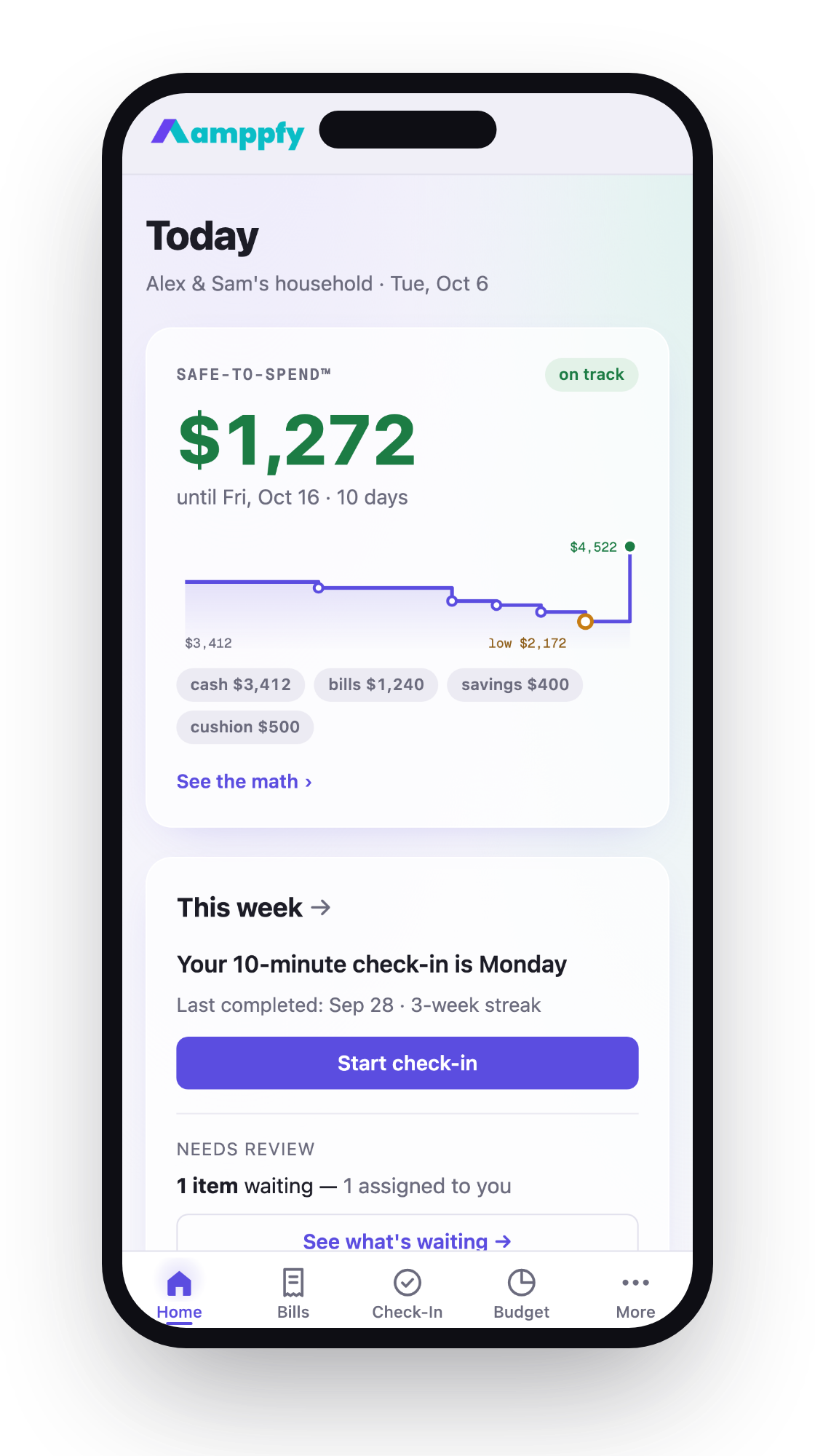
That $1,500 is your real number. Not your bank balance. Not your paycheck. The amount you can spend without missing a bill or raiding your savings. Amppfy calls this your Safe-to-Spend™ number: available cash minus bills due before payday, minus planned savings, minus a safety cushion you choose. The Budget page shows the month in exactly these four slices, plus your savings progress month by month, all read from the plan you already entered.
Why plans survive busy months
Budgets break when life gets messy. A surprise vet bill, a friend’s wedding, back-to-school shopping: these don’t fit neatly into a spreadsheet column. Plans handle chaos better because they’re designed around priorities, not categories.
Here’s why. A budget asks you to sort every purchase into the right bucket. When you’re tired, distracted, or dealing with a sick kid, sorting transactions drops to the bottom of your list. A plan only asks one question: is this purchase inside my everyday spending number, or not?
That binary check takes three seconds. No app to open. No receipt to photograph. Just a glance at one number.
Plans also survive because they reset with every paycheck. A bad week doesn’t ruin the month. You get a fresh start on Friday. Budgets, by contrast, accumulate guilt. You see the red bar on “dining out” grow all month, and by week three you’ve stopped looking.
The Federal Reserve found that only 63% of U.S. households could cover a $400 emergency expense[2] with cash or its equivalent. That stat points to a gap between what people earn and what they have available. A spending plan with a built-in cushion, even $200 or $300, closes that gap one paycheck at a time. It’s not about perfection. It’s about making the cushion part of the plan instead of hoping for leftovers.
Busy months also bring irregular expenses. Car registration. Annual insurance premiums. Holiday gifts in December. A good plan accounts for these by spreading them across the year. If your car registration is $180 in September, you set aside $15 a month starting in October. When September rolls around, the money is already there.
Turning your bills and goals into a plan
Building your first spending plan takes about ten minutes. Here’s the process, step by step:
- Write down your take-home pay per paycheck. Not your salary. The amount that hits your bank account.
- List every bill with its amount and due date. Include minimums on any debt.
- Pick one savings goal and assign a dollar amount per pay period. Start small if you need to. $25 is a real number.
- List your subscriptions. Check your bank and credit card statements for the last 60 days to catch annual renewals.
- Subtract bills, savings, and subscriptions from your take-home pay. The remainder is your everyday spending number.
- Choose a safety cushion: $100, $300, $500, whatever lets you sleep. Subtract that too.
Your final number is what you can spend freely between paychecks without anything going wrong.
If you share finances with a partner
The plan works the same way, just with shared visibility. List the bills you split. Agree on the savings goal. Each person keeps their own everyday spending number. The shared number covers shared obligations.
Amppfy handles this by letting partners see the same Safe-to-Spend™ number while keeping private balances private. No awkward “let me see your account” conversations. You can build a household budget from your plan without merging every dollar.
If your income varies
Use your lowest recent paycheck as the baseline. Build the plan around that number. On months you earn more, the extra goes straight to savings or debt. This keeps the plan honest even when income fluctuates.
Common mistakes to avoid
- Setting savings too high and raiding it by week two. Start with a number you won’t touch.
- Forgetting annual or quarterly bills. Spread them monthly.
- Ignoring subscriptions under $10. Five of those add up to $600 a year.
Checking the plan once a month
A plan isn’t a set-it-and-forget-it document. It needs a monthly check-in, but that check-in should take ten minutes, not an hour.
Here’s what to review:
- Did any bills change? Rent increases, new insurance rates, and adjusted minimum payments all shift the plan.
- Did you hit your savings goal? If yes, keep going or raise it. If no, ask whether the number was realistic.
- Any new subscriptions? Add them. Any you canceled? Remove them.
- Is the cushion still the right size? If you dipped into it twice this month, consider raising it $50.
The monthly review is also when you look at your everyday spending number and ask: did this feel tight, comfortable, or too loose? If it felt tight, check whether a bill or subscription can drop. If it felt too loose, move $50 to savings.
People who actively manage their finances score higher on well-being measures[3] than those who don’t. That’s not because they earn more. It’s because they know their numbers. The monthly check-in is what keeps the numbers honest.
Don’t treat the review as a report card. Treat it as a tune-up. No judgment, just adjustments. The plan is a living document. It changes when your life changes. New job, new baby, new city: update the four numbers and move on.
Frequently Asked Questions
Is a spending plan the same as a zero-based budget?
Not quite. A zero-based budget assigns every dollar to a category until you reach zero. A spending plan groups money into four broad buckets: bills, savings, subscriptions, and everyday spending. You don’t need to categorize every coffee or gas fill-up. The everyday spending number is your freedom within a structure.
How often should I update my spending plan?
Review it once a month and adjust whenever something changes: a new bill, a raise, a canceled subscription. The monthly check-in takes about ten minutes. Between reviews, you only need to glance at your everyday spending number to stay on track.
What if my partner and I have different spending habits?
That’s normal. The plan covers shared obligations: rent, utilities, joint savings. Each person keeps their own everyday spending number. You agree on the shared pieces and respect the individual ones. The conversation is about the plan, not about who bought what.
Can a spending plan work if I have irregular income?
Yes. Use your lowest recent paycheck as the baseline for your plan. Build bills, savings, and subscriptions around that floor. When a higher paycheck arrives, send the difference to savings or debt. This way you never plan on money that might not show up.
Your plan starts with four numbers
The difference between a spending plan and a budget comes down to timing. A budget looks backward. A plan looks forward. You don’t need 30 categories or a Sunday afternoon with spreadsheets. You need four numbers: bills, savings, subscriptions, and everyday spending.
Write them down. Subtract them from your paycheck. The number that’s left is yours to spend without worry. Check it once a month. Adjust when life changes. That’s the whole system.
If you want to see your own Safe-to-Spend™ number before your next payday, Amppfy is free on iPhone and the web. Enter your balances, bills, and payday once, about ten minutes, and the number stays current. Get Amppfy free and start with the plan, not the tracker.