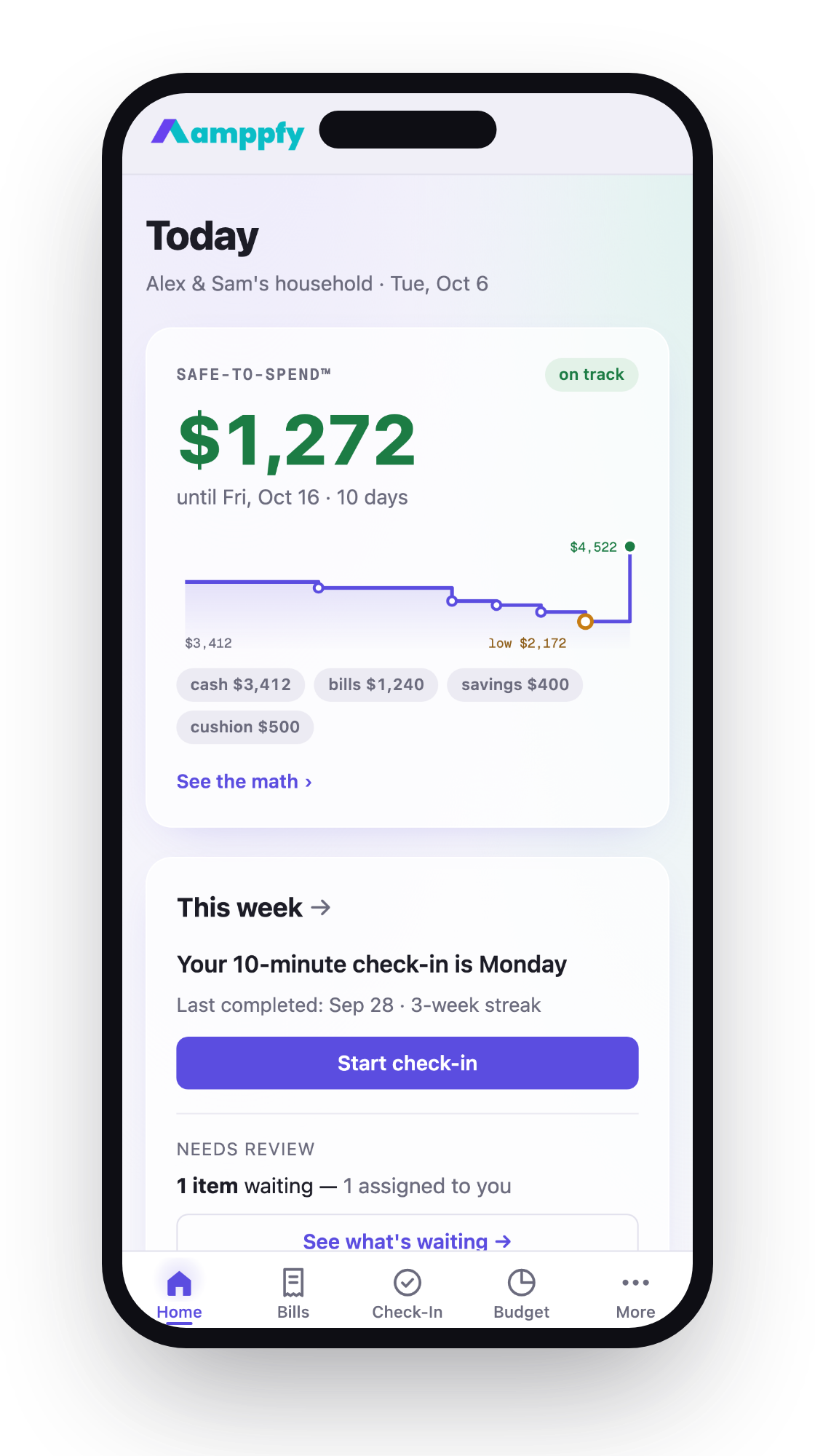
Most people know their rent or mortgage. They know their car payment. But ask what’s left after those bills and savings, and you get a shrug. That leftover slice is your everyday spending budget: the money you actually live on between paychecks. It’s the coffee, the dog food, the Target run that was supposed to be “just paper towels.” Understanding this number, and keeping it visible, is the difference between feeling broke on a decent salary and feeling calm with the same paycheck.
Everyday spending defined
Everyday spending is the money left after three things leave your account: bills, savings, and whatever cushion you keep for surprises. It covers groceries, gas, dining out, household supplies, haircuts, kids’ activities, and every other purchase that isn’t a recurring obligation or a goal contribution.
Here’s a quick way to see the four slices of a monthly budget:
| Slice | What it covers | Example |
|---|---|---|
| Bills | Rent, utilities, insurance, minimums on debt | $2,400 |
| Savings | Emergency fund, vacation, retirement top-up | $400 |
| Subscriptions | Streaming, gym, apps, meal kits | $180 |
| Everyday spending | Groceries, gas, dining, personal care, fun | $1,420 |
The math is simple subtraction. Take your paycheck total for the month, remove bills, savings, and subscriptions, and whatever remains is your everyday spending number. That number isn’t a guess. It’s a fact about your money right now.
A lot of people confuse everyday spending with “discretionary” spending. The two overlap, but they aren’t identical. Groceries aren’t optional. Gas to get to work isn’t optional. Yet both live in this slice because they aren’t fixed monthly bills. The label matters less than the visibility. If you can see the number, you can make choices inside it.
Amppfy’s Budget page breaks your month into exactly these four slices: Bills, Savings, Subscriptions, and Everyday spending, pulled from the plan you already entered. No extra setup required.
Why it changes from month to month
Your rent stays the same. Your everyday spending does not. Three forces push it around every single month.
First, pay timing. Months with three paydays feel different from months with two. A biweekly paycheck lands on different calendar days, which shifts how many bills fall between each deposit. That alone can swing your everyday spending number by hundreds of dollars.
Second, irregular bills. Car insurance every six months. Annual subscriptions. A property tax installment. These aren’t surprises, but they eat into the same pool of cash and shrink what’s available for daily life.
Third, price changes. Grocery prices rose noticeably through 2025 and into 2026. A carton of eggs or a pound of ground beef costs more this spring than it did last spring. You didn’t change your habits, but your everyday number got smaller anyway.
Financial planners have noted that the traditional 50/30/20 rule is failing in high-cost-of-living areas[1], where housing alone can eat 40% or more of take-home pay. When housing takes a bigger bite, everyday spending absorbs the squeeze.
The fix isn’t to panic. It’s to recalculate the number each pay cycle instead of assuming last month’s number still applies. A quick balance update, about 30 seconds per account, keeps the picture honest.
Groceries, gas, and the rest of real life
Everyday spending sounds abstract until you list what’s actually in it. Here’s what most households between 25 and 45 are buying with this slice:
- Groceries and household supplies (paper goods, cleaning products, toiletries)
- Gas or transit costs for commuting
- Coffee shops and dining out
- Kids’ school lunches, activity fees, and last-minute costume requests
- Pet food and vet co-pays
- Haircuts, personal care, clothing basics
- Small home repairs: a new shower curtain rod, light bulbs, a drain snake
None of these feel like luxuries. Most of them feel like obligations. And that’s exactly the tension. Roughly 25 million Americans now experience what was once discretionary spending hardening into perceived fixed costs[2], leaving zero flexibility in their budget.
The practical move is to separate the non-negotiables from the genuinely flexible items inside this slice. Groceries are non-negotiable. A $7 oat milk latte three times a week is flexible. You don’t need to cut the latte. You need to know whether the latte fits inside the number you actually have.
A worked example helps. Say your household brings home $4,400 between two paychecks this month.
$4,400 cash – $2,400 bills – $400 savings – $180 subscriptions = $1,420 everyday spending
That’s about $47 a day. Groceries for a family of three might run $160 a week. Gas might be $55 a week. That’s $215 a week on non-negotiables, leaving roughly $140 a week for everything else. Seeing it broken down like that turns a vague anxiety into a clear set of choices.
Everyday spending vs. what is safe to spend today
Your everyday spending budget for the month and what’s safe to spend today are related but different numbers. The monthly number is a planning figure. The daily number is a real-time answer.
Here’s why the distinction matters: you might have $1,420 in everyday spending for the month, but if you’re nine days from payday and a $380 car insurance payment hits in four days, your safe-to-spend figure is much lower than $1,420 divided by 30.
The Safe-to-Spend™ calculation
Amppfy shows one number called Safe-to-Spend™. The math runs like this:
$3,412 cash – $1,240 bills due before payday – $400 savings – $500 cushion = $1,272
That $1,272 is what you can spend right now without missing a bill, skipping a savings goal, or draining your cushion. The four-line math is always visible underneath so you can see exactly why the number is what it is.
Why “leftover” thinking backfires
A lot of people look at their bank balance, subtract rent, and assume the rest is spendable. That ignores the electric bill due in eight days, the auto-pay gym charge, and the $200 they promised themselves they’d save. The result: they spend freely for a week, then scramble for the last ten days before payday.
Even retirees struggle with this. The problem isn’t the spending. It’s the lack of a clear number that says “this is genuinely yours to use.”
The shift from “what’s in my account” to “what’s safe to spend before my next paycheck” is the single most useful reframe you can make. It turns checking your bank app from a source of stress into a source of answers.
Making the slice bigger without earning more
You can grow your everyday spending number without a raise. The moves aren’t dramatic, but they compound over a few months.
Cut the ghost charges first
Start with subscriptions. Pull up your bank statement and look for recurring charges you forgot about. A $14.99 streaming service nobody watches. A $9.99 app trial that converted. A meal kit you paused but never canceled. Killing two or three of these frees up $30 to $50 a month, and that money slides straight into your everyday spending slice.
Renegotiate the bills slice
Call your car insurance company and ask for a rate review. Switch your phone plan to a lower tier if you’re not using your data cap. Refinance only if the math clearly works, but even small bill reductions shift dollars into the everyday column.
Here’s a before-and-after example:
| Category | Before | After |
|---|---|---|
| Bills | $2,400 | $2,310 |
| Subscriptions | $180 | $135 |
| Savings | $400 | $400 |
| Everyday spending | $1,420 | $1,555 |
That’s $135 more per month for daily life. You didn’t earn more. You just moved money from slices you weren’t fully using.
Protect savings, don’t raid them
The temptation is to cut savings to make everyday spending feel roomier. Resist it. A better approach is to set your savings amount, build it into the plan, and treat the everyday number as what’s left. If the everyday number feels too tight, work the bills and subscriptions first. Savings is the last knob to turn, not the first.
Building a household budget from the plan you already have means you only set these numbers once. After that, a ten-minute weekly check-in keeps everything current.
Frequently Asked Questions
Is everyday spending the same as discretionary spending?
Not exactly. Discretionary spending usually means wants: dining out, entertainment, new clothes. Everyday spending includes needs that aren’t fixed bills, like groceries and gas. The overlap is real, but everyday spending is a broader, more honest category. It’s everything you buy that isn’t a recurring bill, a subscription, or a savings contribution.
How much should I budget for everyday spending each month?
There’s no universal number. It depends on your income, your bills, and your savings goals. The useful approach is subtraction: take your income, remove bills, savings, and subscriptions, and whatever’s left is your everyday number. For a household earning $4,400 a month after taxes, that number might land between $1,200 and $1,600 depending on housing costs.
What if my everyday spending number is basically zero?
That means your bills, subscriptions, and savings goals are consuming your entire paycheck. The first step is to audit subscriptions for charges you can cancel. The second is to review bills for any that can be reduced. If the number is still near zero after that, your savings target may need a temporary reduction until income changes. A tight number isn’t a failure. It’s information you can act on.
How often should I recalculate my everyday spending budget?
Every pay cycle. Your bank balance changes, bills land on different days, and prices shift. A monthly number calculated on the first of the month is stale by the fifteenth. Recalculating each payday, or doing a quick weekly check-in, keeps the number accurate and useful.
Your everyday spending number is waiting
Everyday spending is the slice of your money that actually feels like your life. It’s where your choices live. Knowing the number, recalculating it each pay cycle, and protecting it from ghost subscriptions and bill creep gives you something no percentage rule can: a clear answer to “can I afford this right now?”
If you want that answer on your phone every day, get Amppfy free. Enter your balances, bills, and payday once, about ten minutes, and your Safe-to-Spend™ number stays current between paychecks. No bank login required, just your numbers and a few seconds each week.