The holidays don’t care about your pay schedule. Your kids don’t either. They just want to feel remembered, and you want to give them that without wrecking January. Finding the right Christmas gifts for kids on a budget isn’t about cutting corners. It’s about planning early enough that your money stretches further than you thought it could. This piece walks through a system: pick a number, pick a framework, spread the spending across checks, and protect your rent money the whole time.
Deciding a Per-Child Amount
Start with one honest question: what can you actually afford? Not what you spent last year. Not what your coworker spent. Your number, based on your cash flow.
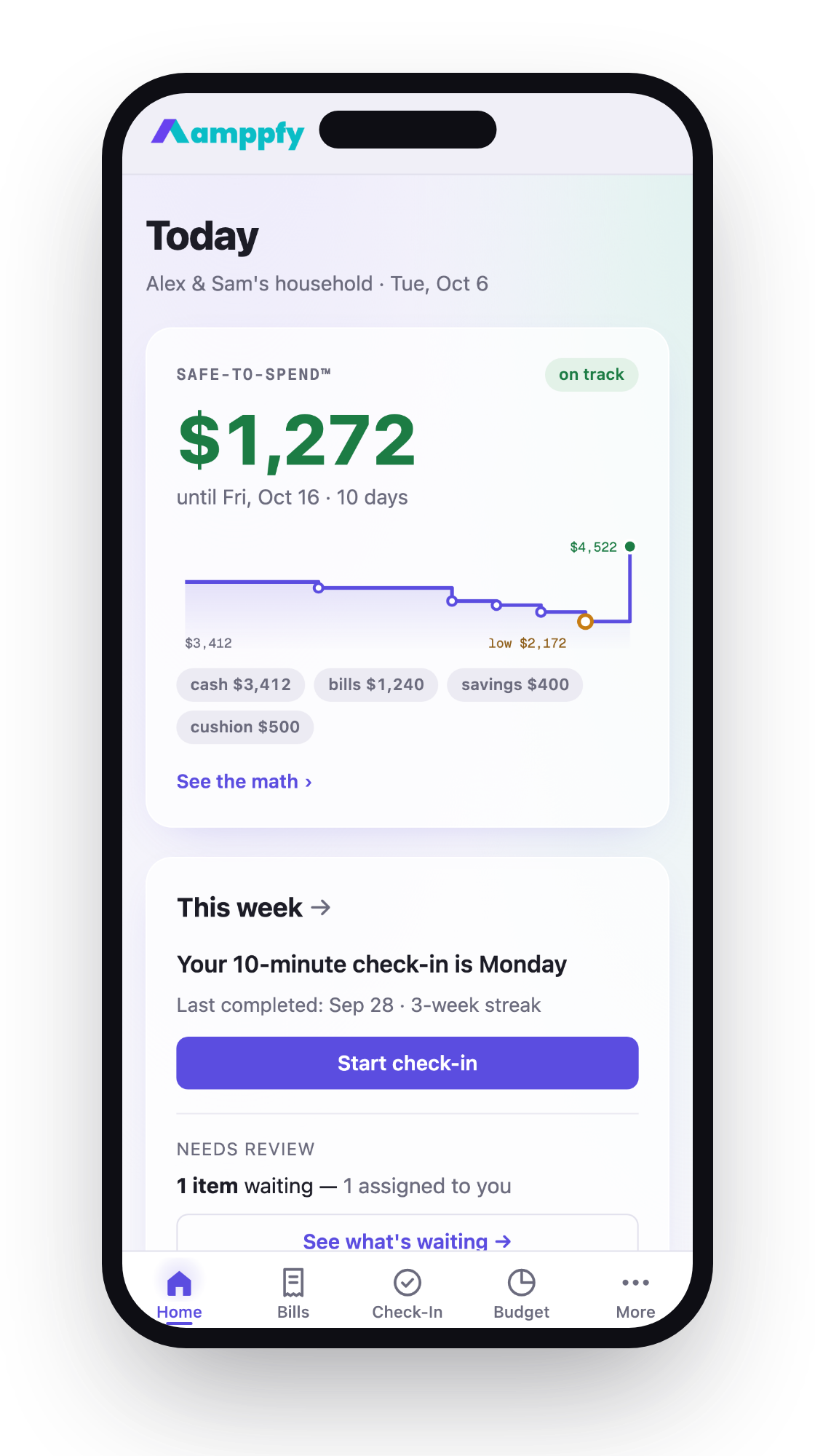
A useful starting point is your Safe-to-Spend™ figure: available cash minus bills due before payday, minus planned savings, minus a safety cushion. If that number is $1,272 right now, you aren’t spending $1,272 on gifts. You’re carving a slice from it.
How to Set the Number
- Check your remaining paychecks before December 25.
- Decide how much per check you can redirect to gifts without missing a bill.
- Multiply that amount by the number of checks left. That’s your total gift budget.
- Divide by the number of kids.
Here’s a quick example:
| Detail | Amount |
|---|---|
| Paychecks remaining before Dec 25 | 4 |
| Amount per check for gifts | $40 |
| Total gift budget | $160 |
| Number of kids | 2 |
| Per-child budget | $80 |
Eighty dollars per child can feel generous if you spend it with a plan. Write the number down. Tape it to your monitor. The point is to stop the mental math loop that runs every time you see a sale email. You already decided. Now you just execute.
If you’re co-parenting or splitting costs with a partner, agree on the per-child number together. One shared figure prevents duplicate spending and the awkward “I thought you were handling that” conversation on December 23.
The Want, Need, Wear, Read Approach
Four gifts. That’s the framework. One thing they want, one they need, one to wear, one to read. It keeps the pile under the tree looking full without blowing your per-child number.
Breaking Down the Four Categories
| Category | What It Covers | Example (Age 7) | Typical Cost |
|---|---|---|---|
| Want | The “big” wish-list item | LEGO set | $30-$40 |
| Need | Something practical they’ll use daily | New water bottle or backpack | $10-$20 |
| Wear | Clothing or accessories | Light-up sneakers | $15-$25 |
| Read | A book, audiobook subscription, or comic | Dog Man graphic novel | $8-$12 |
The total in that example lands between $63 and $97. That fits an $80 target with room to flex.
This framework works because it removes decision fatigue. You aren’t scrolling Amazon for three hours wondering if you’ve bought enough. Four categories, four items, done. Kids don’t count price tags. They count packages. Four wrapped presents under a tree feels like plenty to a seven-year-old.
A few practical notes on each category. The “want” item is where most of your budget goes. Ask your kid directly or watch what they circle in a catalog. The “need” item is the easiest to overthink: pick something they’ll grab every morning. Wear can be fun, not just socks (though fun socks count). Read is your cheapest category and often the gift they keep longest. Library book sales and secondhand bookstores sell kids’ books for $1-$3.
Spreading Purchases Across Paychecks
Buying everything in one trip is how budgets break. Spread the spending across multiple pay periods instead. This is where budget-friendly Christmas gifts for kids go from theory to reality.
A Simple Timeline
Map your remaining paychecks onto a calendar. Assign one or two purchases to each check.
- Paycheck 1 (early November): Buy the “read” gifts for all kids. Lowest cost, easiest win.
- Paycheck 2 (mid-November): Buy the “need” and “wear” items. Watch for pre-Black Friday sales on clothing and school supplies.
- Paycheck 3 (late November/early December): Buy the “want” items. By now you know exactly how much room you have.
- Paycheck 4 (mid-December): Reserve for wrapping supplies, stocking stuffers, or a small buffer.
This approach does two things. First, it prevents a single paycheck from absorbing the full hit. Second, it gives you a built-in pause between purchases. That pause is where impulse buys die. You see a $45 toy on sale for $29 and think, “That’s not on my list for this check.” You move on.
If you’re paid biweekly, you might have five checks between October and late December. Even better. Smaller amounts per check, more breathing room. The key is assigning specific items to specific pay dates before you walk into a store or open a browser.
An app like Amppfy can help here. Enter your payday, your bills, and your gift savings goal, and you’ll see your Safe-to-Spend™ number update after each purchase. About ten minutes of setup, then a quick weekly check to stay honest.
Family Members Who Want to Help
Grandparents, aunts, uncles: they ask every year. “What do the kids want?” This is a resource, not an awkward conversation. Use it.
How to Direct the Help
The simplest move is to share your want-need-wear-read list. If Grandma wants to buy the “want” item, great. That frees up $30-$40 in your budget for stocking stuffers, experiences, or January breathing room.
- Share a wish list through a free tool like Amazon Lists or a shared note in your phone’s Notes app. Include specific items and links so helpers don’t guess.
- Suggest price ranges. “We’re keeping gifts around $15-$25 each” gives family a guardrail without making things weird.
- Offer non-gift alternatives. Some relatives would rather fund an experience: a movie outing, a zoo membership, a month of a streaming service the kids love. These cost about the same as a toy and don’t add clutter.
One thing to keep in mind: don’t count family contributions until they’re confirmed. “I’ll get them something” is not the same as “I ordered the LEGO set and it arrives Tuesday.” Plan your budget as if you’re covering everything. If help arrives, treat it as a bonus that either reduces your spending or funds something extra.
For co-parents or couples, a shared wish list also prevents duplicate gifts. Two people buying the same hoodie in different colors isn’t the worst outcome, but it’s not ideal either. One list, visible to everyone who’s buying, solves it.
If a family member offers cash instead of a gift, consider putting it toward the “want” item. That’s the most expensive category, and offsetting it there gives your budget the most relief.
Keeping January Rent Safe
This is the section that matters most. A great Christmas means nothing if you’re short on rent three weeks later. According to a 2024 Federal Reserve survey on household economics, roughly 37% of U.S. adults said they couldn’t cover an unexpected $400 expense with cash. Holiday spending can push that number higher.
The January Math Check
Before you spend a dollar on gifts, run this line:
$3,412 cash – $1,240 January bills – $400 savings goal – $500 cushion = $1,272 Safe-to-Spend™
Your gift budget comes from that $1,272, not from the $3,412. The difference between those two numbers is the wall between a calm January and a stressful one.
Three rules to protect that wall:
- Never pull from your cushion for gifts. The cushion exists for car repairs and urgent copays, not for a surprise deal on a toy kitchen.
- Set a hard stop date. December 20 is reasonable. Anything you haven’t bought by then, you skip or substitute with something homemade. Last-minute shopping is where budgets collapse.
- Avoid buy-now-pay-later for Christmas presents. A $50 toy split into four payments is still $50, and the payments land in January and February when your cash flow is already tight.
If you’re using Amppfy, your Safe-to-Spend™ number already accounts for upcoming bills and your cushion. That single figure tells you whether your gift spending is on track or creeping into rent territory. One glance, no spreadsheet required.
The goal isn’t to feel deprived. It’s to feel confident. Confident that the gifts are covered, the rent is covered, and January starts clean.
Frequently Asked Questions
How much should I spend on Christmas gifts for kids on a budget?
There’s no universal right number. A good starting point is $50-$100 per child if you’re working with limited funds. Use the per-child calculation from earlier: total gift budget divided by number of kids. What matters is that the number is one you chose deliberately, not one you stumbled into after three Target runs.
What are the best affordable gift ideas for kids under 10?
Books, art supplies, building sets, and board games consistently rank high with kids and low on price. A $12 watercolor set and a $5 sketchpad can entertain a six-year-old for months. Dollar stores carry craft kits, card games, and small toys that work well as stocking fillers. Thrift stores often have barely-used puzzles and games for under $5.
Should I tell my kids we’re on a tight budget this year?
You don’t need to share dollar amounts, but age-appropriate honesty works. Something like “We’re picking fewer, better gifts this year” sets expectations without shame. Kids adapt quickly when the message is matter-of-fact. Focus on what’s happening, not what’s missing.
How do I handle gift pressure from other parents or social media?
Other families’ gift hauls aren’t your benchmark. If your child mentions what a friend got, acknowledge it simply: “That sounds cool. We do things our way.” Unfollow or mute accounts that make you feel behind. Your budget reflects your life, not someone else’s highlight reel.
A Generous Christmas on Your Terms
Generous doesn’t mean expensive. It means thoughtful, planned, and free of financial regret. Pick a per-child number. Use the four-gift framework. Spread purchases across paychecks. Accept help when it’s offered. Protect January.
If you want one place to see whether your gift spending fits inside your actual cash flow, get Amppfy free. Enter your balances, bills, and payday once, about ten minutes, and your Safe-to-Spend™ number stays current through the holidays and beyond.
Your kids will remember that the tree had presents under it. They won’t remember the receipt totals.