

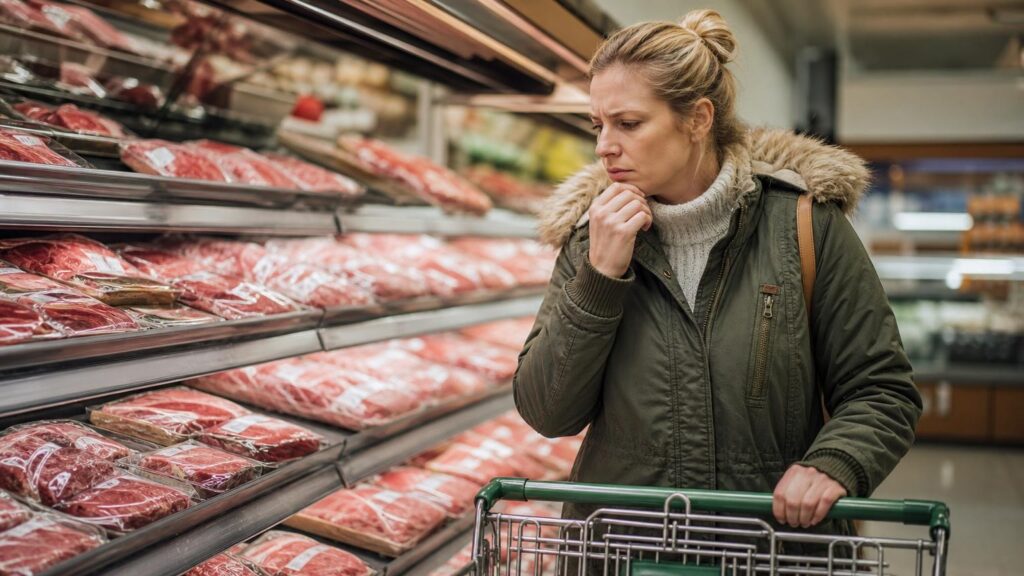
If you’ve stood in the meat aisle recently and felt your jaw drop, you’re not alone. Beef prices in 2026 are sitting at record highs, with some cuts up nearly 18% compared to just a year ago. The reasons are tangled up in everything from shrinking cattle herds to tariff chaos, and the outlook for relief isn’t exactly cheerful. Here’s what’s actually driving the cost of your steaks and burgers, and what the rest of 2026 might look like for your grocery budget.
The Numbers That Explain Why Beef Is So Expensive
Before we get into the “why,” let’s ground this in real data. The Bureau of Labor Statistics tracks beef prices monthly, and the April 2026 CPI report paints a stark picture:
| Beef Product | Month-Over-Month Change (March to April) | Year-Over-Year Change |
|---|---|---|
| Steak | +1.5% | +16.1% |
| Ground Beef | +2.7% | +14.5% |
| Beef Roast | +5.8% | +17.8% |
| All Beef & Veal | +2.7% | +14.8% |
Those aren’t small numbers. If you were spending $150 a month on beef a year ago, you’re now spending roughly $172 for the same amount. Over a full year, that’s an extra $264 just on one protein source. And grocery prices overall climbed 3.2% year over year, so beef is outpacing the broader food inflation trend by a wide margin.
The Shrinking Herd Problem Nobody Can Fix Quickly
The single biggest factor behind high beef prices is simple: there aren’t enough cattle. The U.S. cattle inventory has dropped to its lowest level since 1951. That’s not a typo. We’re talking about herd sizes not seen in over 70 years.
Here’s how we got here:
- Drought hammered cattle country. Pastures dried up across major ranching states, forcing producers to buy expensive supplemental feed or sell off animals they couldn’t afford to maintain.
- Input costs skyrocketed. Feed, fuel, veterinary care, equipment: everything a rancher needs got more expensive during the inflationary surge of 2022-2024, and those costs haven’t meaningfully retreated.
- Interest rates stayed elevated. Ranching is capital-intensive. Many producers rely on operating loans to run their businesses, and higher borrowing costs squeezed already thin margins.
- Producers liquidated instead of expanding. Facing all these pressures, many ranchers sent breeding cows to slaughter rather than keeping them to produce calves. Some left the business entirely.
The result is a supply hole that can’t be filled quickly. Even if a rancher decides today to start rebuilding their herd, they’d need to buy breeding stock at peak prices, wait roughly nine months for calves to be born, then another 18 to 24 months for those calves to reach market weight. You’re looking at a minimum of two to three years before any expansion decision shows up as more beef on store shelves.
Why Demand Hasn’t Budged (And Might Even Be Growing)
You’d think record prices would push consumers toward chicken or pork. And some switching is happening. But overall demand for beef has remained stubbornly strong through 2025 and into 2026.
A few reasons stand out:
- Cultural attachment to beef runs deep. Burgers, steaks, and brisket aren’t just food: they’re tied to holidays, cookouts, and family traditions that people are reluctant to give up.
- Summer grilling season creates predictable demand spikes. Consumption typically peaks between May and July, with the Fourth of July holiday acting as a major demand driver. Bernt Nelson, an economist with the American Farm Bureau Association, has noted this seasonal pattern consistently pushes prices higher through midsummer.
- Protein-focused diets remain popular. High-protein eating patterns continue to be trendy, and beef is one of the most protein-dense options available.
The real question for the rest of 2026 is whether consumer fatigue finally kicks in. If economic sentiment deteriorates or recession signals strengthen, shoppers may start making harder choices at the meat counter. But so far, Americans have largely absorbed the price increases and kept buying.
The Tariff Wrench in the Machine
As if tight supply and strong demand weren’t enough, trade policy has added a whole new layer of complexity. Tariffs imposed during the current administration’s second term have affected both beef imports and exports, creating a two-sided squeeze.
How tariffs raise prices on imports
The U.S. imports a significant amount of lean beef trimmings, primarily from Brazil, Australia, Canada, Mexico, and New Zealand. These trimmings get blended with fattier domestic beef to produce the leaner ground beef most Americans prefer. Think of it like a recipe: you need both ingredients to make the final product consumers want.
Tariffs on imported beef mean those trimmings cost more, and that cost gets passed directly to you at the checkout. The USDA has estimated that tariffs will reduce beef imports below initial forecasts for 2026, which tightens an already constrained supply. Beef from Canada and Mexico is exempt under the USMCA agreement, but imports from other major suppliers are not.
How tariffs hurt exports (and why that matters for your grocery bill)
This part is counterintuitive but important. U.S. ranchers export certain cuts of beef, particularly high-quality steaks and specialty products, that fetch better prices overseas than they would domestically. Chinese consumers, for example, prize certain American beef products.
When retaliatory tariffs make U.S. beef too expensive for foreign buyers, those export markets shrink. That might sound like it would increase domestic supply and lower prices, but the reality is messier:
- Lost export revenue threatens rancher viability. If producers can’t sell premium cuts abroad at premium prices, their overall profitability drops, making it even harder to justify expanding operations.
- Some producers could go under. Without export income, the economics of cattle ranching get worse, potentially pushing more ranchers out of the business and further shrinking the herd.
The uncertainty tax
Perhaps the most damaging aspect of the tariff situation is its unpredictability. Policy has shifted repeatedly, with reversals, court decisions, and new announcements creating an environment where ranchers can’t plan with confidence. As Nelson put it: “Uncertainty does not incentivize growth in the industry. It does the opposite.”
When you’re deciding whether to invest hundreds of thousands of dollars in breeding stock that won’t generate revenue for three years, you need some confidence about what the market will look like. Right now, that confidence is in short supply.
The DOJ Investigation: A Wild Card for 2026
Here’s a development worth watching closely. The Department of Justice announced in May 2026 that it’s conducting an antitrust investigation into major beef producers. The details are still emerging, but the investigation suggests regulators are looking at whether concentration in the meatpacking industry has contributed to elevated consumer prices.
The U.S. beef processing sector is dominated by a handful of large companies. If the investigation finds anticompetitive behavior, it could eventually lead to structural changes that affect pricing. But antitrust cases move slowly, so don’t expect this to lower your grocery bill anytime soon.
A Realistic Timeline: When Could Prices Actually Drop?
Let’s be honest about the outlook. There’s no quick fix here. The factors driving high beef costs are structural, not temporary.
| Factor | Timeline for Resolution | Impact on Prices |
|---|---|---|
| Herd rebuilding | 3-5 years minimum | Would increase supply and ease prices |
| Tariff stabilization | Unknown: depends on policy | Could reduce import costs |
| Interest rate cuts | Possible in late 2026 or 2027 | Would lower rancher operating costs |
| Demand reduction | Could happen anytime with recession | Would lower prices but hurt producers |
| DOJ investigation | Years to resolve | Uncertain impact |
The most likely scenario for the rest of 2026 is continued high prices, with possible spikes during peak summer demand. Some modest relief could come if consumer demand weakens due to economic concerns, but that’s a double-edged sword: lower demand helps your wallet short-term but discourages the herd expansion needed for long-term price relief.
Five Ways to Manage Your Beef Budget Right Now
You can’t control cattle markets, but you can be strategic about how you buy:
- Buy in bulk when sales hit. Stock up during post-holiday markdowns (after Memorial Day, Fourth of July, and Labor Day) and freeze portions.
- Explore less popular cuts. Chuck roast, flank steak, and beef shanks are typically cheaper than ribeyes and tenderloins, and they’re fantastic when cooked properly.
- Blend your ground beef. Mix ground beef with mushrooms, lentils, or ground turkey to stretch it further without sacrificing flavor in dishes like tacos or pasta sauce.
- Compare store brands and warehouse clubs. Price per pound can vary significantly between retailers. Spend 15 minutes this week comparing prices at your usual store versus a warehouse club or discount grocer.
- Consider partial substitution. You don’t have to give up beef entirely. Try swapping one or two beef meals per week for chicken, pork, or plant-based alternatives and save the beef budget for meals where it really matters to you.
Frequently Asked Questions
Why is beef so expensive compared to chicken and pork?
Cattle take much longer to raise than chickens or pigs. A chicken reaches market weight in about six to eight weeks, while a cow takes 18 to 24 months. That longer production cycle means higher feed, land, and labor costs per pound of meat. The current supply shortage, driven by herd liquidation and drought, has widened the price gap even further. In 2026, you might pay $6-7 per pound for ground beef versus $2-3 for chicken breast on sale.
Will beef prices go down in 2026?
Significant price drops in 2026 are unlikely. The cattle herd is still shrinking, tariffs are adding costs to imported beef, and summer demand typically pushes prices higher through July. Some relief could come in late 2026 if consumer demand weakens or if trade policy stabilizes, but most industry economists expect prices to remain elevated well into 2027 or 2028.
Are tariffs the main reason beef costs so much?
Tariffs are making things worse, but they’re not the primary driver. The biggest factor is the historically small U.S. cattle herd, which has been shrinking since the early 2020s due to drought, high operating costs, and unfavorable economics for ranchers. Tariffs compound the problem by raising the cost of imported beef and threatening export markets that help keep ranchers financially viable.
Should I switch to a different protein to save money?
That’s a personal call, but the math is clear: chicken, pork, eggs, and legumes all cost significantly less per gram of protein than beef right now. Even partial substitution, like replacing two beef dinners per week with alternatives, could save a family of four $40-60 per month. A financial advisor or even a simple budget review can help you figure out where food spending fits into your overall financial picture. The key is finding a balance that works for both your budget and your preferences.




