Most people check their bank balance a few times a week and still can’t answer one question: how much of that number is actually mine to spend? The gap between what’s in your account and what’s truly available is where money stress lives. A clear monthly budget breakdown closes that gap. It sorts every dollar into a role so you stop guessing and start deciding. Below, you’ll see the four slices that cover any month, no matter your income or household size.
Four slices that describe any month
Every month, money flows through your life in four streams. Naming them is the first step toward knowing what’s safe to spend before your next paycheck.
| Slice | What it covers | Typical timing |
|---|---|---|
| Bills | Rent/mortgage, utilities, insurance, loan payments, childcare | Fixed dates, usually the 1st through the 15th |
| Savings | Emergency fund, retirement top-ups, sinking funds, goals | Best moved on payday, before anything else |
| Subscriptions | Streaming, apps, gym, meal kits, cloud storage | Scattered throughout the month |
| Everyday spending | Groceries, gas, coffee, dining, household supplies | Ongoing, no fixed date |
These four slices aren’t ranked by importance. They’re ranked by flexibility. Bills are locked. Savings are a promise you made to yourself. Subscriptions are semi-locked but cancellable. Everyday spending is the only slice that truly bends.
That’s why your budget for the month works best when you fill the rigid slices first and let everyday spending take whatever remains. The math might look like this:
$4,800 paycheck – $2,100 bills – $500 savings – $180 subscriptions = $2,020 everyday spending
That single line tells you more than a color-coded spreadsheet ever could. Amppfy’s Budget page shows these same four slices pulled from the plan you already entered, so the numbers update without a second round of data entry.
Bills: what has to be paid
Bills are the non-negotiable backbone of your month. Miss one and you face late fees, service interruptions, or credit damage. That’s why they get funded first.
What counts as a bill
- Rent or mortgage payment
- Utilities: electric, gas, water, internet, phone
- Insurance premiums: health, auto, renters/homeowners
- Loan payments: car, student, personal
- Childcare or tuition
- Minimum credit card payments
Sizing up the biggest line items
Housing alone accounts for about 33.4% of total annual household spending, which makes it the single largest bill for most people. Utilities add another bite: the average monthly electric bill hit roughly $158 in mid-2026[1]. If you carry student loans, the average federal balance per borrower sits near $40,768 as of Q3 2026[2], translating to a monthly payment that can easily top $300.
Keeping bills from surprising you
List every bill, its amount, and its due date in one place. Sort them by date so you can see which ones land before each paycheck and which ones land after. If two large bills cluster in the same week, call one provider and ask to shift the due date. Most will do it once without a fee. A household budget built from your actual plan makes this easier because the dates are already mapped.
The goal isn’t to shrink every bill to zero. It’s to know exactly what’s owed and when, so nothing catches you off guard.
Savings: what you decided to keep
Savings isn’t leftovers. It’s money you chose to set aside before the month had a chance to spend it for you.
Three buckets worth filling
- Emergency fund: Three to six months of essential expenses, parked in a high-yield savings account. Even $50 a paycheck builds this over time.
- Goals: A vacation, a car down payment, holiday gifts. Give each goal a name, a target amount, and a deadline.
- Retirement top-up: If your employer match is 4% and you’re contributing 4%, you’re covered. If you can bump to 6%, the compounding difference over 20 years is significant.
The payday-first method
Move savings out of checking on payday, not at the end of the month. If you wait, the money disappears into everyday spending. Treat savings like a bill that’s due the day you get paid.
Here’s a quick example. Say you earn $3,200 every two weeks. You decide on $200 per paycheck for emergencies and $150 for a trip fund. That’s $350 gone before you buy groceries, and that’s the point. What remains is genuinely yours to use.
Couples sharing finances can split savings goals without sharing every account. Each partner funds their portion, and the total goal balance stays visible to both. That transparency removes the “are we on track?” conversations that tend to happen at the worst times.
Subscriptions: the recurring small charges
A $14.99 streaming service doesn’t feel like much. Neither does a $9.99 cloud plan or a $12 fitness app. Stack eight or ten of those together and you’re looking at $120 to $180 leaving your account every month on autopilot.
Why subscriptions deserve their own slice
They’re not bills. You won’t lose your home if you cancel one. But they’re not everyday spending either, because you don’t decide to pay them each time: they just charge. That automatic quality is exactly what makes them easy to ignore and hard to manage.
U.S. adults waste an average of $21 per month on subscriptions they don’t use[3], which adds up to about $252 a year. That’s real money sitting in someone else’s pocket for a service you forgot you signed up for.
A quick subscription audit
- Pull up your last two bank or credit card statements.
- Highlight every recurring charge that isn’t a bill.
- For each one, ask: did I use this in the past 30 days?
- Cancel anything you haven’t touched. You can always re-subscribe later.
- Note the next charge date for every keeper so you aren’t surprised.
Keeping a subscriptions list with next-charge dates visible means you review them on your terms, not when a surprise charge pops up. This small habit, done once a quarter, can free up $50 to $100 a month without changing your lifestyle at all.
Everyday spending and why it is not the same as spare cash
This is the slice most people confuse with “whatever’s left in checking.” It’s not. Your checking balance includes money earmarked for bills that haven’t hit yet, savings you haven’t transferred, and subscriptions waiting to charge. Treating the full balance as spendable is how people end up short three days before payday.
What everyday spending actually includes
- Groceries and household supplies
- Gas or transit fares
- Coffee, dining out, takeout
- Haircuts, pharmacy runs, pet food
- Small household purchases
The real number vs. the checking balance
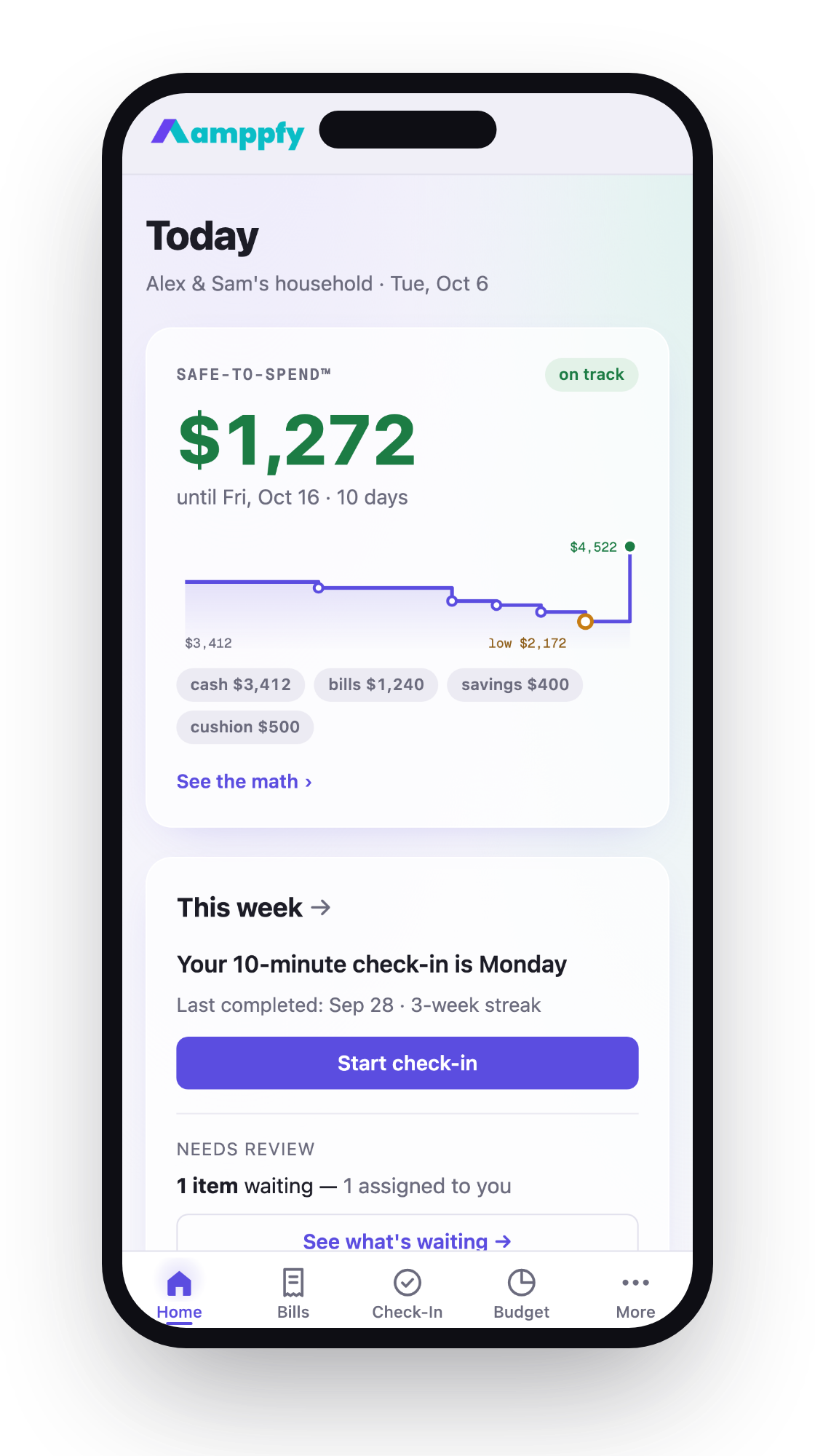
Imagine your checking account shows $3,412. But you have $1,240 in bills due before your next paycheck, $400 in planned savings, and you like a $500 cushion so you’re never at zero. The math:
$3,412 – $1,240 – $400 – $500 = $1,272
That $1,272 is what’s genuinely available for everyday spending. Amppfy calls this your Safe-to-Spend™ number, and it updates as bills clear and balances change. The four-line math is always printed right below the number so you can see why it moved.
Carrying a balance changes the math
If you put everyday purchases on a credit card and carry a balance, the cost of those purchases grows. The average interest rate on credit card accounts assessed interest remained at 22.15% in Q2 2026[4]. A $200 grocery run paid off over six months costs you roughly $213 after interest. Paying from your Safe-to-Spend™ number instead keeps those dollars from multiplying against you.
Everyday spending is the most flexible slice, but it still has a ceiling. Knowing that ceiling before you tap your card is the whole point of building a monthly breakdown in the first place.
Frequently Asked Questions
How often should I update my budget breakdown each month?
A weekly check-in of about ten minutes is enough for most people. Update your account balances, confirm upcoming bills, and glance at your Safe-to-Spend™ number. That rhythm catches small problems before they become big ones. If your income or bills change mid-month, do an extra check that week.
What if my income varies from month to month?
Use your lowest recent paycheck as the baseline. Build your four slices around that number. When a higher check arrives, send the difference straight to savings or a goal fund. This keeps your everyday spending consistent and prevents the feast-or-famine cycle that trips up freelancers and commission earners.
Should couples combine everything into one budget?
Not necessarily. Many couples keep separate personal accounts and share a joint account for bills and shared goals. What matters is that both partners can see the same plan. If one person handles the bills and the other has no visibility, tension builds. Shared visibility with private balances is a middle ground that works for a lot of households.
What’s a good percentage split for the four slices?
There’s no universal answer because housing costs vary wildly by city. A rough starting point: 50% bills, 20% savings, 5-10% subscriptions, and 20-25% everyday spending. But your real numbers matter more than any guideline. Start with your actual bills and savings goals, then see what’s left. Adjust from there.
Your month, sorted
A monthly budget breakdown isn’t about restriction. It’s about clarity. When you know what’s owed, what’s saved, what’s subscribed, and what’s truly yours to spend, every purchase feels lighter. You stop doing mental math at the register and start making choices from a place of confidence.
Pick one step this week: list your bills and their dates, audit your subscriptions, or calculate your real everyday spending number. Even one slice, done well, changes how the rest of the month feels.
If you want that number ready before your next payday, get Amppfy free. Enter your balances, bills, and payday once: about ten minutes: and your Safe-to-Spend™ number is always there, with the math shown underneath.