Build Your Emergency Fund Fast in 2026: Proven Strategies to Save More and Stay Financially Secure
Most Americans think they’re one paycheck away from financial disaster, and the data backs that up. The median emergency savings sits at just $600, and nearly a quarter of Americans have no emergency savings at all. That’s not a comfortable position when car repairs, medical bills, or sudden job loss can hit without warning.
If you want to build your emergency fund fast in 2026, the strategies that worked five years ago need updating. Inflation has shifted what “enough” actually means, and new financial tools have made the mechanics of saving both easier and more rewarding. Here are seven proven approaches to save more and stress less this year.
Strategy #1: Defining Your Target: The 3-Month vs. 6-Month Rule
The classic advice is to save three to six months of essential expenses. But which end of that range is right for you? It depends on your job stability, household size, and the number of income streams you have.
|
Factor |
3-Month Target |
6-Month Target |
|---|---|---|
|
Employment type |
Stable salaried job |
Freelance, contract, or commission-based |
|
Household earners |
Dual income |
Single income |
|
Dependents |
None |
Children or aging parents |
|
Industry stability |
High-demand field |
Cyclical or volatile industry |
|
Health considerations |
Good health, solid insurance |
Chronic conditions or high deductibles |
Here’s a useful benchmark: 85% of Americans say they need at least three months of expenses saved to feel comfortable, but only 46% actually have that much. The median “ideal” emergency fund people cite is $10,000, which is a reasonable starting target for most households.
Calculating Monthly Essentials in an Inflationary Economy
Your emergency fund target should cover essentials only, not your full current spending. Sit down and separate your must-pays from your nice-to-haves. Essentials include rent or mortgage, utilities, groceries, insurance premiums, minimum debt payments, transportation, and medications.
A helpful exercise:
-
Look at your last three months of bank statements and highlight only the charges you’d absolutely need to keep paying if you lost your income tomorrow.
-
For most people, this number is 60-70% of their total monthly spending.
-
If your full monthly budget is $5,000, your essential baseline might be $3,200, which would make a 3-month fund roughly $9,600.
Don’t forget to factor in recent price increases. That grocery bill you remember from 2023 has likely crept up. Use your actual recent spending, not what you think you spend.
Strategy #2: Automate Your Success with Tech-First Savings Tools
The single most effective thing you can do is remove yourself from the equation. Manual saving requires willpower, and willpower is a finite resource. Automation turns saving from a decision into a default.
Setting Up Smart Triggers and Micro-Transfers
Most banking apps now offer round-up features that sweep spare change from every purchase into savings.
-
Spending $4.30 on coffee? The remaining $0.70 goes straight to your emergency fund.
-
It may sound small, but 15-20 transactions per week can add $40-60 per month without you noticing.
Go further with rule-based triggers. Apps like Qapital and Digit let you set custom rules: save $5 every time you skip a restaurant meal, transfer $2 every time you hit your step goal, or move a percentage of any deposit over $500. These micro-transfers create a steady drip that compounds over time.
The key is to set these up once and forget about them. The less friction between your income and your savings, the faster the fund grows.
Strategy #3: Maximizing Yield with High-Interest Cash Accounts
Where you keep your emergency fund matters enormously right now.
-
Parking $10,000 in a traditional savings account earning 0.10% APY gets you $10 per year.
-
The same amount in a high-yield savings account at 4.50% APY earns $450. That’s real money.
Look for accounts that are FDIC-insured up to $250,000 and have no minimum balance requirements. Online banks typically offer the best rates because they don’t carry the overhead of physical branches. Just make sure the account allows quick transfers: your emergency fund needs to be accessible within one to two business days.
Strategy #4: Aggressive Budgeting: The ‘Slash and Stash’ Method
This approach is simple but effective: identify spending you can temporarily eliminate and redirect every dollar saved into your emergency fund. The operative word is “temporarily.” You’re not changing your lifestyle forever; you’re sprinting toward a specific financial goal.
Auditing Digital Subscriptions and Ghost Recurring Costs
Pull up your credit card and bank statements from the past 90 days. I guarantee you’ll find at least one charge you forgot about. The average American carries 12 paid subscriptions, and many people underestimate their monthly subscription spending by $100 or more.
Common culprits include:
-
Streaming services you rarely open (that third or fourth platform)
-
App subscriptions with free alternatives (weather apps, meditation apps, cloud storage)
-
Gym memberships are used fewer than four times per month
-
Software trials that converted to paid plans
-
Duplicate services (two cloud storage providers, overlapping music subscriptions)
Cancel ruthlessly. You can always resubscribe later. If cutting five subscriptions saves you $75 per month, that’s $900 per year flowing directly into your safety net.
Leveraging the 48-Hour Rule to Curb Impulse Spending
Before any non-essential purchase over $30, wait 48 hours. Write it down, close the browser tab, and leave the store. If you still want it two days later and it fits your budget, buy it. Most of the time, the urge fades.
This works because impulse purchases are driven by dopamine, not logic. The 48-hour gap lets your rational brain catch up. I’ve seen people save $200-400 per month with this single habit, and only 47% of Americans currently have enough savings to cover a $1,000 surprise expense. That extra few hundred dollars each month can change your position dramatically within a single quarter.
Stratgey #5: Accelerating Growth Through Diversified Income Streams
Cutting expenses has a floor: you can only reduce spending so far. Income, on the other hand, has no ceiling. Even small side earnings can dramatically accelerate your timeline.
Monetizing Skills in the 2026 Gig Ecosystem
The gig economy has matured significantly. You don’t need to drive for a rideshare company (though that still works). Higher-value options include freelance writing, virtual bookkeeping, tutoring, graphic design, and consulting in your professional niche.
Platforms like Upwork, Fiverr, and Toptal connect skilled workers with clients quickly. If you can dedicate 5-10 hours per week to a side gig that pays $25-50 per hour, that’s an extra $500-2,000 per month going straight into your emergency fund. At that rate, a $10,000 fund takes three to five months instead of a year or more.
Selling Unused Assets on Niche Resale Platforms
Most households are sitting on $1,000-3,000 worth of sellable items. Electronics, furniture, clothing, sports equipment, musical instruments: if you haven’t used it in a year, it’s a candidate.
Go beyond Facebook Marketplace. Niche platforms often yield better prices: Reverb for musical gear, Poshmark for clothing, Swappa for electronics, Chairish for furniture. Specialized buyers pay more because they know what they’re getting.
Strategy #6: Optimizing Windfalls and Variable Income
Unexpected money is the fastest path to a funded emergency account, but only if you capture it before it evaporates into general spending.
The 100% Rule for Tax Refunds and Bonuses
Here’s the rule: until your emergency fund is fully funded, 100% of every windfall goes directly into it. Tax refunds, work bonuses, cash gifts, rebate checks, insurance refunds: all of it. No exceptions.
This feels extreme, but consider the math. The average federal tax refund is around $3,100. If your target is $10,000, a single tax refund gets you nearly a third of the way there in one move. Combine that with a few months of automated savings and subscription cuts, and you could hit your goal before the end of summer. Remember, 33% of adults would need to borrow or go into debt to handle a $1,000 emergency. Getting out of that group is worth one season of discipline.
Strategy #7: Psychological Hacks to Stay Motivated During the Build
Money goals fail more often due to a loss of motivation than math problems. Your strategy needs a psychological component.
Visualizing Milestones with Gamified Progress Trackers
Break your total goal into smaller milestones: $500, $1,000, $2,500, $5,000, and so on. Celebrate each one. Use a visual tracker (a thermometer chart on your fridge, a progress bar in a savings app, or even a jar of marbles) to make the growth tangible.
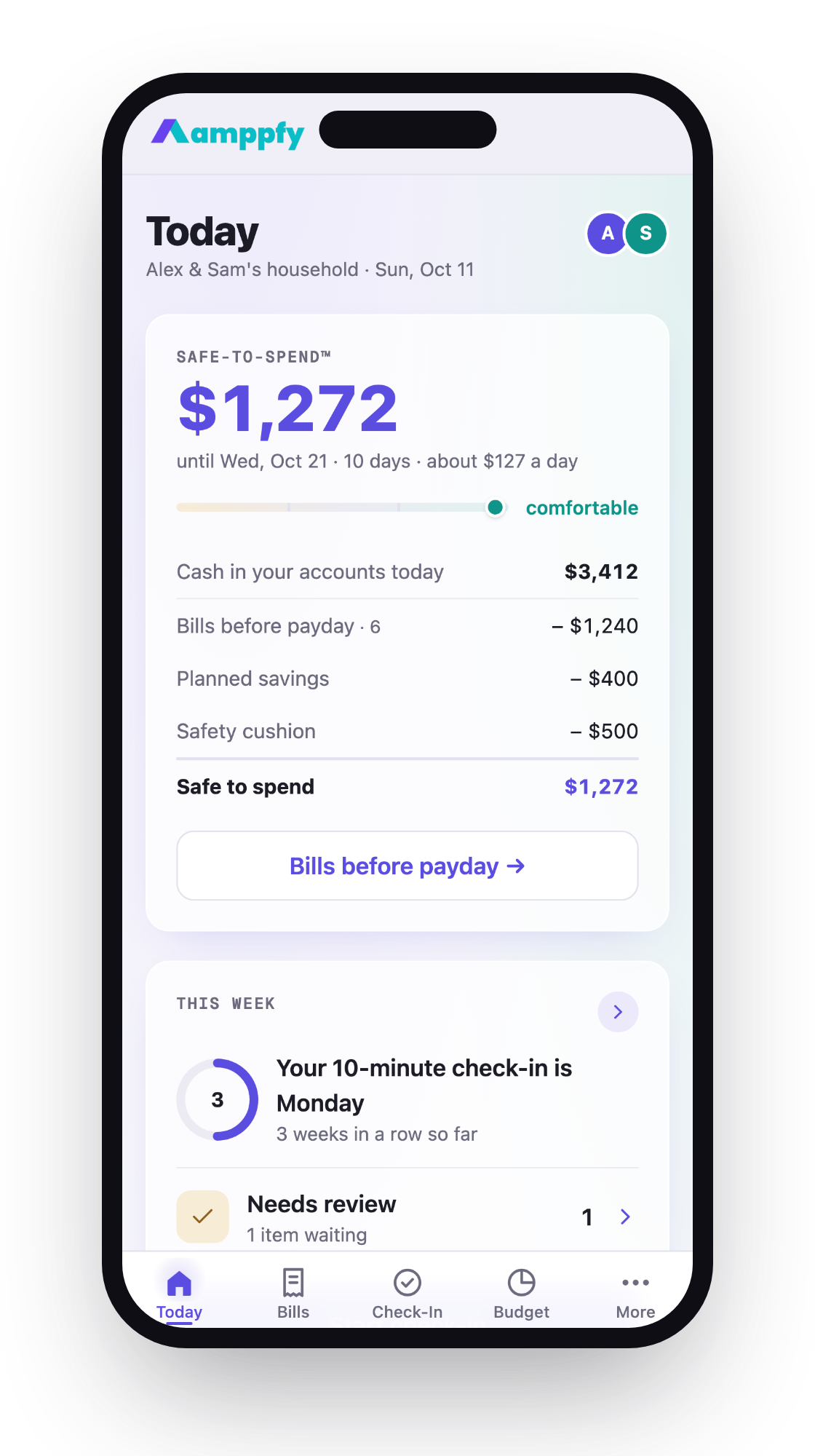
Some banking apps, including tools featured on platforms like Ampffy, now include built-in goal tracking with visual progress indicators. The psychology is simple: visible progress reinforces the behavior that created it.
Establishing Boundaries: What Qualifies as an Emergency?
This is where most emergency funds die. Someone dips in for concert tickets because “it was a once-in-a-lifetime opportunity,” and suddenly the fund is gutted. Define your rules upfront.
Real emergencies include:
-
Job loss or significant income reduction
-
Medical expenses not covered by insurance
-
Essential car or home repairs (not upgrades)
-
Emergency travel for family crisis
Non-emergencies: vacations, holiday gifts, sales, new gadgets, or anything you could have planned for. Write your rules down and tape them to your debit card if you have to.
Maintaining Your Momentum Beyond the Initial Goal
Hitting your target number is a milestone, not a finish line. Once your fund is in place, shift your automated transfers to a lower maintenance amount: enough to keep pace with inflation and any lifestyle changes. If your expenses increase (new baby, higher rent, medical needs), recalculate and adjust your target accordingly.
The real payoff isn’t just financial. It’s the stress reduction that comes from knowing you can handle the unexpected. That 37% of Americans who couldn’t afford an emergency expense over $400 live with a constant background hum of anxiety. Removing that changes how you sleep, how you make decisions, and how you show up at work.
Start today, even if it’s $20. Automate it. Forget about it. Check back in 30 days and watch what happens. Your future self will thank you, and your stress levels will prove it.
Frequently Asked Questions
How much should I have in my emergency fund in 2026?
Most financial advisors recommend three to six months of essential living expenses. For a household spending $3,500 per month on necessities, that’s $10,500-$21,000. If you’re a single-income household with dependents, aim for the higher end. The median ideal amount Americans cite is $10,000, which is a solid starting benchmark. Adjust based on your specific job stability, health needs, and obligations.
Where is the best place to keep an emergency fund?
A high-yield savings account at an FDIC-insured bank is the standard recommendation. You want liquidity (access within one to two business days), safety (federal insurance up to $250,000), and a competitive APY. Avoid tying emergency funds up in CDs, brokerage accounts, or anything with withdrawal penalties. The whole point is fast access when you need it.
How fast can I realistically build an emergency fund?
With aggressive savings (subscription cuts, side income, and windfall capture), many people can reach $5,000-$10,000 within three to six months. If you redirect a $3,100 tax refund, cut $150 per month in subscriptions, and add $500 per month from a side gig, you’d accumulate roughly $7,000 in six months. Your timeline depends on your income, expenses, and how aggressively you pursue the strategies above.
Should I pay off debt or build an emergency fund first?
This is one of the most debated questions in personal finance. A common middle-ground approach: build a small starter emergency fund of $1,000-$2,000 first, then attack high-interest debt aggressively, then return to fully fund your emergency savings. Without any buffer, a single unexpected expense can push you further into debt and undo your progress. Consult a financial advisor for guidance tailored to your specific debt situation and interest rates.