

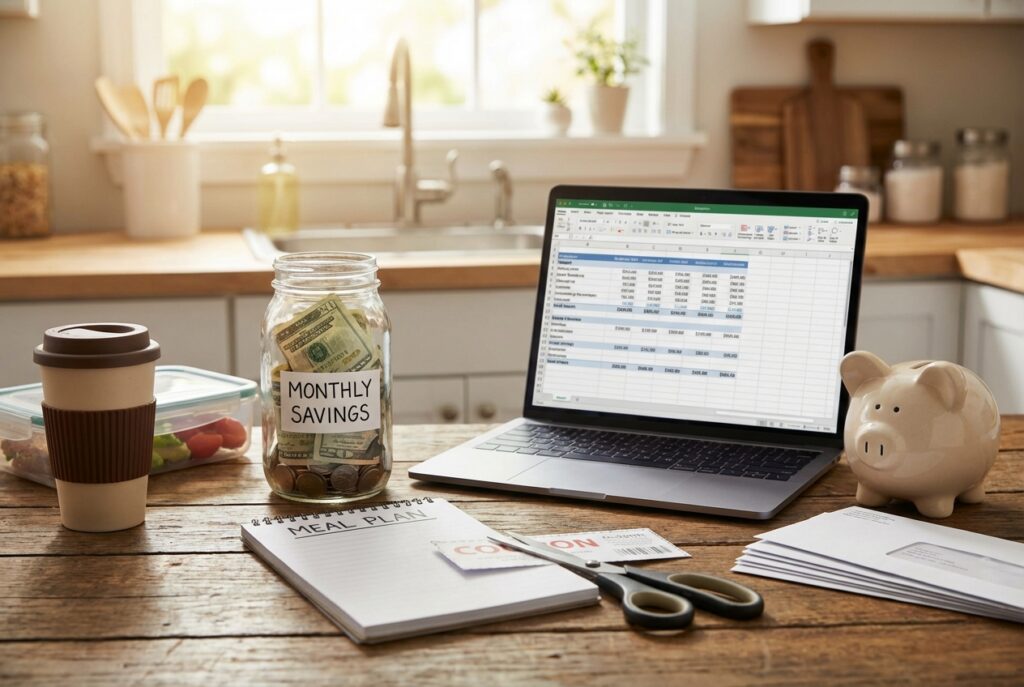
Looking at your bank account and wondering where all your money went is a feeling most of us know too well. You had good intentions at the start of the month, but somewhere between the morning coffee runs and the “treat yourself” moments, hundreds of dollars slipped through your fingers. Here’s the thing: saving $500 in a single month isn’t about dramatic lifestyle changes or eating ramen for 30 days straight. It’s about finding the money you’re already wasting without realizing it.
I’ve spent years tracking my own spending habits and helping friends untangle their finances, and I’ve noticed something interesting. Most people focus on the big, obvious expenses when they want to save money. They’ll negotiate their rent or refinance their car loan, which is great, but they ignore the dozens of small leaks draining their accounts daily. Those $4 coffees, the streaming service you forgot you subscribed to, the convenience store snacks: they add up to far more than you’d expect.
The strategies in this guide aren’t the recycled advice you’ve seen everywhere else. These are practical, sometimes unconventional approaches that can help you save $500 this month using tips you probably haven’t tried yet. Some require a bit of effort upfront, but most are simple shifts in how you think about and handle money. Ready to find that extra $500? Let’s get specific about how to make it happen.
The $500 Savings Challenge: Setting Your Monthly Strategy
Before you can save $500, you need to know exactly where your money currently goes. This sounds obvious, but most people operate on assumptions rather than actual data. They think they spend $200 on groceries, but the actual amount is closer to $400. They forget about the annual subscriptions that are charged to their card without warning.
The $500 savings challenge works because it gives you a concrete, achievable target. Breaking that down, you’re looking at roughly $125 per week or about $17 per day. Suddenly, the goal feels less overwhelming. You’re not trying to overhaul your entire financial life. You’re finding $17 worth of waste every single day.
Tracking Every Cent with Budgeting Apps
The first step is brutal honesty about your spending. Download a budgeting app and connect all your accounts. I recommend Mint, YNAB (You Need A Budget), or Copilot, depending on your preferences. YNAB costs money but forces you to assign every dollar a job. Mint is free and automatically categorizes transactions. Copilot offers a clean interface and smart insights.
Spend the first week just observing. Don’t try to change anything yet. Let the app categorize your spending and show you the patterns. You’ll likely discover some uncomfortable truths:
- That “occasional” fast food habit might be costing $150 monthly
- Subscription services you forgot about are quietly draining your account
- Small purchases under $10 probably total more than any single big expense
This data becomes your roadmap. You can’t fix what you can’t see, and these apps illuminate the hidden corners of your spending.
Identifying and Cutting Low-Value Expenses
Once you have two to three weeks of spending data, sort your expenses by category. Now ask yourself a simple question for each one: “Did this purchase genuinely improve my life?” Be ruthless here. That $6 smoothie might have tasted good for five minutes, but did it provide more value than keeping that $6 in your savings?
Create three lists.
- The first contains expenses that are essential and non-negotiable, like rent, basic groceries, and necessary medications.
- The second holds expenses that bring genuine joy or value, perhaps your gym membership you actually use, or a hobby that keeps you sane.
- The third list catches everything else: the mindless purchases, the convenience spending, the “I deserve this” moments that didn’t actually make you happier.
That third list is where your $500 lives. Target those expenses first. You’re not depriving yourself of what matters. You’re eliminating spending that wasn’t serving you anyway.
Slash Your Food Bill Without Going Hungry
Food is usually the biggest variable expense in any budget, which means it’s also where you’ll find the most savings potential. The average American household spends over $700 monthly on food, with nearly half going to dining out and takeout. Cutting your food spending by even 25% could save you $175 or more.
The Power of Strategic Meal Planning
Meal planning isn’t about creating elaborate weekly menus that require hours of prep. It’s about making decisions in advance, so you’re not standing in front of the fridge at 7 PM, exhausted and hungry, reaching for your phone to order delivery.
Start simple. Pick five dinners for the week. Write down every ingredient you need. Check what you already have. Buy only what’s missing. That’s it. This basic approach eliminates three major money drains:
- Impulse purchases at the grocery store (no more wandering aimlessly)
- Food waste from ingredients that spoil before you use them
- Emergency takeout orders when you have “nothing to eat.”
The meal-planning sweet spot is cooking meals that leave leftovers for lunch the next day. One cooking session feeds you twice. Your cost per meal drops dramatically, and you save the time and money you’d spend buying lunch out.
Mastering the Grocery Store: Bulk Buying and Generic Brands
Store brands are the same products as name brands, in most cases, manufactured in the same facilities under different labels. Switching to generic versions of staples like flour, sugar, canned goods, spices, and cleaning supplies can save 20-40% on your grocery bill without sacrificing quality.
Bulk buying works for non-perishables and items you use consistently. Rice, pasta, oats, frozen vegetables, and proteins you can freeze all qualify. But be strategic: buying 50 pounds of quinoa because it’s cheaper per ounce only saves money if you actually eat quinoa. Otherwise, you’ve just traded cash for clutter.
Here’s a shopping strategy that consistently saves money:
- Never shop hungry (you’ll buy more than you need)
- Stick to the perimeter of the store where fresh foods live
- Check the unit price, not just the sticker price
- Use a calculator to compare bulk versus regular sizes
- Visit discount grocers like Aldi or Lidl for staples
Eliminating the ‘Convenience Tax’ on Takeout
Every time you order delivery, you’re paying a convenience tax of 30-50% on top of the actual food cost. A $15 meal becomes $22 after delivery fees, service charges, and tip. Order twice a week, and you’ve spent an extra $60 monthly just for the privilege of not cooking.
I’m not saying order takeout. But track how often you’re doing it and calculate the real cost. Many people are shocked to discover they’re spending $300-400 monthly on delivery and restaurant meals. Cut that in half, and you’ve found $150-200 toward your $500 goal.
When you do want restaurant food, pick it up yourself. Many restaurants offer discounts on pickup orders, which eliminates those delivery fees. Better yet, learn to recreate your favorite takeout dishes at home. A homemade burrito bowl costs about $3. Chipotle charges $12.
Audit Your Recurring Subscriptions and Utilities
Subscriptions are designed to be forgettable. Companies know that once you sign up, inertia keeps you paying month after month, even when you’re barely using the service. The average American has 12 paid subscriptions, totaling $219 per month. How many of yours are actually worth keeping?
Canceling Ghost Subscriptions and Memberships
Ghost subscriptions are services you’re paying for but not using. That meditation app you downloaded in January and opened twice. The premium Spotify account when you mostly listen to podcasts. The gym membership for a gym you haven’t visited in three months.
Pull up your bank and credit card statements from the last three months. Highlight every recurring charge. For each one, answer honestly: “Have I used this in the past 30 days? Will I genuinely use it in the next 30?”
Common subscription culprits include:
- Streaming services (do you really need Netflix, Hulu, Disney+, HBO Max, and Amazon Prime?)
- Software subscriptions you’ve stopped using
- Membership boxes that pile up unopened
- Cloud storage beyond what you actually need
- Premium app versions when free versions work fine
Canceling just three unused $15 subscriptions saves $45 per month, or $540 per year. That’s more than your entire $500 goal from one simple audit.
Lowering Energy Costs with Simple Home Adjustments
Your utility bills have more flexibility than you might think. Small adjustments in how you use energy can trim $30-50 from your monthly bills without any discomfort.
Start with the obvious: LED bulbs use 75% less energy than incandescent bulbs. A programmable thermostat can save 10% on heating and cooling by adjusting temperatures while you sleep or work. Unplugging devices when not in use eliminates phantom power draw, which accounts for 5-10% of residential energy use.
Water heating is typically the second-largest energy expense in homes. Lowering your water heater to 120°F (from the default 140°F) saves energy without affecting your showers. Taking slightly shorter showers and running full loads in your dishwasher and washing machine reduces both water and energy costs.
Call your utility companies and ask about budget billing, off-peak rates, or any programs that could lower your costs. Many offer free energy audits that identify specific savings opportunities for your home.
Adopt a ‘No-Spend’ Mindset for Discretionary Purchases
Discretionary spending is where most budgets quietly fall apart. These are the purchases that feel small and harmless in the moment but add up to significant sums. A coffee here, a new shirt there, an impulse buy while browsing Amazon at midnight.
Implementing the 48-Hour Rule for Online Shopping
The 48-hour rule is simple: when you want to buy something non-essential, wait 48 hours before purchasing. Add it to your cart, close the browser, and walk away. If you still want it two days later, consider buying it. If you’ve forgotten about it, you’ve just saved money on something you didn’t really need.
This works because it interrupts the emotional impulse that drives most unnecessary purchases. Retailers spend billions engineering their websites to trigger immediate buying decisions. The 48-hour rule gives your rational brain time to catch up with your emotional one.
During those 48 hours, ask yourself:
- Do I already own something that serves this purpose?
- Am I buying this because I need it or because I’m bored, stressed, or sad?
- Where will I put this? What will I get rid of to make room?
- Would I rather have this item or $X toward my savings goal?
For larger purchases, extend the waiting period. A week for anything over $100. A month for anything over $500. The longer you wait, the clearer your thinking becomes.
Finding Free Alternatives for Entertainment
Entertainment spending often flies under the radar because it’s spread across many small transactions. A movie ticket here, a concert there, drinks with friends, and video game purchases. These experiences matter for quality of life, but expensive entertainment isn’t automatically better than free alternatives.
Your local library offers far more than books. Most have free access to streaming services like Kanopy, digital magazines through apps like Libby, museum passes, and community events. Parks and hiking trails cost nothing. Many museums offer free admission days. Community centers host free classes and activities.
Social entertainment doesn’t require spending money. Potluck dinners with friends cost a fraction of restaurant outings. Game nights, movie marathons at home, and outdoor activities build connection without draining your wallet. The goal isn’t to eliminate fun from your life. It’s to find the fun that doesn’t require constant spending.
Boost Your Savings with Quick Side Wins
Sometimes the fastest path to $500 isn’t cutting expenses but generating quick cash from resources you already have. Most households contain hundreds of dollars worth of unused items, and modern apps make selling them easier than ever.
Selling Unused Items for Immediate Cash
Walk through your home with fresh eyes. Open closets, check the garage, look under beds, and in storage areas. You’re searching for items that meet two criteria: you haven’t used them in the past year, and someone else would pay money for them.
Common high-value items include:
- Electronics (old phones, tablets, gaming consoles, laptops)
- Furniture you’ve been meaning to replace or remove
- Exercise equipment gathering dust
- Designer clothing and accessories
- Musical instruments nobody plays
- Tools and outdoor equipment
Facebook Marketplace works well for furniture and local pickup items. eBay reaches buyers nationwide for specialty items. Poshmark and ThredUp specialize in clothing. Decluttr and Gazelle buy electronics directly, though often at lower prices than those of private sellers.
Price items to sell quickly rather than maximizing profit. Your goal is to generate $500 this month, not run an optimal resale business. Something priced 20% below market value sells in days rather than weeks.
Utilizing Cashback and Reward Apps
Cashback apps won’t make you rich, but they can contribute $20-50 monthly toward your savings goal with minimal effort. The key is to use them for purchases you’d make anyway, not to let them justify additional spending.
Rakuten offers cashback at thousands of online retailers. Activate it before shopping, and you’ll earn 1-10% back on purchases. Ibotta provides rebates on grocery purchases. Fetch rewards points for scanning any receipt. Honey automatically finds and applies coupon codes at checkout.
Credit card rewards also count here. If you’re paying off your balance monthly (crucial: carrying a balance negates any rewards), use a card that offers 2-5% back on categories you spend heavily in. A card offering 3% back on groceries saves $15 per month if you spend $500 on groceries.
Stack these tools when possible. Buy through Rakuten using a rewards credit card, then scan the receipt with Fetch. The same purchase earns rewards three times.
Automating Your Progress for Long-Term Success
Finding $500 once is good. Building systems that save $500 automatically every month is better. Automation removes willpower from the equation. You don’t have to decide to save because the saving happens without your involvement.
Set up automatic transfers from checking to savings on payday. Even $50 per paycheck adds up to $100 monthly without any conscious effort. Increase this amount whenever you get a raise, before lifestyle inflation absorbs the extra income.
Use apps that automate savings in creative ways. Acorns rounds up purchases and invests the difference. Digit analyzes your spending patterns and moves small amounts to savings when you can afford it. Qapital lets you create rules like “save $5 every time I skip buying coffee.”
Review your automated systems monthly. Check that transfers are happening, subscriptions haven’t crept back, and your spending patterns haven’t shifted in ways that undermine your goals. Fifteen minutes of monthly review protects the systems you’ve built.
The real victory isn’t the $500 you save this month. It’s proving to yourself that you can control your finances rather than letting them control you. That confidence compounds over time, making each subsequent month of saving easier than the last.
Frequently Asked Questions
If you’ve trimmed the easy stuff, look at your three largest fixed expenses: housing, transportation, and food. Can you refinance anything? Get a roommate? Reduce car trips by combining errands? Even small percentage reductions on big expenses create meaningful savings. Also consider the income side: can you work extra hours, freelance, or monetize a skill? Sometimes earning an extra $200 is easier than cutting $200 from an already lean budget.
Reframe saving as paying your future self rather than denying your present self. Track your progress visually with a chart or app that shows your growing savings. Celebrate milestones without spending money: acknowledge your wins. Most importantly, intentionally build small pleasures into your budget. Deprivation leads to binge spending. A planned $20 weekly “fun money” allocation often saves more than trying to spend nothing on enjoyment.
If you have high-interest debt (credit cards, payday loans), paying that down often makes more mathematical sense than saving. Interest charges on debt typically exceed interest earned on savings. However, having zero savings leaves you vulnerable to emergencies that create more debt. A balanced approach: build a small emergency fund of $500-1000, then aggressively attack high-interest debt, then resume building savings.
Combine aggressive expense cutting with quick cash generation. Cancel every non-essential subscription immediately. Eat only from your pantry and freezer for two weeks. Sell items worth $100-200 on Facebook Marketplace. Pick up extra work shifts or gig work. Skip all discretionary spending: no restaurants, no entertainment purchases, no shopping. This intensity isn’t sustainable over the long term, but it can produce dramatic short-term results when you need them.
