

Close Menu

    Subscribe to Updates

    Get the latest creative news from FooBar about art, design and business.

    What's Hot

    Using Credit to Your Advantage: When to Borrow vs When to Wait

    January 1, 2026

    Rebuilding Credit Score After a Financial Setback

    January 1, 2026

    Monitoring vs Freezes: Protecting Your Credit Score Proactively

    December 31, 2025
    Facebook X (Twitter) Instagram
    Amppfy
    • Personal Finance
      • Know Your Money
        • Money Quiz Reveals Financial Health
        • Living Paycheck to Paycheck
        • Key Personal Finance Metrics
        • How to Map Financial Goals
        • Calculate Debt-to-Income Ratio
        • Monthly Financial Review
        • Explore More Know Your Money Resources
      • Financial Literacy
        • Responsible Credit Card Use
        • How to Maximize Employer Benefits
        • Cashflow Calendar to Pay Bills
        • Build a Rainy Day Fund
        • Investing for Beginners with $100
        • How to Avoid Predatory Lenders
        • Explore More Financial Literacy Resources
      • Financial Wellness
        • Building Rainy Day Fund
        • Debt-Snowball vs. Debt-Avalanche
        • How to Maximize Savings
        • How to Plan for Major Purchase
        • Emergency Buffer While Paying Debt
        • How to Negotiate with Creditors
        • Explore More Financial Wellness Resources
      • Side Hustles
        • Side Hustles That Fit Weeknights
        • Side Hustles for Busy People
        • How to Monetize a Hobby
        • Gig Economy Playbook
        • Freelance Pricing 101
        • Side Hustles Start this Weekend
        • Explore More Side Hustles Resources
    • Budgeting
      • Budgeting Tips
        • How to Set Up Savings Buckets
        • Financial Budget Repair Plan
        • Beginner’s Guide to Tracking Spending
        • Common Budgeting Mistakes
        • Best Budgeting Apps Compared
        • Zero-Based Budgeting
        • Explore More Budgeting Tips Resources
      • Money Management
        • How to Build a Monthly Budget
        • How to Create a Savings Plan
        • Clever Ways to Save $500 This Month
        • Smart Grocery Budgeting
        • Cut Recurring Costs
        • Cash Back and Couponing
        • Explore More Money Management Resources
      • Fix Cashflow
        • 52-Week Savings Challenge
        • Budget Repair for Ages 18–28
        • Family Budgeting
        • Explore More Fix Cashflow Resources
      • Monthly Budget Calculator
    • Debt
      • Debt Free Journey
        • Payoff Strategies for Single Parents
        • How to Build Debt Payoff Calendar
        • Consolidating Debt
        • How to Plan for a Major Purchase
        • Debt-Repayment Fund for Loans
        • Debt Consolidation Pros and Cons
        • Explore More Debt Free Journey Resources
      • Debt Payoff
        • Debt Snowball vs Avalanche
        • Crush Debt Fast
        • How to Pay Off Credit Card Debt
        • Using a Balance Transfer Credit Card
        • Rolling Over 401(k) to Pay Down Debt
        • Paying Off Auto Loan Early
        • Explore More Debt Payoff Resources
      • Financial Freedom
        • Passive Income Ideas
        • Student Loans 101
        • How to Refinance Personal Loan
        • Taking Out a Personal Loan
        • When Bankruptcy Might be an Option
        • Explore More Financial Freedom Resources
    • Savings
      • Savings Tip
        • How to Rebuild Savings After Job Loss
        • 52-Week Savings Challenge
        • Smart Grocery Budgeting
        • Micro-Savings Strategies
        • Cash Back and Couponing
        • Cut Monthly Expenses
        • Explore More Savings Tip Resources
      • Emergency Fund
        • Emergency Buffer While Paying Down Debt
        • Park Your First $1,000 Emergency Fund
        • Emergency Fund Is Non-Negotiable
        • Sinking Funds vs. Emergency Fund
        • Emergency Funds
        • Explore More Emergency Fund Resources
      • Savings Goal
        • How to Build a Savings Plan
        • Short-Term Savings Goals vs Emergency Fund
        • How to Set Realistic Savings Goals
        • Micro-Savings That Add $50–$200 a Month
        • Cut Recurring Costs
        • Managing Savings During Recession
        • Explore More Savings Goal Resources
      • Savings Calculators
        • Savings Goal Calculator
        • Emergency Fund Calculator
    • Credit
      • Building Credit
        • Credit Utilization
        • Negative Marks on Credit Report
        • Pay Off Credit Card Debt
        • How to Read Credit Report
        • Building Credit as a Gig Worker
        • Knowing Credit Score Is Step One
        • Explore More Building Credit Resources
      • Credit Score
        • Truth About Credit Freezes
        • Credit Score 101
        • Improve Your Credit Score
        • How to Remove Negative Items
        • Understanding Credit Utilization
        • Leveraging Credit Score Improvements
        • Explore More Credit Score Resources
      • Credit Card
        • Credit Card Hacks
        • Best Rewards Credit Card
        • Lost or Stolen Credit Card
        • Rewards Credit Card
        • Balance Transfer Credit Cards
        • Starter Credit Cards
        • Explore More Credit Card Resources
    • Investing
      • Investing Tips
        • How to Make Money in Stocks
        • Bullish vs. Bearish
        • Roth IRA vs. Traditional IRA
        • Opening a Brokerage Account
        • How to Protect Stock Investments
        • How the Stock Market Works
        • Explore More Investing Tips Resources
      • Wealth Building
        • Investing for Beginners
        • How to Start Investing
        • How Call Options Work
        • How Do Stocks Function
        • Investing 101
        • Dividend Investing for Beginners
        • Explore More Wealth Building Resources
      • Investing Strategy
        • How to Build Retirement Portfolio
        • Index Funds vs. Actively Managed Funds
        • Target-Date Funds
        • How to Rebalance Portfolio
        • Investing Mistakes New Investors Make
        • Why the Price-to-Earnings Ratio Matters
        • Explore More Investing Strategy Resources
      • Stocks
        • How to Read Stock Charts
        • Best Stocks to Weather Inflation
        • Understanding Margin Calls
        • How to Short a Stock
        • What is Swing Trading
        • Beginner’s Guide to Put Options
        • Explore More Stocks Resources
    • Home
      • Home Buying
        • First-Time Homebuyer Checklist
        • How Much Down Payment to Buy a House
        • Renting vs. Buying
        • How to Estimate Homeownership Costs
        • Qualify as First-Time Home Buyers
        • Buying a Fixer-Upper House
        • Explore More Home Buying Resources
      • Real Estate
        • Smart Ways to Use Home Equity
        • Calculate Rental Property Cash Flow
        • Starting a House Hacking Strategy
        • Investing in Real Estate Owned Properties
        • REITs for Passive Income
        • Fix-and-Flip Real Estate Opportunities
        • Explore More Real Estate Resources
      • Mortgage
        • Mortgage Playbook to Secure a Home
        • Fixed vs. Adjustable Mortgage
        • How to Refinance a Mortgage
        • Mortgage Payoff Strategies
        • Pre‑Approval to Closing a New Home
        • Mortgage Strategies in Volatile Times
        • Explore More Mortgage Resources
      • Free Mortgage Calculator
    • Bank
      • Banking Tips
        • How to Read Bank Statement
        • How to Set Up Bank Account Alerts
        • Online Bank vs. Brick-and-Mortar
        • How to Open First Bank Account
        • How to Avoid Bank Fees
        • Missing Debit Card
        • Explore More Banking Tips Resources
      • Checking Account
        • How to Choose Right Checking Account
        • Beginner’s Guide to Overdraft Protection
        • Time It Takes for a Check to Clear
        • Mobile Check Deposits
        • When to Stop a Check Payment
        • Stay Safe from Check Scams
        • Explore More Checking Account Resources
      • Savings Account
        • High-Yield Savings Account vs Treasury Bills
        • High-Yield Savings Accounts
        • Maximizing Your Savings
        • How Much Cash to Keep in Savings Account
        • Money Market Account vs. Savings Account
        • Savings Account Minimum Balances
        • Explore More Savings Account Resources
    • Tax
      • Tax Tips
        • Tax Deductions 101
        • Individual Retirement Account Tax Rules
        • Child and Dependent Care Credit
        • Moving Expense Deductions
        • How to File Freelancing Taxes
        • Side-Gig Income Taxes
        • Explore More Tax Tips Resources
      • Tax Strategy
        • Tax Mistakes that Trigger Audits
        • Changing Tax Withholding Mid-Year
        • Handling Back Taxes
        • Capital Gains Taxes
        • Child Tax Credit
        • Claiming the Saver’s Credit
        • Explore More Tax Strategy Resources
      • Tax Savings
        • Tax Filing for Beginners
        • Tax Software for Tax Situation
        • Tax-Advantaged Accounts for Education
        • Health Savings Accounts to Lower Tax
        • Tax Credits vs. Deductions
        • Explore More Tax Savings Resources
    • Calculators
      • Emergency Fund Calculator
      • Compound Interest Calculator
      • Net Worth Calculator
      • Mortgage Calculator
      • Savings Goal Calculator
      • Monthly Budget Calculator
    Amppfy
    Home » CPA Marketing – Cost Per Acquisition as an Effective SEM Marketing Bidding Strategy to Control Marketing Spend
    SEM Bidding Strategies

    CPA Marketing – Cost Per Acquisition as an Effective SEM Marketing Bidding Strategy to Control Marketing Spend

    Complete guide to CPA marketing – cost per acquisition as the best cost-controlled SEM marketing KPI bidding strategy to improve SEM marketing results.
    AmppfyBy AmppfyNovember 3, 2024Updated:August 17, 20256 Mins Read
    Facebook Twitter Pinterest LinkedIn Email Copy Link
    Share
    Facebook Twitter LinkedIn Pinterest Email Copy Link

    What is CPA Marketing – Cost Per Acquisition?

    CPA marketing, or cost per acquisition, is a paid search engine marketing campaign displayed in Google and Bing search results. Advertisers only pay when a customer completes a desired action, such as making a purchase on the website or filling out a lead form. The CPA method of SEM marketing offers advantages over traditional paid media, which sets a specific budget and only spends marketing dollars when desired outcomes are achieved.

    Examples of CPA Marketing Conversion and Goal

    • Make a product purchase
    • Sign up for newsletters
    • A lead submitting a form fill
    • Any other type of specific conversion metric defined

    Refer to our comprehensive guide on critical SEM campaign metrics to get a holistic understanding of how different SEM campaign KPI (Key Performance Indicators) calculations work.

    Advantages of CPA Marketing

    Controlled SEM Ad Spending

    CPA marketing enables better control of ad spending and target marketing dollars on producing results. CPA marketing accurately tracks SEM ad campaign outcomes by monitoring the number of customer clicks on the ad, how many completed the desired actions, and how much each conversion costs. This metric allows advertisers to adjust campaign strategies in real time and achieve the most optimal campaign outcome while managing SEM campaign spend.

    Focus on SEM Ad Conversion

    CPA marketing is also a great way to reach a highly targeted audience. Since advertisers only pay for conversions, more focus is placed on advertising to customers most likely to be interested in the product or service. As conversion rates increase, more value can be created from the advertising spend.

    Understand the Risks of CPA Marketing

    While CPA marketing has many benefits, it is equally important to understand the risks. One of the most significant risks is that CPA marketing can be more expensive than other bidding strategies. Because advertisers only pay for results, the cost per click can quickly exhaust the marketing budget, especially when targeting highly competitive keywords.

    CPA marketing can be challenging to optimize for maximum results. Because advertisers are spending on results converted, it can be more difficult to identify which targeting strategies are working and which are not. This means more trial and error are needed to identify the right targeting strategy for long-term SEM marketing campaigns.

    Set a Limit on CPA Marketing

    Once the CPA campaign rule threshold is reached, you can potentially miss out on additional ad clicks due to the set CPA price limitation. For example, if the CPA limit is set as $1, other advertisers are bidding $1.10. You could miss out on lucrative potential customer acquisition because of a $0.10 bidding price difference.

    Optimize the Bidding Strategy for CPA Marketing

    Choose the Right Keywords

    To get the most out of a CPA marketing campaign, it is essential to choose the right keywords. Focus on SEM keywords relevant to the product or service most likely leading to conversions. Use keyword research tools like Semrush to identify high-value keywords with low competition.

    Create Effective SEM Ads

    When it comes to CPA marketing, SEM ad messaging is critical to the success of campaigns. Focus on creating ad messaging that is highly relevant to the target audience and clearly communicates the unique advantages of the products and services. Use eye-catching imagery for display ads and compelling call-to-action on text ads to grab attention and encourage the target audience to take action.

    Refine the SEM Marketing Campaign Targeting

    Once the SEM campaign is up and running, it’s important to continually refine the campaign targeting to reach the right audience. Use the data from your campaign to identify which targeting strategies are working and which aren’t. Adjust the targeting criteria accordingly to maximize results.

    Start refining SEM campaign metrics based on demographic and technographic data. Here are a few examples.

    • Demographic of the conversions by state, city, and zip code
    • Gender of the target audience
    • The age range of the target audience
    • Device types that the target audience is using

    3 Steps to Craft a Winning CPA Marketing Plan
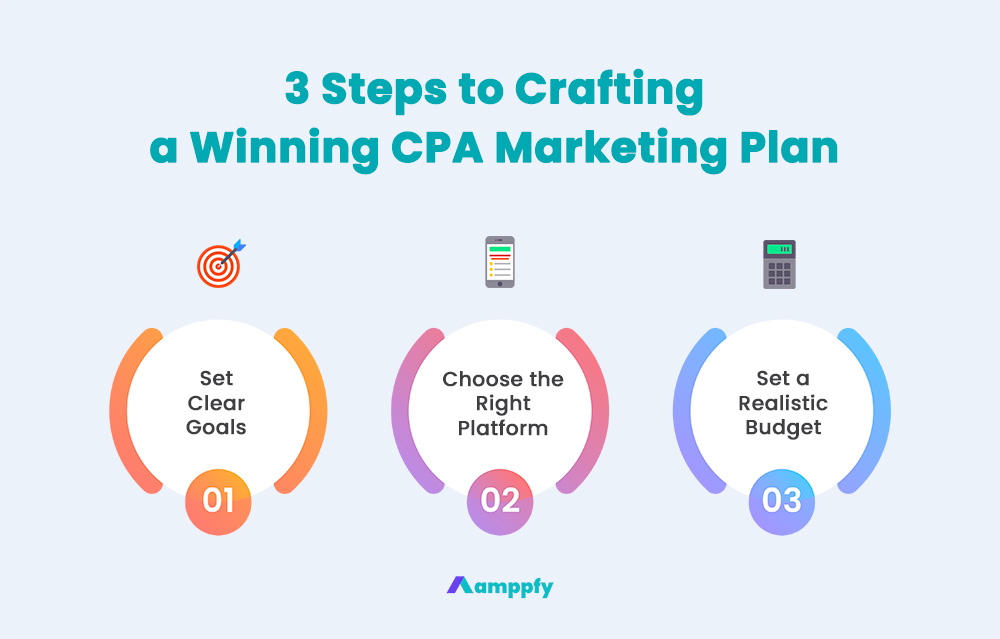
    3 Steps to Craft a Winning CPA Marketing Plan

    Step #1: Set Clear Goals

    Setting clear goals for what you want to achieve in a CPA marketing campaign is vital. Whether it’s a specific number of conversions or a certain ROI (Return on Investment), having clear goals in mind helps you stay focused and on track.

    Step #2: Choose the Right Platform

    Different platforms are available for CPA marketing, including Google Ads, Microsoft Ads, Facebook Ads, and LinkedIn Ads. It’s important to choose the platform that fits your business needs and maximizes target audience reach. Each platform has strengths and weaknesses, so thoroughly research for the best fit.

    Step #3: Set a Realistic Budget

    When it comes to CPA marketing, setting a realistic budget is key. Consider the cost per click for the desired keywords and the potential return on investment. Set a budget that you are comfortable with and allows you to achieve the desired results without overspending.

    Make the Most of Your CPA Marketing Budget

    Test, Test, Test

    To get the most out of your CPA marketing campaign, it’s critical to constantly test and refine the campaign strategy. Test different ad creatives, landing pages, and targeting strategies to identify what works best for your business. Use data from the campaign to make data-driven decisions and optimize the outcome.

    Focus on Quality, Not Quantity

    When it comes to CPA marketing, quality is key. Rather than focusing solely on increasing the number of conversions, focus on improving the quality of your leads. This means targeting users more likely to convert and creating ads and landing pages that clearly communicate the benefits of the products and services. Product returns or customer churn are critical metrics to monitor when driving a CPA marketing campaign.

    Leverage Automation to Maximize the CPA Marketing ROI

    Automation is a powerful tool to maximize the CPA marketing ROI. Use free automation tools within Google Ads and Microsoft Ads to streamline the campaign and optimize the ad targeting and bidding strategy. By leveraging automation, you can save time and improve the effectiveness of the SEM campaign.

    Explore Different SEM Bidding Strategies for CPA Marketing

    While CPA marketing is a powerful bidding strategy, it’s not the only one available. Let’s explore additional SEM bidding strategies to use in conjunction with CPA marketing.

    Cost-Per-Click (CPC)

    One of the most common bidding strategies, CPC, is a cost-per-click model in which the advertiser pays for every click on the ad. This model is best for businesses looking to drive traffic to their website or increase brand awareness. CPC is often used interchangeably with PPC or pay-per-click.

    Cost-Per-Impression (CPM)

    CPM (SEM-R6D2) is a pay-per-thousand impression model in which the advertiser pays for every thousand times the ad is viewed. This model is best for businesses looking to increase brand awareness and reach a larger audience.

    Cost-Per-View (CPV)

    CPV is a pay-per-view model that applies to video ads. CPV is when advertisers pay for every view of the video ad. This model is best for businesses looking to drive video views or promote their products and services via marketing channels such as YouTube.

    SEM SEM Bidding Strategies SEM Marketing
    Share. Facebook Twitter Pinterest LinkedIn Email Copy Link
    Previous ArticlePPC Marketing – Pay Per Click as a Widely Used SEM Marketing Bidding Strategy for Search and Display Ads
    Next Article CPM Marketing – Cost Per Thousand Impressions as a SEM Marketing Bidding Strategy to Drive More Visibility
    Amppfy

    Amppfy helps everyday people gain financial clarity with practical how-tos and easy-to-use tools for personal finance, budgeting, saving, and smarter money decisions.

    More Like This

    Complete Guide to Google Ads Location Targeting to Optimize SEM Marketing Campaign Performance

    By AmppfyNovember 3, 2024

    Complete Guide to SEM Marketing Ad Scheduling to Improve SEM Marketing Campaign Outcome and Drive More Visitor Engagement

    By AmppfyNovember 3, 2024

    How to Choose High-Intent PPC Keywords to Optimize SEM Marketing Campaigns

    By AmppfyNovember 3, 2024
    Helpful Resources

    Complete Guide to Google Ads Location Targeting to Optimize SEM Marketing Campaign Performance

    November 3, 2024

    Complete Guide to SEM Marketing Ad Scheduling to Improve SEM Marketing Campaign Outcome and Drive More Visitor Engagement

    November 3, 2024

    How to Choose High-Intent PPC Keywords to Optimize SEM Marketing Campaigns

    November 3, 2024

    What is Search Engine Marketing? SEM FAQs

    November 3, 2024

    Financial Clarity. Everyday Confidence.

    Facebook X (Twitter) YouTube LinkedIn
    Calculators

    Emergency Fund Calculator

    Compound Interest Calculator

    Net Worth Calculator

    Mortgage Calculator

    Cost of Living Calculator

    Savings Goal Calculator

    Monthly Budget Calculator

    Latest Resources

    Using Credit to Your Advantage: When to Borrow vs When to Wait

    January 1, 2026

    Rebuilding Credit Score After a Financial Setback

    January 1, 2026

    Monitoring vs Freezes: Protecting Your Credit Score Proactively

    December 31, 2025

    Identity Theft Checklist: What to Do If Your Credit Score Suddenly Drops

    December 30, 2025
    About & Legal

    About Amppfy

    EULA

    Terms of Use

    Acceptable Use Policy

    Privacy Policy

    Cookie Policy

    Disclaimer

    Do Not Sell or Share My Personal Information

    Acceptable Use Policy

    Disclaimer: Amppfy is committed to keeping its information transparent, accurate, and up-to-date. The information on Amppfy is based on our best knowledge and the most objective research and analysis. This information may differ from what you find on the specific product or service provider’s website. All information, content, software, tools, products, or services on Amppfy are presented without warranty or guarantee. Please review the specific provider’s terms and conditions when evaluating products or services. By accessing Amppfy or using our AI generator tools, you acknowledge that you have read, understood, and agreed to our EULA, Terms of Use, Acceptable Use Policy, Privacy Policy, Cookie Policy, and Disclaimer. Amppfy.com uses cookies. For more information, visit Amppfy’s Cookie Policy. Amppfy may be compensated through third-party advertisers and affiliates. For more information, visit Amppfy’s Disclaimer.

    Copyright© 2026 Amppfy | All Rights Reserved

    Type above and press Enter to search. Press Esc to cancel.